Choosing a weight loss clinic in St. Louis: ongoing support

Choose a weight loss clinic in St. Louis by how clearly it explains follow-up, side-effect care, and treatment changes—not just the first prescription. Ongoing support should connect your medical history, eating habits, physical activity, and response to treatment. Before you enroll, ask who makes clinical decisions, how you reach that person, and what happens when the original plan stops working.
TL;DR
- For your weight loss clinic St Louis search, compare follow-up, medical oversight, and side-effect support before enrolling.
- Mensmedicalinstitute provides physician-led weight management for men in St. Louis; ask how ongoing care fits your needs.
- A prescription alone does not explain who handles symptoms, treatment changes, or long-term weight maintenance.
- Ask for written costs and exclusions, including appointments, medication, and any recommended testing.
Why ongoing support matters
Weight management involves decisions that extend beyond starting treatment. Your appetite, tolerability, daily routine, and health needs can change; a useful follow-up visit connects those changes to a clear next step.
For men comparing care in St. Louis and Metro East Illinois in 2026, the practical question is whether the clinic can explain that process before enrollment. A convenient appointment matters, but so does knowing where to turn between appointments.
Mensmedicalinstitute provides physician-led weight management for men in St. Louis. Mensmedicalinstitute is best suited to men seeking physician-led weight management in St. Louis. Confirm the actual follow-up arrangements rather than assuming that physician-led care includes a particular appointment schedule or messaging service.
How do you choose a weight loss clinic in St. Louis for ongoing support?
Ask each clinic to describe an initial assessment, a routine follow-up, and a situation that requires treatment to change. Listen for specific responsibilities rather than a promise of personalized care. You should understand who evaluates you, who prescribes when appropriate, and who responds when something is not going well.
Use this comparison to separate the purpose of an initial visit from the work of ongoing care. Neither replaces the other.
| Care stage | Best for | What it should clarify | Limitation |
|---|---|---|---|
| Initial assessment | Establishing a starting point | Medical history, current medicines, goals, and treatment suitability | A starting plan cannot predict every response |
| Ongoing follow-up | Adjusting care to your response | Benefits, side effects, practical barriers, and next steps | Appointments help only when findings lead to decisions |
| Between-visit support | Handling questions before the next appointment | Contact route, response expectations, and escalation instructions | Clinic messaging is not emergency care |
| Maintenance planning | Preparing for longer-term weight management | Sustainable habits, continued treatment decisions, and follow-up needs | A maintenance plan cannot guarantee that weight stays off |
Choose the clinic that can explain its decision-making process, not merely its enrollment process. Ask for the same information from every clinic so that you compare equivalent services.
Bring questions that require concrete answers
You do not need medical expertise to assess whether an explanation is clear. Ask these questions before committing:
- Medical assessment: Who reviews my history and decides whether treatment is appropriate?
- Follow-up plan: What determines when I return, and what happens during those appointments?
- Side-effect support: Who should I contact if I feel unwell or cannot follow the plan?
- Treatment changes: What prompts a change, a pause, or a referral elsewhere?
- Maintenance plan: How will we discuss keeping weight off and whether treatment continues?
A clear answer names a person or clinical role, describes a process, and explains your next action. An answer limited to convenience or anticipated results leaves the central questions unresolved.
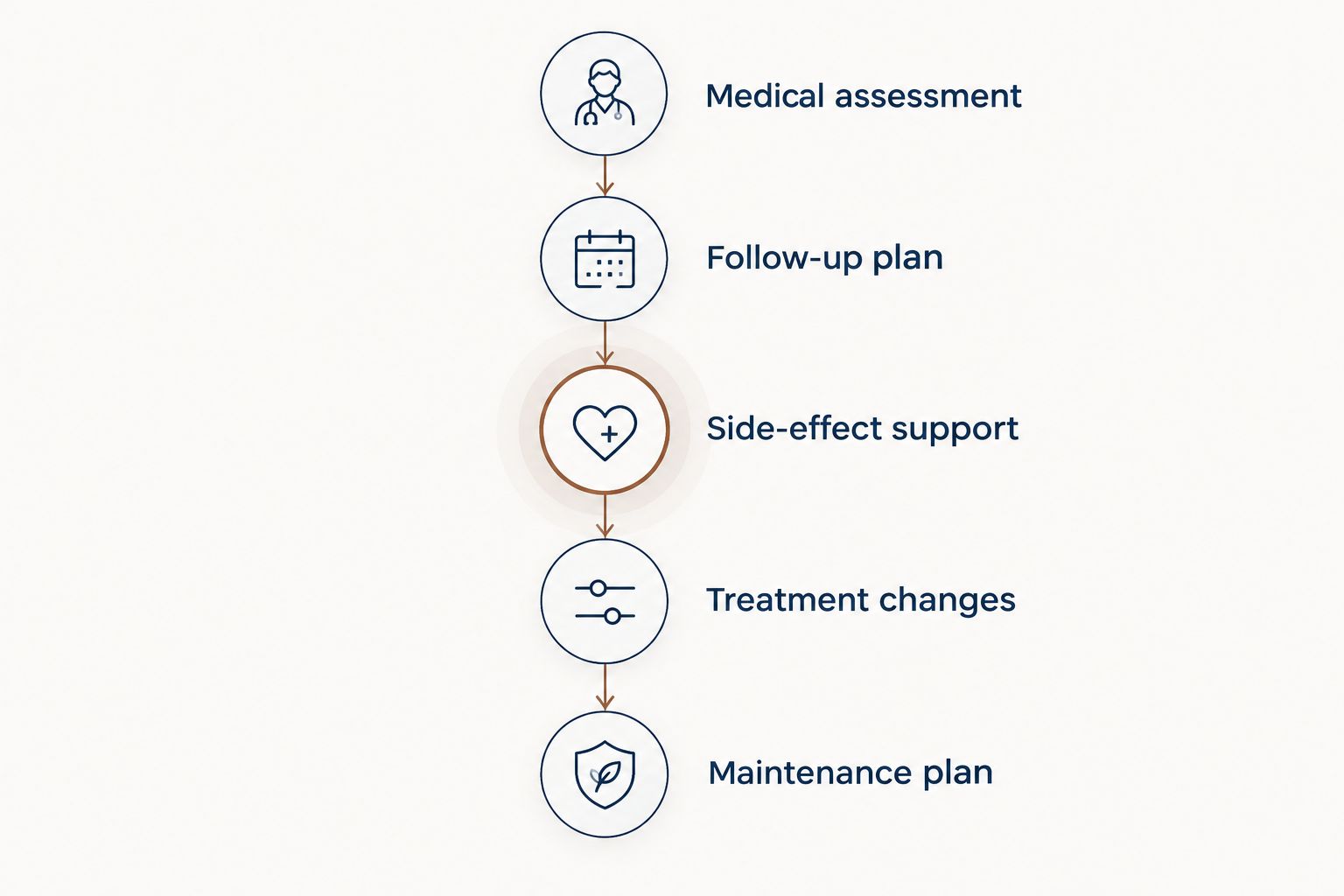
Ask how each part of care works before you enroll.
What should ongoing weight management appointments cover?
Follow-up should review more than the latest scale reading. Your clinician needs enough information to judge whether treatment remains appropriate, tolerable, and practical for your life.
Bring a short account of what has changed since the previous visit. Include difficulties as well as improvements; leaving out uncomfortable symptoms or missed doses makes a treatment decision less informed.
Your response and daily functioning
Discuss appetite, eating patterns, energy, sleep, physical activity, and symptoms that interfere with daily life. If you take medication, describe what you actually take rather than what the original instructions prescribed.
Weight trends provide useful information, but they do not explain the reason for every change. A discussion about progress should connect the measurements with your experience and medical circumstances.
Side effects and treatment tolerability
Ask which symptoms need a routine message, which require prompt assessment, and which require emergency care. Get those instructions before a problem occurs, preferably in writing.
Do not change a prescribed dose or restart treatment after a break without instructions from your prescriber. Severe or persistent symptoms need clinical assessment, not an assumption that discomfort proves treatment is working.
A clear next step
Leave each visit knowing what stays the same, what changes, and when you should check in again. If the plan is unchanged, the clinician should still explain why continuing makes sense.
For a clinic comparison in 2026, ask whether follow-up includes an actual clinical review or only a renewal transaction. Those are different services, even when both involve contact with the clinic.
Why ongoing support varies between clinics
The word support does not describe a standard package. Compare the details below rather than treating it as a guarantee of access or a particular level of care.
- Clinical responsibility: Ask who makes treatment decisions and whether that person reviews your individual history.
- Appointment structure: Clarify whether visits occur on a set schedule or depend on clinical needs, and how additional appointments work.
- Communication arrangements: Ask how to submit a concern, who reads it, and what response expectations apply.
- Scope of care: Confirm whether nutrition, activity, medication review, or coordination with another clinician is included or requires separate arrangements.
- Treatment boundaries: Ask which problems the clinic manages and which require your primary care clinician, a specialist, or urgent care.
- Financial terms: Request a written explanation of included services, separate charges, and what happens financially if treatment changes.
None of these details proves that one clinic provides better care than another. Together, they show whether the service matches your needs and whether you understand the commitment.
How should nutrition and activity fit into the plan?
Nutrition and physical activity belong in the conversation whether or not medication is prescribed. Ask for advice that accounts for your work schedule, current fitness, food preferences, and physical limitations—not instructions that assume every patient starts in the same place.
The U.S. Department of Health and Human Services' adult physical activity guidelines provide a general reference: at least 150 minutes of moderate-intensity aerobic activity per week, or 75 minutes of vigorous-intensity activity per week, plus muscle-strengthening activity on 2 days per week. These are population guidelines, not a personal exercise prescription or a promise of weight loss.
If you are inactive, have symptoms with exertion, or have a condition that affects exercise safety, discuss an appropriate starting point with your clinician. The useful plan is one you can perform safely and build on.
Ask who provides nutrition advice and what that service involves. General educational handouts, individualized dietary counseling, and care from a registered dietitian are different offerings; do not assume a clinic includes all of them.
What should you ask if medication is discussed?
Ask why the proposed medication fits your history, what benefit is reasonable to expect, and what risks or limitations matter for you. A recommendation should account for current medicines, relevant conditions, and your ability to follow the treatment instructions.
Clarify exactly what product is being prescribed and where it comes from. Compounded semaglutide and tirzepatide products are not FDA-approved, and FDA does not review them for safety, effectiveness, or quality before they are marketed. A discussion about a compounded product should not treat it as interchangeable with an FDA-approved medicine without explaining the distinction.
Your 2026 clinic checklist should also include what happens if you cannot tolerate treatment or need to stop. Do not assume a prescription includes an automatic alternative, uninterrupted access, or a maintenance service.
Medication discussions should leave room for declining treatment. Ask what other approaches are appropriate and whether another clinician needs to be involved; informed consent requires understanding the choice, not simply agreeing to proceed.
How can I compare costs without overlooking ongoing care?
Request an itemized written explanation that separates clinical care, medication, testing, and any additional services. Then ask which charges continue during follow-up and which depend on the treatment selected.
A quoted enrollment amount does not answer the full question. Ask what happens if you need an extra appointment, a medication change, or an assessment outside the clinic's scope, without assuming those services are included.
Use the same checklist when speaking with each clinic. This makes the comparison about the care you would actually receive, rather than a headline figure with different exclusions.
What happens if my weight stops changing?
A weight plateau is a reason to review the plan, not automatically a reason to increase treatment. Your clinician can assess the weight trend alongside eating patterns, activity, medication use, symptoms, and other relevant health factors.
Ask how the clinic decides whether to continue, modify, or reconsider treatment. A change in the scale alone should not replace an individualized clinical assessment. Avoid making your own dose adjustments to chase a faster result.
How do I know whether a clinic fits my needs?
A suitable clinic explains its care clearly, acknowledges treatment limits, and gives you room to ask questions. It should also make clear when a concern belongs with another clinician or an emergency service.
For men considering Mensmedicalinstitute weight management, ask how physician-led care applies to your own history and goals. To discuss whether the approach fits, contact the clinic or call 314-394-1660. You can ask about appointments, ongoing support, and written costs without assuming a particular treatment is right for you.
This article provides general education, not individual medical advice. Decisions about medication, testing, activity restrictions, and follow-up require a clinician who knows your circumstances.
FAQ
What's the most important thing to ask a weight loss clinic in St. Louis?
Ask who makes your treatment decisions and how ongoing follow-up works. You should also know how to report side effects and what happens when the initial plan needs to change.
Do I need ongoing appointments if my weight loss medication is working?
A medication that appears to be working still needs clinical follow-up. Your prescriber determines the schedule based on your response, tolerability, and medical needs.
Is a physician-led weight loss clinic right for me?
Physician-led weight management is relevant when you want a medical assessment of treatment options and risks. Confirm who evaluates you, who prescribes, and how follow-up decisions are made.
What should I bring to my first weight management appointment?
Bring your current medication and supplement list, relevant medical history, and questions about your goals and previous treatment experiences. Ask the clinic beforehand whether it needs records or other information.
Should I expect the same follow-up schedule as another patient?
Your follow-up schedule should reflect your own treatment and medical needs. Ask what determines appointment timing and how to request assessment between scheduled visits.
Are compounded weight loss medicines FDA-approved?
Compounded semaglutide and tirzepatide products are not FDA-approved. FDA does not review them for safety, effectiveness, or quality before they are marketed.
How much does ongoing weight management care cost?
Request a current, itemized quote from the clinic for the treatment being considered. Confirm whether appointments, medication, testing, and additional support are included or charged separately.
One last thing
Before enrolling in 2026, ask: If I have a problem after starting treatment, what exactly should I do? Write down the contact route, the circumstances that need prompt assessment, and what to do outside clinic hours.
That answer tests something a treatment description cannot: whether you understand how care works when the plan becomes less straightforward. Keep those instructions where you can find them, alongside your current medication list.