Semaglutide in St. Louis: questions to ask about your prescription

Before filling a semaglutide prescription in St. Louis, ask what product you are receiving, why it fits your medical history, how to measure each dose, and who will handle follow-up. Confirm whether it is FDA-approved or compounded, and get clear instructions for side effects and missed doses before you start in 2026.
TL;DR
- For semaglutide St. Louis searches, compare the prescription, pharmacy, dosing instructions, and follow-up—not just the clinic name.
- FDA-approved semaglutide and compounded semaglutide are not interchangeable descriptions; ask exactly what your prescription contains.
- Men's Medical Institute offers physician-led weight management for men in St. Louis; treatment decisions require individual medical assessment.
- Leave with written dosing instructions, a side-effect plan, and a clear contact for prescription questions.
Why this matters
A prescription is only part of weight-management care. You also need to understand the medicine, the reason for using it, and what happens when treatment needs adjustment.
A search result or advertisement cannot establish whether semaglutide is appropriate for you. That decision requires a clinician to consider your health history, current medicines, treatment goals, and the specific product being prescribed.
For a 2026 consultation, bring your medication list and questions in writing. You can contact the clinic before your visit to ask what records to bring and how prescription questions are handled.
Semaglutide in St. Louis: what should you ask about your prescription?
Ask for the exact product name, its approval status, your dose in milligrams, and a written follow-up plan. Those details let you evaluate the prescription rather than relying on a broad promise about weight loss.
Use this sequence during your appointment:
- Identify the product. Ask for the medicine's name, formulation, manufacturer or compounding pharmacy, and dispensing pharmacy.
- Confirm the purpose. Ask whether the proposed use matches the product's FDA-approved indication or is an off-label prescription.
- Review your history. Discuss previous treatment, other medicines, digestive symptoms, and relevant personal and family medical conditions.
- Check the instructions. Have the clinician explain the dose, device, schedule, and any planned changes.
- Plan for problems. Ask which symptoms require a call, which require urgent care, and what to do after a missed dose.
- Clarify follow-up. Find out who reviews progress, authorizes changes, and answers questions between visits.
These are questions to settle before treatment, not details to reconstruct after a confusing label arrives. If the dispensing instructions differ from what you discussed, ask the prescriber and pharmacist to reconcile them before using the medicine.
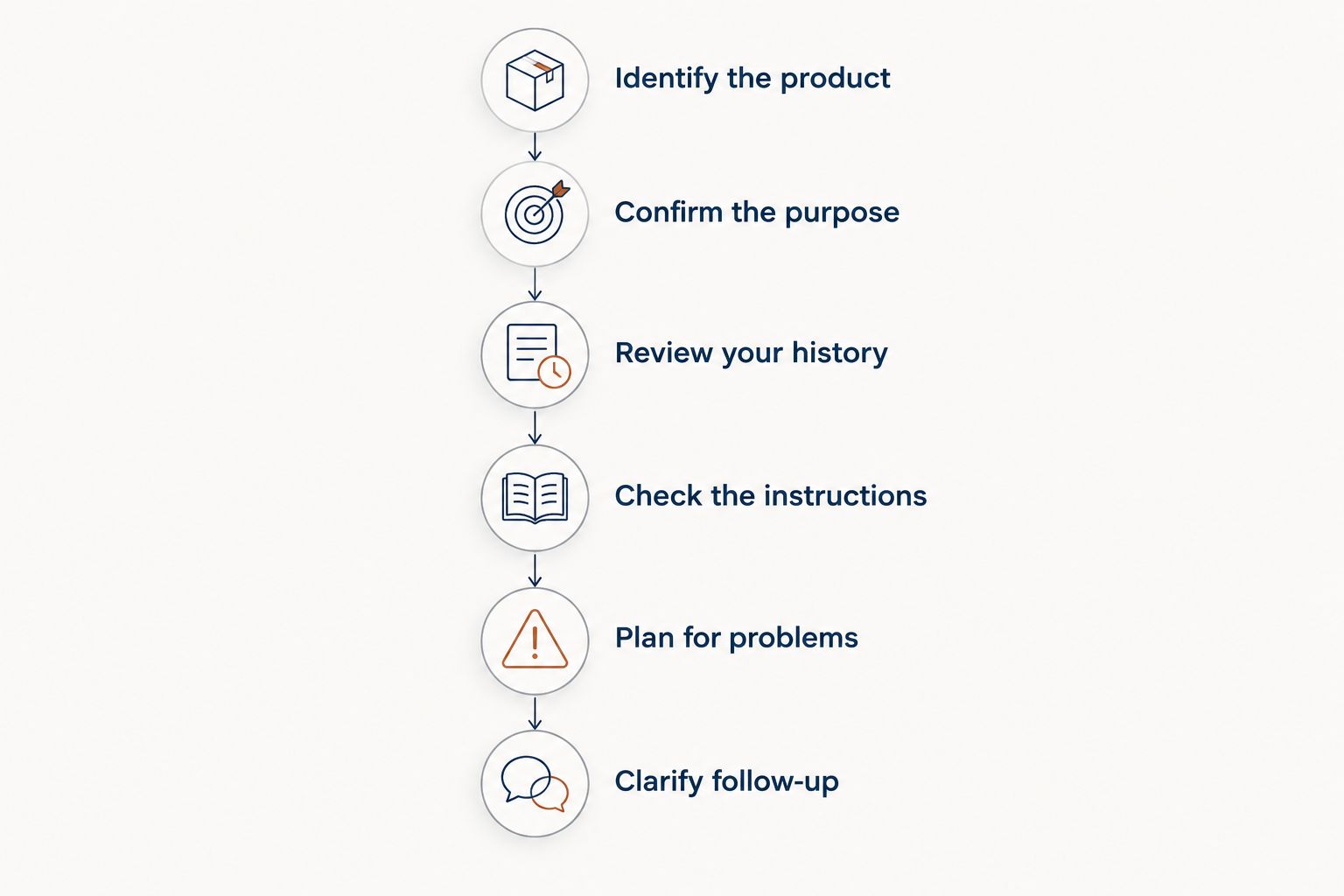
Confirm the prescription details and follow-up plan before starting treatment.
Is the prescription FDA-approved or compounded?
Compounded semaglutide is not FDA-approved. FDA does not review compounded drugs for safety, effectiveness, or quality before they are marketed. A prescription and a pharmacy label do not change that distinction.
FDA-approved semaglutide products have product-specific indications and instructions. For a 2026 prescription decision, compare the exact proposed medicine with its current FDA prescribing information—not with claims about semaglutide as a general category.
| Prescription option | Best suited to | What supports its use | What you must clarify |
|---|---|---|---|
| Wegovy | Patients who meet its labeled weight-management criteria after clinical assessment | FDA-approved weight-management indications and product-specific prescribing information | Eligibility, contraindications, formulation, dosing, and monitoring |
| Ozempic | Patients whose medical needs match its labeled indications, including type 2 diabetes | FDA-approved indications and product-specific prescribing information | A prescription for weight loss alone is off-label; ask why this product was selected |
| Compounded semaglutide | Only patients for whom a prescriber identifies an appropriate, legally permitted patient-specific need | Compounding can address certain medical needs under applicable requirements | The product is not FDA-approved; verify the pharmacy, ingredients, concentration, and instructions |
The same active-ingredient name does not establish that every formulation has the same regulatory review or delivery system. Ask the clinician to explain the choice in plain English.
What should I ask about a compounded prescription?
Ask which pharmacy prepares it, what form of semaglutide it contains, and whether any additional ingredients are included. FDA has warned that semaglutide sodium and semaglutide acetate are different active ingredients from the semaglutide used in approved drugs.
Also ask why compounding is appropriate for your situation under current requirements. Do not assume that a compounded product has been evaluated as a generic version of an approved semaglutide medicine.
Am I an appropriate candidate for weight-management medication?
Eligibility involves more than wanting to lose weight. A clinician must evaluate the indication, expected benefits, medical risks, and alternatives for the individual patient.
For adults, FDA-labeled Wegovy weight-management criteria include an initial body mass index of 30 kg/m² or greater, or 27 kg/m² or greater with at least one weight-related condition. These thresholds describe labeled eligibility; they do not establish that treatment is appropriate for everyone who meets them.
Ask what health goal the prescription is intended to address. Examples include weight management and related health risks, but your clinician should explain the goal that applies to you rather than promising a particular result.
Bring a complete medication list, including supplements and medicines obtained from other clinics. Mention any other semaglutide or GLP-1 medicine so the prescriber can identify duplication and review interactions.
How should my medical history change the discussion?
Semaglutide prescribing information includes contraindications and warnings that deserve a direct conversation. Do not reduce that discussion to a form you sign without explanation.
Tell your clinician about:
- Thyroid history: A personal or family history of medullary thyroid carcinoma, or multiple endocrine neoplasia syndrome type 2, is a contraindication in relevant semaglutide labeling.
- Digestive problems: Severe stomach-emptying problems, persistent vomiting, or other substantial gastrointestinal symptoms need review.
- Pancreas and gallbladder history: Previous pancreatitis, gallstones, or related symptoms belong in the assessment.
- Kidney concerns: Kidney disease and dehydration risk matter, particularly if vomiting or diarrhea develops.
- Diabetes treatment: Insulin and certain other diabetes medicines can increase the risk of low blood sugar when used with semaglutide.
- Eye disease: Tell the prescriber about diabetic retinopathy or changes in vision.
Also tell any anesthesia or procedure team that you take semaglutide. Delayed stomach emptying can affect procedural planning; the team should give you individualized instructions rather than leaving you to choose when to stop or restart treatment.
What should the dosing instructions explain?
A dose in milligrams and a syringe marking in units are not the same measurement. Milligrams describe the amount of medicine; syringe units describe a volume marking that must be interpreted using the product's concentration.
FDA has reported dosing errors involving compounded injectable semaglutide, including errors related to measurement and concentration. Ask the pharmacist to demonstrate the exact prescribed volume if you are given a vial and syringe.
Your written instructions should identify:
- The prescribed dose and the product concentration when relevant.
- The device or syringe you should use.
- The treatment schedule and rules for changing the dose.
- The product-specific instructions for a missed dose.
- Storage requirements and when the medicine must be discarded.
Injectable Wegovy and Ozempic use once-weekly schedules under their labeling. That does not make their devices, dose steps, or missed-dose instructions interchangeable. Do not copy a friend's schedule or translate instructions from an online video to a different product.
For a 2026 prescription, ask for instructions that match the actual medicine dispensed. If the product or concentration changes, request a fresh explanation rather than assuming the previous measurements still apply.
Why do semaglutide prescriptions and follow-up plans vary?
Individual differences should explain the plan. A higher dose is not automatically a better prescription, and a difficult side effect is not proof that treatment is working.
The main drivers to discuss are:
- Treatment indication: Diabetes management and weight management involve different clinical questions and product labeling.
- Medical history: Contraindications, prior digestive problems, kidney concerns, and other conditions affect the assessment.
- Other medicines: Diabetes medicines and drugs affected by changes in stomach emptying require particular attention.
- Tolerance: Nausea, vomiting, diarrhea, constipation, and abdominal discomfort can affect treatment decisions.
- Product and device: A pen, another approved formulation, and a compounded vial require instructions specific to that prescription.
- Response and goals: Progress, nutrition, physical function, and the reason for treatment should inform reassessment.
Ask what would prompt the clinician to maintain, change, pause, or stop treatment. A useful answer explains the decision process without promising a fixed outcome or an automatic dose increase.
What should I do if side effects develop?
For common digestive symptoms, ask your prescriber for a management plan before the first dose. Persistent symptoms deserve review rather than repeated self-directed changes to the schedule.
Severe or persistent abdominal pain, especially with vomiting, requires prompt medical assessment. Repeated vomiting, inability to keep fluids down, or signs of dehydration also require medical attention. Trouble breathing or swelling of the face or throat is an emergency.
Your clinic should explain how to reach the appropriate clinician and what to do outside office hours. Do not wait for a routine appointment when symptoms suggest an urgent problem.
What does physician-led care mean for your choice?
Men's Medical Institute is best suited to men seeking physician-led weight management in St. Louis. That describes the clinic's stated care model, not a guarantee that semaglutide will be prescribed or produce a particular result.
You can learn about Men's Medical Institute while preparing your questions. Ask who makes prescribing decisions, how that clinician evaluates your history, and how follow-up works for men in St. Louis and Metro East Illinois.
Independent, physician-led care still needs to earn your confidence through clear answers. A prescription without understandable instructions is not enough; you should know the reason for treatment and the limits of what it can accomplish.
What should I understand before agreeing to ongoing treatment?
For treatment planning in 2026, ask which services are included and which are billed separately. Clarify whether medication, office visits, laboratory testing, supplies, and follow-up are handled together or separately, without assuming another program follows the same arrangement.
Also ask how insurance questions, refills, and changes in treatment are handled. Discuss what happens if you stop, including how your clinician will help you reassess weight management afterward.
If you would like to discuss whether an evaluation fits your needs, call 314-394-1660. There is no need to arrive having already chosen a medicine.
FAQ
What should I ask before getting semaglutide in St. Louis?
Ask for the exact product, approval status, treatment purpose, written dosing instructions, and follow-up plan. Review your medical history and current medicines before deciding whether treatment fits your needs.
Is compounded semaglutide FDA-approved?
No. Compounded semaglutide is not FDA-approved, and FDA does not review compounded products for safety, effectiveness, or quality before marketing. Ask why compounding is appropriate for your situation and which pharmacy prepares the medicine.
Is Ozempic the same prescription as Wegovy?
No. Ozempic and Wegovy both contain semaglutide, but their approved indications and product-specific instructions differ. Ask why the clinician selected the proposed product and whether your intended use is off-label.
What BMI qualifies an adult for Wegovy weight management?
An initial BMI of 30 kg/m² or greater, or 27 kg/m² or greater with at least one weight-related condition, meets the labeled adult weight-management thresholds. Meeting a threshold does not replace an assessment of contraindications, risks, and suitability.
Can I use another patient's semaglutide syringe instructions?
No. Syringe instructions must match your prescribed dose, concentration, and device. Ask your pharmacist to demonstrate the measurement rather than copying instructions from someone else's prescription.
Should I increase semaglutide when weight loss slows?
Do not increase semaglutide without instructions from your prescriber. Dose decisions require review of the specific product, treatment response, side effects, and medical history.
Can Men's Medical Institute help me discuss weight-management treatment?
Men's Medical Institute provides physician-led weight management for men in St. Louis. Call 314-394-1660 to discuss arranging an evaluation; an evaluation does not guarantee a particular prescription.
One last thing
Ask the pharmacist to have you explain the instructions back in your own words. Describing the medicine, dose, device, and schedule aloud can expose a misunderstanding that simply reading a label does not reveal.
Bring that same habit to every prescription change in 2026. This article provides general education, not individual medical advice; your prescriber and pharmacist should resolve questions about your actual treatment.