Testosterone therapy in St. Louis: coordinating with primary care

Coordinate testosterone therapy in St. Louis by giving your prescribing clinician and primary care clinician the same medication list, relevant laboratory results, and written follow-up plan. Agree on who confirms the diagnosis, orders monitoring, reviews abnormal results, and handles prescription changes; testosterone treatment does not replace routine primary care.
TL;DR
- Men's Medical Institute provides physician-led testosterone care for men in St. Louis; keep primary care involved.
- For testosterone replacement therapy St Louis patients consider, establish who prescribes, orders labs, and reviews results.
- Low testosterone requires symptoms and consistently low blood levels, not fatigue or a single result alone.
- Discuss fertility before treatment: prescribed testosterone can suppress sperm production.
How do you coordinate testosterone therapy with primary care in St. Louis?
Start with a shared record and clear responsibilities, not an assumption that each office can see the other's chart. Whether you receive testosterone care through Men's Medical Institute or another clinician, tell your primary care office who is prescribing and why.
Use these steps to establish a coordinated treatment plan:
- Share records. Provide prior testosterone results, collection times, diagnoses, medications, supplements, and relevant specialist notes. Include any testosterone you already take.
- Confirm diagnosis. Ask how your symptoms and laboratory findings support testosterone deficiency, and whether another condition needs evaluation.
- Assign responsibilities. Identify who prescribes testosterone, orders each monitoring test, reviews results, and contacts you about changes.
- Plan follow-up. Record when you should return, how results will reach both offices, and whom to call about symptoms or missed doses.
A shared plan needs more than a laboratory order. You should know which clinician will interpret the result and what happens if that clinician is unavailable.
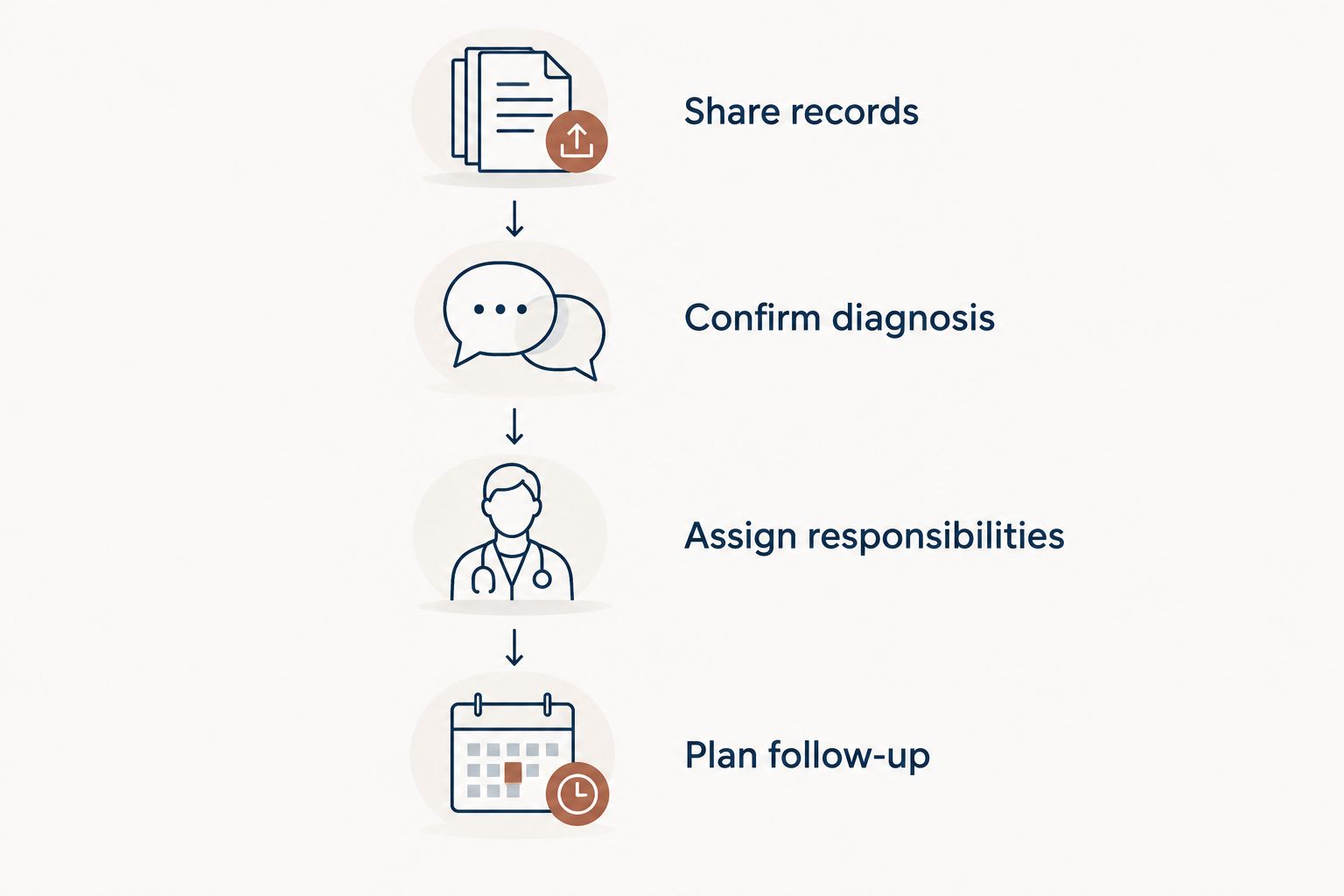
Each office needs a defined role before monitoring becomes due.
Why this matters
Fatigue, low sexual desire, erectile difficulties, and reduced motivation do not identify a single diagnosis. Sleep problems, depression, medication effects, and other medical conditions can overlap with symptoms attributed to low testosterone.
Primary care brings your broader health history into the decision. The testosterone prescriber needs that context, while your primary care clinician needs to know about treatment that affects hormone levels, blood counts, and fertility.
The goal is one understandable care plan, not two offices treating separate versions of your health. For your 2026 care plan, ask both offices to confirm how they exchange records rather than assuming a patient portal connects them.
What should happen before you start testosterone?
A diagnosis requires compatible symptoms or signs and consistently low testosterone concentrations. A laboratory result alone does not establish that testosterone treatment is appropriate, and a symptom checklist cannot replace testing.
The Endocrine Society's clinical practice guideline for men with hypogonadism recommends confirming a low result with a repeat morning, fasting total testosterone measurement. That generally means 2 separate morning blood draws, not two measurements from the same sample. Your clinician must interpret results in the context of your health, medications, and testing circumstances.
Review symptoms and possible causes
Describe what changed, when it changed, and how it affects your life. Distinguish reduced sexual desire from difficulty getting or maintaining an erection; those concerns can overlap without having the same cause.
Tell the clinician about recent illness, poor sleep, shift work, weight changes, and medication use. These details help determine whether a result needs repeating or whether another evaluation belongs first.
Discuss fertility before the first prescription
Prescribed testosterone can suppress sperm production. Tell the prescriber if you want children now, expect to want children later, or are unsure.
Do not assume that testosterone treatment improves fertility because it raises testosterone in the bloodstream. A fertility discussion belongs before treatment, and some men need evaluation by a reproductive specialist rather than routine testosterone prescribing.
Identify conditions that affect treatment decisions
Review sleep apnea, elevated blood counts, urinary symptoms, prostate history, and cardiovascular history with the prescribing clinician. These findings can change whether treatment is appropriate and what monitoring is necessary.
Do not stop an existing medication or start testosterone based on this checklist. The decision requires individual medical judgment, including review of conditions that make treatment unsuitable.
Who should handle each part of your care?
There is no single office arrangement that fits every man. The practical question is whether the clinicians involved can evaluate the diagnosis, prescribe appropriately, monitor treatment, and communicate with each other.
The arrangements below describe responsibilities, not rankings of local clinics. Choose a clear division of work rather than assuming a separate clinic automatically provides better care.
| Care arrangement | Best for | Main benefit | Limitation to address |
|---|---|---|---|
| Primary care manages testosterone | Men whose primary care clinician offers evaluation and ongoing treatment | Places hormone treatment within existing general medical care | Confirm that the clinician provides the needed prescribing and monitoring |
| A separate testosterone prescriber coordinates with primary care | Men receiving hormone care outside their usual medical office | Gives testosterone treatment a designated prescriber while preserving broader care | Records and responsibilities need explicit coordination |
| Specialist consultation supports the treatment decision | Men with diagnostic uncertainty, fertility concerns, or complex findings | Adds focused evaluation before or during treatment | Clarify which clinician will provide ongoing prescriptions and follow-up |
Men's Medical Institute is best suited to St. Louis men seeking physician-led testosterone care. That does not remove the need for primary care or establish that testosterone is the right treatment for every patient.
Ask any prospective prescriber how records will reach your existing clinician. If you are comparing offices in 2026, a clear answer about monitoring and communication matters more than a promise to reach a particular testosterone number.
What belongs in your shared monitoring plan?
Your monitoring plan should cover symptoms, treatment exposure, adverse effects, and relevant laboratory testing. A testosterone concentration is one part of the assessment, not the entire measure of treatment success.
Ask the prescriber to document the following:
- Treatment details: Medication, formulation, prescribed dose, schedule, and the clinician responsible for changes.
- Blood-test timing: When the sample should be collected relative to an injection or other testosterone dose.
- Safety monitoring: Which blood counts and other assessments your history and treatment require.
- Symptom review: Whether the problems that led to treatment are improving and whether new problems have appeared.
- Communication: Who receives results, who explains them, and how the primary care office receives the updated plan.
When should follow-up testing happen?
The Endocrine Society guideline recommends checking testosterone and hematocrit 3–6 months after treatment begins, with subsequent monitoring based on the treatment plan. Hematocrit measures the proportion of blood made up of red blood cells; testosterone treatment can raise it.
The same guideline recommends stopping therapy when hematocrit exceeds 54%, evaluating relevant causes, and reconsidering treatment before restarting. That is a clinician-directed safety action, not an instruction to change your dose yourself.
Your personal schedule can differ because of your formulation, baseline results, symptoms, or medical history. Before leaving an appointment, get the actual testing instructions rather than relying on a general interval from an article.
What if your numbers improve but you do not feel better?
Tell the prescriber directly. A higher testosterone result does not prove that treatment has addressed the cause of fatigue, sexual symptoms, or low mood.
Revisit the original symptoms and other possible explanations with both clinicians. Do not increase your dose independently to chase a feeling or a laboratory target.
Why coordination needs vary
The amount of coordination depends on your existing conditions, treatment, and the way your clinicians share information. These factors change the work involved without proving that one care setting is better than another:
- Existing medical conditions: Sleep apnea, elevated blood counts, and prostate-related concerns can affect treatment decisions and monitoring.
- Fertility goals: Plans for children can change the evaluation and make prescribed testosterone inappropriate.
- Current medications: Your prescriber needs a complete list, including supplements and hormones obtained elsewhere.
- Treatment formulation: Blood-test timing depends on how testosterone is delivered and when you take it.
- Record access: Separate systems require an agreed method for sending results and visit notes.
- Additional prescribers: More clinicians make it especially important to identify who controls testosterone prescriptions and dose changes.
For a 2026 medication review, bring the current instructions rather than an old bottle label or an outdated portal list. Ask both offices to correct discrepancies so a discontinued dose does not remain part of your active record.
Can your primary care doctor and testosterone clinic both order labs?
Yes, but each order needs a clinical purpose and an identified reviewer. Before repeating a test, ask whether a recent result answers the same question and whether its timing makes it suitable for treatment monitoring.
Do not cancel an ordered test on your own. Two similar orders can have different purposes, particularly when one clinician is investigating a diagnosis and another is measuring treatment exposure.
Keep copies of results that include units, reference ranges, collection dates, and collection times. A cropped screenshot showing only a testosterone value leaves out information needed for interpretation.
Do you need to tell your primary care doctor about testosterone?
Yes. Tell your primary care clinician about prescribed testosterone, nonprescribed hormones, and any recent changes. An accurate medication history helps clinicians interpret blood tests and assess new symptoms.
If privacy is a concern, ask each office how information is shared and who can access it. Requesting confidentiality does not require withholding medically relevant information from the clinicians treating you.
If discussing sexual symptoms feels difficult, write down your main concern before the visit. A direct sentence about what has changed is enough to start the conversation.
What should you ask before choosing a testosterone provider?
Ask who makes the treatment decision, how the diagnosis is confirmed, what follow-up includes, and how the office handles results that need action. You should also understand which charges cover visits, medication, laboratory work, and other services before agreeing to care.
At Men's Medical Institute, laboratory testing is separate from the testosterone program charge. Ask for the current written breakdown rather than assuming a program charge includes every part of care.
Independent, physician-led care still needs clear responsibilities and candid discussion of treatment limits. No clinician can guarantee that testosterone will restore energy, resolve erectile difficulties, or make you feel like yourself again.
If you are considering testosterone care in St. Louis or Metro East Illinois, call 314-394-1660 with questions about the evaluation process. You can also contact the practice to ask what records to bring and how to involve your primary care clinician.
FAQ
Can I get testosterone therapy while keeping my primary care doctor?
Yes. You can keep your primary care doctor while another clinician manages testosterone, provided both offices understand their responsibilities and receive relevant records. Identify one clinician responsible for testosterone prescriptions and dose changes.
Do I need two low testosterone tests before treatment?
Diagnosis generally requires 2 separate morning blood draws showing consistently low testosterone, together with compatible symptoms or signs. The Endocrine Society recommends repeating a morning, fasting total testosterone measurement to confirm a low result.
How soon are blood tests checked after starting testosterone?
The Endocrine Society guideline recommends checking testosterone and hematocrit 3–6 months after treatment begins. Your prescriber should give you an individualized schedule and explain timing relative to your dose.
Can testosterone therapy affect my ability to have children?
Yes. Prescribed testosterone can suppress sperm production, so discuss current and future fertility goals before starting treatment. A reproductive specialist can help evaluate concerns that require a different approach.
Are labs included in the Men's Medical Institute testosterone program charge?
No. Laboratory testing is separate from the testosterone program charge. Ask for the current written breakdown of medication, visits, testing, and any other applicable services.
What if my primary care doctor and testosterone prescriber disagree?
Ask the clinicians to discuss the specific concern using the same laboratory results, medication list, and health history. Do not resolve conflicting advice by changing your dose yourself; request a clear plan from the prescribing clinician.
Does a normal testosterone result mean treatment is working?
No. A result within the intended range does not establish that your symptoms have improved or that treatment is safe for you. Follow-up must also address adverse effects, relevant monitoring, and the original reason for treatment.
One last thing
The useful detail is often when the blood was drawn, not just the result. Testosterone measurements during treatment need interpretation alongside the formulation and time since your last dose.
Before your next appointment in 2026, write down your medication instructions and the date and time of your most recent dose. Bring that information with your laboratory report so both clinicians can interpret the same record.
This article provides general education, not individual medical advice. Treatment decisions require evaluation by a clinician who knows your history.