Cheap TRT offers: spotting prescription and sourcing red flags

A cheap TRT offer deserves consideration only if it includes a legitimate prescription process, a verifiable dispensing pharmacy, and a clear monitoring plan. A low advertised payment does not establish that treatment is appropriate for you, and it can leave laboratory testing, follow-up visits, or injection supplies outside the quoted amount.
TL;DR
- Cheap TRT should pass prescription, pharmacy, and monitoring checks before you compare costs.
- Mensmedicalinstitute offers physician-led testosterone care; compare clinical oversight as well as the advertised payment.
- Testosterone without a prescription, unidentified pharmacies, and guaranteed treatment approval are red flags.
- Ask which laboratory tests, follow-up appointments, and supplies are excluded before committing.
How do you spot unsafe cheap TRT offers?
Check the prescriber, the pharmacy, and the follow-up plan before paying. For a 2026 comparison, use the American Urological Association’s Testosterone Deficiency Guideline for diagnostic expectations and the FDA’s BeSafeRx guidance for online-pharmacy warning signs. Neither a professional-looking website nor a low payment substitutes for those checks.
Use this screening sequence before comparing the full cost of TRT care:
- Verify the prescriber. Get the clinician’s name and confirm an active license through the relevant state licensing board. Ask who decides whether testosterone is medically appropriate.
- Check the evaluation. Ask how the clinician reviews symptoms, medical history, medications, fertility plans, and testosterone testing before prescribing.
- Identify the pharmacy. Get the dispensing pharmacy’s legal name, location, and contact details. Verify its license through the appropriate state board of pharmacy.
- Confirm follow-up. Ask who reviews results, handles side effects, and changes or stops treatment when necessary.
- Request written terms. Separate medication, laboratory testing, visits, supplies, shipping charges, and cancellation terms rather than treating a headline payment as the whole agreement.
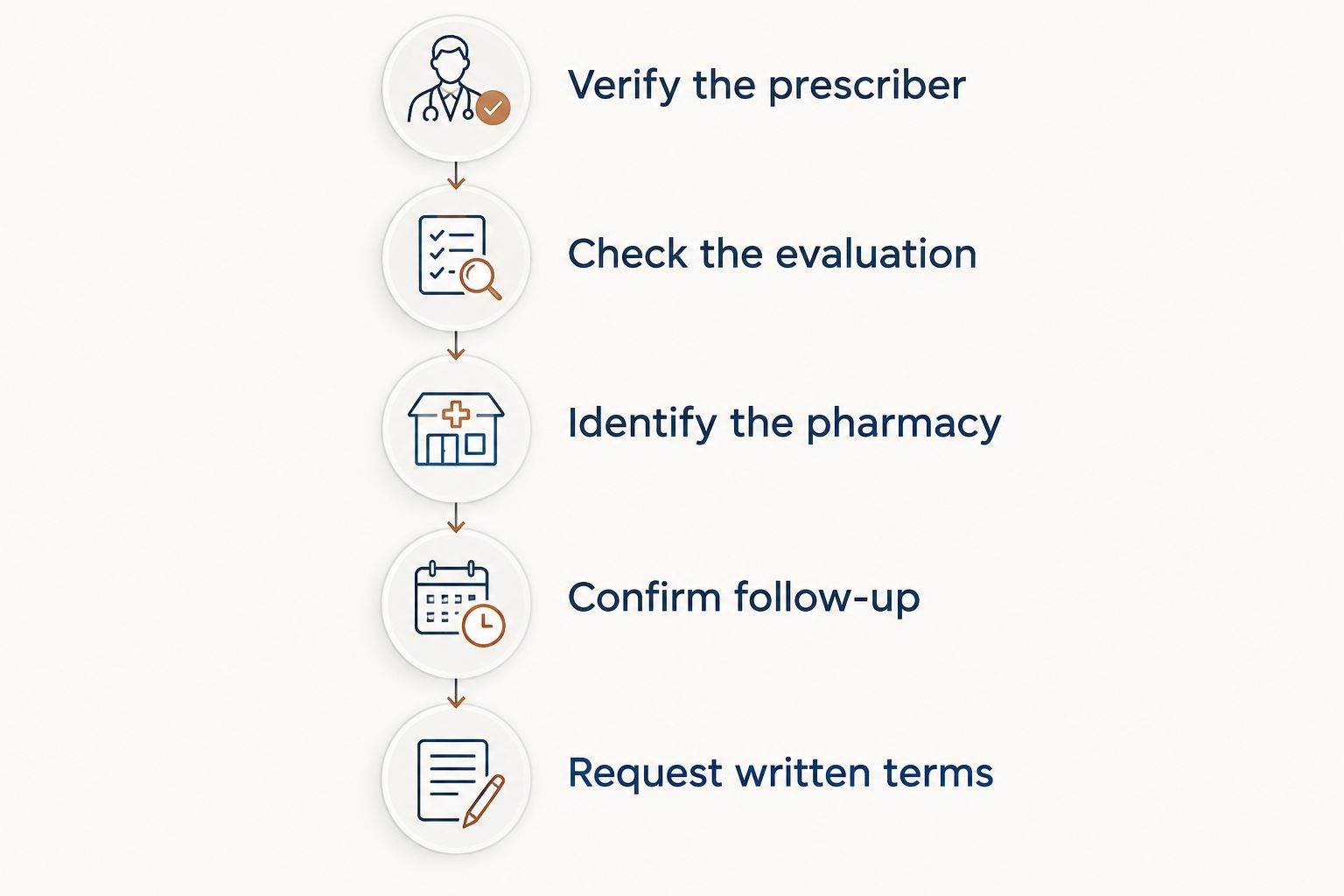
Verify clinical care and medication sourcing before comparing the payment.
Why this matters
Testosterone treatment is a medical decision, not simply a purchase of medication. Fatigue, reduced sexual interest, and erection difficulties do not establish testosterone deficiency on their own; sleep problems, depression, medication effects, and other conditions also deserve consideration.
A legitimate evaluation can end with a recommendation not to prescribe testosterone. That is a safeguard, not evidence that the appointment failed. An offer promising approval before a clinician evaluates you reverses the order of care.
Your goal in 2026 is not to find the most elaborate package. It is to find an appropriate treatment plan with an identifiable clinician, traceable medication, and clear responsibility for follow-up.
What should happen before a testosterone prescription?
The American Urological Association recommends diagnosing testosterone deficiency only when low testosterone levels occur alongside relevant symptoms or signs. Its guideline uses a total testosterone level below 300 ng/dL as a reasonable cutoff supporting the diagnosis, not as an automatic instruction to prescribe.
The guideline also calls for 2 early-morning total testosterone measurements on separate occasions. Results need clinical interpretation: illness, sleep patterns, medications, and testing conditions can affect what a result means. Tell the clinician if you work nights rather than choosing a testing time without guidance.
A questionnaire can collect useful history, but it does not replace clinical judgment. Ask what happens when symptoms and laboratory findings disagree, whether another explanation needs investigation, and who discusses that uncertainty with you.
Fertility belongs in the first conversation
Testosterone treatment can suppress sperm production. Tell the prescribing clinician if you want children now or in the future, even if fertility is not your main reason for seeking care.
Do not accept a blanket assurance that fertility will remain unchanged. Ask how your plans affect the recommendation and whether evaluation by a reproductive specialist is appropriate before treatment begins.
Which prescription and sourcing signs should make you stop?
Some gaps call for clarification; others are reasons not to proceed. Do not buy testosterone from a seller offering it without a prescription or labeling it for research rather than human treatment.
| Offer or situation | What it means | Recommended action | Best for |
|---|---|---|---|
| Named prescriber and verifiable licensed pharmacy | Basic accountability is identifiable, but treatment still needs evaluation | Continue checking clinical care and written terms | Men comparing legitimate care options |
| Prescription guaranteed before assessment | The promise conflicts with an individualized prescribing decision | Do not commit based on guaranteed approval | Men screening promotional claims |
| Pharmacy identity withheld before purchase | You cannot independently check the medication source | Pause until the pharmacy is identified and verified | Men checking medication sourcing |
| Testosterone sold without a prescription | A central prescription safeguard is absent | Do not purchase | Men avoiding unsafe sellers |
| Product labeled for research use | The label does not establish suitability for human treatment | Do not inject or use it for self-treatment | Men encountering nonmedical sellers |
A named pharmacy is necessary information, not proof of quality by itself. Verify the details independently rather than relying only on a badge, screenshot, or testimonial supplied by the seller.
The FDA’s BeSafeRx guidance identifies prescription requirements, state pharmacy licensing, and access to a licensed pharmacist as important checks for online pharmacies. Use those checks when evaluating online offers in 2026, including offers promoted through social media.
Is compounded testosterone a red flag?
Compounded testosterone is not automatically evidence of an illegitimate prescription. However, compounded drugs are not FDA-approved, and the FDA does not review them for safety, effectiveness, or quality before they are marketed.
Ask whether the prescribed medication is an FDA-approved product or a compounded preparation. If it is compounded, ask why that formulation is appropriate for your medical needs and which pharmacy prepares it.
| Medication category | Useful distinction | Limitation to understand | Best for |
|---|---|---|---|
| FDA-approved testosterone product | FDA has evaluated the specific product for its approved use | Approval does not establish that testosterone is appropriate for you | Men discussing an approved formulation with a clinician |
| Compounded testosterone preparation | Can address a patient-specific need when clinically appropriate | The compounded preparation itself is not FDA-approved | Men with a documented need discussed with the prescriber |
Neither category removes the need for a valid prescription and monitoring. An explanation such as customized or clinic-exclusive is not enough on its own; the clinician should explain the medical reason in plain language.
What should a real monitoring plan include?
A monitoring plan should explain what will be checked, when reassessment occurs, and who responds to an abnormal result. Simply renewing medication is not the same as reassessing whether treatment remains appropriate.
Discuss these areas before starting:
- Treatment response: Which symptoms are being treated, and how will you and the clinician judge whether treatment helps?
- Testosterone testing: When should the blood sample be collected relative to the particular formulation and dosing schedule?
- Blood counts: Who monitors hemoglobin and hematocrit, and what happens if they rise?
- Prostate assessment: What evaluation is appropriate for your age, history, and individual risk?
- Adverse effects: Whom should you contact about new symptoms, and when is urgent medical care necessary?
The American Urological Association identifies a hematocrit of 54% or higher during treatment as requiring intervention. That is a clinician-managed safety threshold, not a target to approach or a reason to adjust medication yourself.
Ask what happens if laboratory results become concerning or symptoms do not improve despite an appropriate testosterone level. A responsible plan includes reconsidering treatment, not just increasing the dose or adding another medicine.
Why cheap TRT offers vary
Different offers can describe different amounts of care. For your 2026 comparison, ask each provider to explain the same categories rather than assuming that a monthly payment covers them all.
- Medication formulation: The prescription and delivery method affect what medication and supplies you need.
- Laboratory testing: Baseline and follow-up testing can be billed separately from the treatment program.
- Clinical appointments: Ask whether initial evaluation and later reassessments are included or billed separately.
- Injection supplies: If injections are prescribed, confirm responsibility for needles, syringes, and sharps disposal.
- Medication fulfillment: Ask about dispensing arrangements and any separate shipping charges.
- Program terms: Check payment commitments, cancellation procedures, and what happens financially if treatment is not prescribed or is stopped.
A lower payment is not proof of unsafe care, and a higher payment is not proof of better care. Compare the clinical safeguards first, then compare written inclusions and exclusions.
Keep the answers together. If one offer includes testing and another does not, you are not yet comparing equivalent services; request clarification before deciding.
Can online TRT be legitimate?
Online TRT can be legitimate when care meets applicable prescribing requirements, the clinician is appropriately licensed, and medication comes from a verifiable licensed pharmacy. The online format alone does not establish either safety or poor care.
For men in St. Louis and Metro East Illinois, confirm that the clinician can legally provide care where you are located. Also ask where you will obtain laboratory testing and how an in-person evaluation will be arranged if needed.
Does a normal testosterone result rule out your symptoms?
A normal testosterone result does not make fatigue, low sexual interest, or erection difficulties unimportant. It means the clinician should interpret the result alongside your symptoms and consider other explanations rather than automatically prescribing testosterone.
Ask what the next diagnostic step is. Care should address the reason you sought help, even when testosterone replacement is not the right treatment.
What should you bring to a first appointment?
Bring previous laboratory reports, a medication and supplement list, and a short account of your symptoms. Include when symptoms began, your sleep schedule, fertility plans, and any previous testosterone or anabolic steroid use.
If you already receive testosterone elsewhere, bring the medication label and prescribing instructions. Do not change or stop prescribed treatment solely because an advertisement or another clinic uses a different protocol. Arrange a clinician-led review instead.
For a 2026 appointment, useful questions are straightforward: Who is responsible for my prescription? Which pharmacy dispenses it? What testing is separate? What would make you recommend against treatment? Clear answers matter more than a promise that every patient qualifies.
Where independent, physician-led care fits
Mensmedicalinstitute is best for men seeking independent, physician-led testosterone care in St. Louis. The practice also provides ED treatment, weight management, and NAD+ therapy; those services do not establish that any particular treatment is appropriate for you.
At Mensmedicalinstitute, laboratory testing is separate from the testosterone program payment. That exclusion belongs in your comparison rather than being overlooked when you review an advertised payment.
Physician-led care still deserves the same questions about eligibility, sourcing, monitoring, and written terms. If you live in Metro East Illinois, ask about care arrangements for your location before scheduling. To discuss whether an evaluation fits your needs, call 314-394-1660; the conversation does not commit you to treatment.
FAQ
Is cheap TRT always unsafe?
No. Cheap TRT is not automatically unsafe, but a low payment does not establish appropriate prescribing or reliable sourcing. Verify the clinician, dispensing pharmacy, monitoring plan, and written exclusions.
Can I buy testosterone online without a prescription?
Do not buy testosterone from an online seller offering it without a prescription. FDA BeSafeRx guidance treats prescription requirements and verifiable pharmacy licensing as important safety checks.
How many blood tests do I need before starting TRT?
The American Urological Association recommends 2 early-morning total testosterone measurements on separate occasions when evaluating testosterone deficiency. Diagnosis also requires relevant symptoms or signs and clinician interpretation.
Does a testosterone level below 300 ng/dL mean I need TRT?
A testosterone level below 300 ng/dL does not automatically mean you need TRT. The American Urological Association uses that cutoff to support diagnosis alongside symptoms or signs, with confirmation and clinical evaluation.
Is compounded testosterone FDA-approved?
No. Compounded testosterone preparations are not FDA-approved, and FDA does not review compounded drugs for safety, effectiveness, or quality before marketing. Ask why compounding is appropriate for your medical needs.
Will TRT affect my ability to have children?
Testosterone treatment can suppress sperm production. Discuss current and future fertility plans before starting so the clinician can consider an appropriate evaluation and treatment approach.
Are labs included in the testosterone program payment at Mensmedicalinstitute?
No. Laboratory testing is separate from the testosterone program payment at Mensmedicalinstitute. Ask which initial and follow-up tests your clinician recommends and request written billing details before committing.
One last thing
Ask a prospective prescriber: What findings would make you recommend that I do not start testosterone? The answer tells you whether the conversation allows for a genuine medical decision rather than an assumed prescription.
This article provides general education, not individual medical advice. A clinician who knows your history and test results should guide decisions about starting, changing, or stopping treatment.