Low testosterone symptoms in men: keeping a useful symptom diary

Low testosterone symptoms in men can include reduced sex drive, fewer spontaneous erections, fatigue, and changes in mood or muscle strength, but these symptoms do not establish a diagnosis. A useful symptom diary records what changed, how it affects daily life, and relevant sleep, illness, and medication details so a physician can interpret symptoms alongside appropriate blood tests.
TL;DR
- Low testosterone symptoms in men overlap with sleep problems, depression, medication effects, and other conditions.
- Track specific changes in sex drive, erections, energy, sleep, and daily function—not just a general feeling.
- A symptom diary supports evaluation; it cannot diagnose testosterone deficiency or determine treatment.
- Men's Medical Institute provides physician-led testosterone care for men in St. Louis.
Why this matters
Fatigue after poor sleep and a persistent loss of sexual interest deserve different questions. If your diary labels both as low testosterone, it hides information your physician needs.
For your 2026 appointment, aim to describe changes rather than prove a suspected diagnosis. If you already receive care elsewhere, coordinating testosterone care with primary care helps keep medication changes, testing, and other health concerns in the same conversation.
The diary's job is to make your history clearer, not make a treatment decision for you. Bring it even if the entries show no consistent pattern.
How do you keep a useful diary of low testosterone symptoms in men?
Use a short, repeatable entry that captures symptoms, context, and impact. Start when you notice a concern; do not postpone an appointment just to build a longer record.
- Describe the change. Write what is different from your usual baseline, including roughly when it began.
- Record the context. Note sleep quality, illness, unusual stress, alcohol use, and medication changes without assuming they caused the symptom.
- Show daily impact. Explain what became harder, less frequent, or less enjoyable.
- Summarize the pattern. Before your visit, identify the concerns that matter most and whether they are persistent or intermittent.
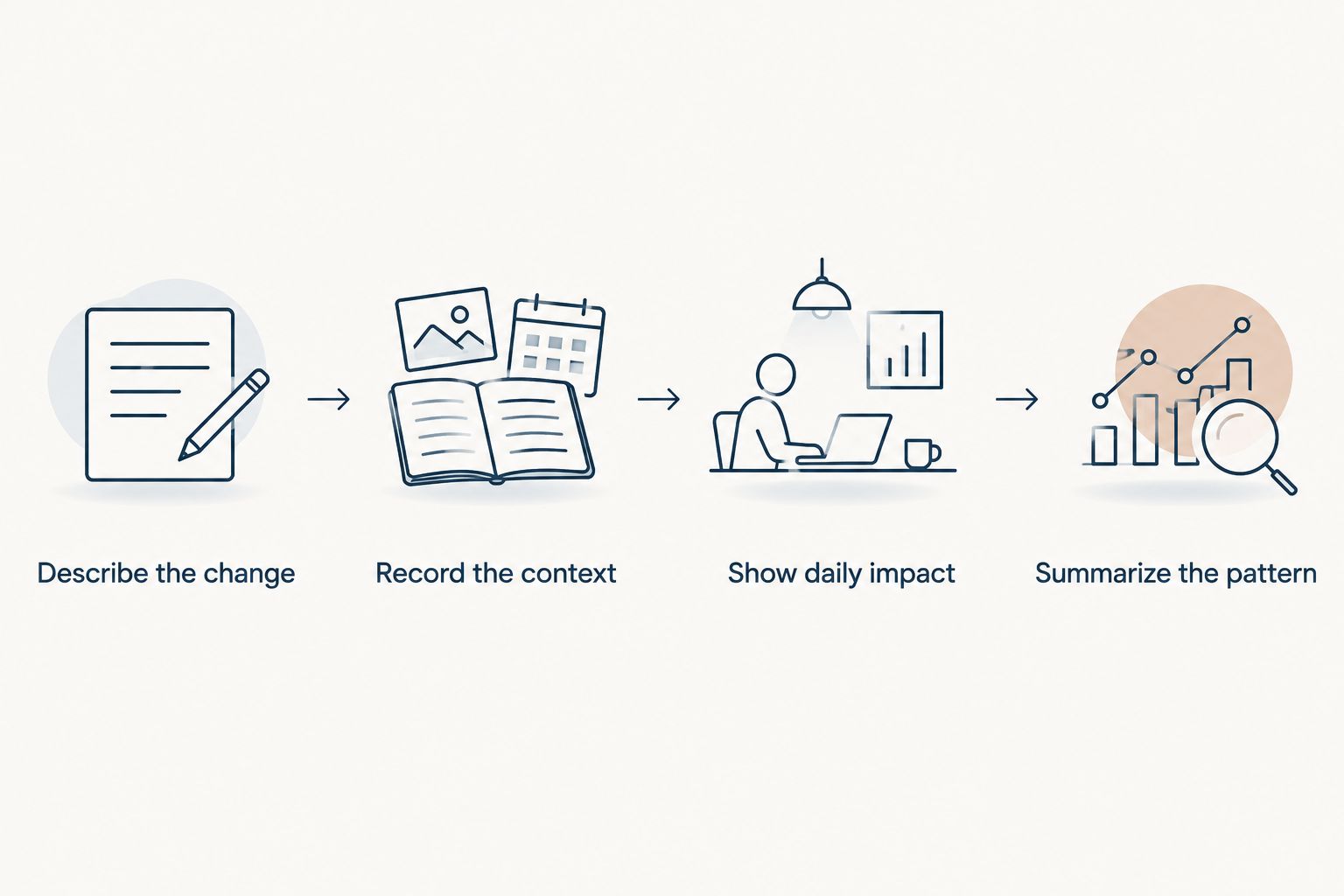
Record observations first; leave the diagnosis to a clinical evaluation.
Choose a format you can maintain: a paper notebook, a private phone note, or a simple spreadsheet. The format matters less than consistent wording and honest entries, including days when you feel well.
Which symptoms belong in the diary?
Sexual symptoms are relevant to testosterone evaluation, but they still have several possible causes. Fatigue, poor concentration, and low mood are especially nonspecific; recording them is useful without labeling them hormonal.
| Symptom area | What to record | What the entry cannot establish |
|---|---|---|
| Sex drive | A change in sexual interest compared with your usual pattern | Whether testosterone is the cause |
| Spontaneous erections | A noticeable change in morning or other spontaneous erections | A diagnosis from morning erections alone |
| Erections during sex | Difficulty getting or maintaining an erection, including the circumstances | Whether the cause is hormonal, vascular, psychological, or mixed |
| Energy and mood | When fatigue, irritability, or low mood occurs and what it interrupts | Whether testosterone treatment would help |
| Strength and activity | A specific change in usual exercise or physical tasks | Whether the change reflects hormones, illness, pain, or reduced activity |
Avoid turning the table into a checklist you must complete. Record symptoms you actually experience; an empty category is better than an assumed symptom.
What should a daily symptom entry include?
A useful entry is brief enough to repeat but specific enough to interpret. You do not need to document every meal, mood change, or sexual experience.
Use the following fields as a starting point:
- Date and routine: Workday, day off, travel, or a shift change.
- Sleep: Approximate sleep duration, interruptions, and whether you woke rested.
- Main concern: The symptom that stood out, described in ordinary language.
- Daily impact: A task, relationship concern, or activity affected by the symptom.
- Relevant context: Illness, stress, alcohol, medication changes, or unusually demanding exercise.
- Questions: Anything you want the physician to explain.
An optional 0–10 scale can help you compare your own entries. Define what the endpoints mean and keep the direction consistent—for example, 0 means no fatigue and 10 means the worst fatigue you can imagine. This is a personal tracking aid, not a validated testosterone test.
A symptom diary template for 2026
Copy this into your preferred private format:
- Date:
- Sleep duration and quality:
- Main symptom or change:
- When it occurred:
- Effect on ordinary activities:
- Sexual changes, if relevant:
- Illness, stress, alcohol, or medication changes:
- Question for the appointment:
Do not backfill details you cannot remember. An entry marked uncertain is more useful than a precise-looking account created from guesswork.
What does a useful entry sound like?
These are fictional examples of documentation, not patient stories or diagnostic patterns:
- May 4, 2026: Slept about 6 hours with repeated waking. Felt tired during an afternoon meeting and skipped my usual walk. Sexual interest seemed unchanged. Started a new prescription recently; bring the medication name.
- May 5, 2026: Slept about 8 hours and woke more rested. Energy improved, but sexual interest still felt lower than usual. Ask about both concerns rather than assuming they have the same cause.
The useful detail is the contrast between days. Better energy after better sleep does not rule testosterone deficiency in or out, and persistent low sexual interest still needs its own discussion.
Why do symptoms vary from day to day?
Symptoms sit within a larger health picture. Record these factors because they help a physician ask better questions—not because a diary can establish cause and effect.
- Sleep quality: Insufficient sleep and sleep disorders can contribute to fatigue and problems with concentration or sexual function.
- Stress and mood: Anxiety, depression, and relationship stress can affect energy, desire, and erections.
- Illness and recovery: Acute illness can change how you feel and temporarily affect testosterone measurements.
- Medicines and substances: Some medications, including opioids, can affect testosterone; other medicines can affect sexual function through different mechanisms.
- Activity and weight changes: Changes in exercise, nutrition, and body weight provide context for fatigue and physical performance.
Do not stop a prescribed medicine to test a theory from your diary. Record the name, dose, and timing if known, then discuss the concern with the prescriber.
Likewise, avoid interpreting a single difficult day as a trend. A persistent change and an isolated bad afternoon are different clinical histories.
Can a symptom diary tell you whether testosterone is low?
No. Symptoms and diary scores cannot diagnose testosterone deficiency. For adult men, Endocrine Society and American Urological Association guidance calls for symptoms or signs together with consistently low testosterone measurements, rather than symptoms alone.
Evaluation generally includes testosterone testing on 2 separate mornings. Your clinician should explain the collection instructions, account for your sleep schedule, and decide whether additional testing is appropriate.
An abnormal result is not a self-contained explanation for every symptom. A physician may need to investigate the reason for the result and assess other conditions before discussing treatment.
Tell the clinician if you work nights, are currently ill, or already take testosterone or other hormones. Those details affect how the testing history should be interpreted; do not change medication timing without instructions.
Should you use an app or a paper diary?
Best for consistency: use the format you will actually keep. Paper makes it easy to write a short account without extra notifications, but it can be misplaced and is harder to summarize. A digital note is easier to search and share, but it requires attention to privacy and access settings.
| Format | Best for | Main benefit | Main limitation |
|---|---|---|---|
| Paper notebook | Men who prefer an offline routine | Flexible entries without account setup | Can be lost or left at home |
| Private digital note | Men who already use their phone for reminders | Searchable entries and easy summaries | Privacy depends on device and account settings |
| Spreadsheet | Men who want to compare repeated fields | Makes patterns easier to scan | Can encourage unnecessary detail or scoring |
The point of using daily health data is to connect observations with practical questions, not turn an app score into a diagnosis. For example, repeated tiredness after interrupted sleep is a reason to discuss sleep, even when your original concern was testosterone.
Consumer sleep or activity estimates can add context, but they do not measure testosterone. Bring the underlying observations rather than relying on a device's readiness or wellness label.
Keep sexual-health entries somewhere you control. Review sharing settings before putting sensitive details into a workplace account or a shared family device.
What should you bring to the appointment?
Bring the diary and a short summary, not a conclusion that treatment is necessary. For your 2026 visit, put these items at the top:
- The symptoms that concern you most and when they began.
- Whether the change was gradual, sudden, persistent, or intermittent.
- Current prescriptions, over-the-counter medicines, supplements, and hormone use.
- Previous hormone results, including collection times when available.
- Sleep concerns, existing medical conditions, and fertility plans.
Fertility deserves an explicit conversation because testosterone treatment can suppress sperm production. A desire for children changes the discussion; do not assume testosterone replacement is the right next step.
Men's Medical Institute is an option for St. Louis men seeking physician-led testosterone care. Its physician-led approach fits an evaluation built around symptoms, medical history, and clinical judgment—not a diary score alone.
To discuss an evaluation, contact Men's Medical Institute or call 314-394-1660. Bring concerns even if you have not started tracking; a completed diary is not a prerequisite for asking for help.
When should you stop tracking and seek care?
A symptom diary must never become a reason to delay care. New erectile difficulties, persistent fatigue, or ongoing low mood deserve an appointment even when you are unsure whether hormones are involved.
Seek urgent care for severe or rapidly worsening symptoms rather than documenting them for later. Chest pain, sudden weakness, or trouble breathing requires emergency assessment, not a testosterone appointment.
If recording symptoms makes you repeatedly check your body or increases distress, simplify the diary or stop. Tell your clinician what you noticed; more tracking is not always better information.
FAQ
What are common low testosterone symptoms in men?
Low testosterone symptoms in men can include reduced sex drive, fewer spontaneous erections, fatigue, and changes in mood or muscle strength. These symptoms overlap with other conditions and require clinical evaluation rather than self-diagnosis.
How long should I keep a symptom diary before seeing a doctor?
You do not need to complete a set tracking period before seeing a doctor. Start recording concerns now and bring whatever you have; persistent or concerning symptoms should not wait for a finished diary.
Can I have low testosterone without erection problems?
Yes. Erectile difficulty is not required for testosterone deficiency, and erectile difficulty alone does not establish it. Your clinician considers the overall symptom history and appropriate blood tests.
Does waking up without an erection mean my testosterone is low?
No. A single morning without an erection does not diagnose low testosterone. Record a noticeable change from your usual pattern and discuss it alongside sleep, medications, and other symptoms.
Can a smartwatch or health app diagnose low testosterone?
No. A smartwatch or general health app cannot diagnose testosterone deficiency. Sleep and activity observations can support your history, but they do not replace a clinical evaluation and blood testing.
How many testosterone blood tests are usually needed?
Testosterone evaluation generally includes measurements on 2 separate mornings. Your physician should give collection instructions and interpret the results alongside symptoms, health conditions, and medications.
Can I discuss symptoms before deciding whether I want testosterone treatment?
Yes. An evaluation is a discussion of symptoms and possible causes, not a commitment to treatment. Men's Medical Institute provides physician-led testosterone care in St. Louis; call 314-394-1660 to discuss an appointment.
One last thing
Record good days too. A diary containing only difficult days leaves out the contrast that helps explain whether symptoms are persistent, situational, or changing.
Bring observations, not a verdict. This article provides general education, not individual medical advice; your physician should determine which evaluation and treatment, if any, fit your health and goals.