Men's clinic or primary care: which appointment do you need?

Choose primary care when symptoms are new, unexplained, or part of several health concerns; choose a physician-led men's clinic when you need focused evaluation of testosterone, erections, or medical weight management. You can use both: focused treatment should complement your general medical care, not replace it, and urgent symptoms need urgent assessment rather than either routine appointment.
TL;DR
- Searching mens clinic near me? Choose by symptoms and clinical scope, not location alone.
- Primary care is best for unexplained symptoms, preventive care, and several health concerns together.
- Men's Medical Institute provides physician-led testosterone care, ED treatment, and weight management in St. Louis.
- A men's clinic can provide focused care without replacing your primary care clinician.
Why this matters
Fatigue, lower sex drive, erection changes, and weight gain do not identify a single diagnosis. Sleep problems, depression, medication effects, and other medical conditions can overlap with symptoms men associate with testosterone.
For men in St. Louis and Metro East Illinois choosing care in 2026, the first decision is what needs evaluating—not which treatment to request. Men's Medical Institute offers physician-led testosterone replacement therapy, NAD+ therapy, ED treatment, and weight management. Those services have a defined scope; they are not a substitute for every kind of medical care.
Men's clinic or primary care: which appointment do you need?
Start with the appointment that matches the problem you need solved. A focused concern can belong in either setting, depending on the clinician's experience and services. The clinic label alone does not tell you whether that clinician evaluates your concern.
| Appointment | Best for | Main advantage | Main limitation |
|---|---|---|---|
| Primary care | New or unexplained symptoms, preventive care, multiple conditions | Connects symptoms with your wider medical history | Ask whether the clinician provides the specific hormone, sexual health, or weight treatment you need |
| Physician-led men's clinic | Focused testosterone, erection, or weight-management concerns within its services | Centers the visit on a defined men's health concern | Does not automatically cover preventive care or unrelated illnesses |
| Urgent or emergency care | Sudden, severe, or time-sensitive symptoms | Addresses immediate safety concerns | Does not replace ongoing evaluation and follow-up |
If you already trust a primary care clinician, ask whether they manage the problem before assuming you need another practice. If you book a focused appointment first, bring your medical history and identify who will handle the rest of your care.
Primary care: best for unexplained symptoms and overall health
Primary care is a sensible first appointment when you feel generally unwell but cannot identify one clear concern. Examples include fatigue alongside poor sleep, mood changes, unexplained weight changes, or symptoms affecting several parts of your life.
The advantage is breadth. A primary care clinician can consider your symptoms together, review medicines, address preventive care, and decide whether specialist evaluation belongs in the plan.
The limitation is scope within that particular practice. Not every primary care clinician offers testosterone treatment, injectable ED treatment, or medical weight management. Ask directly rather than treating a referral as a sign that the clinician dismissed your concern.
For your 2026 appointment, write down what changed, when it changed, and what you can no longer do comfortably. Describing reduced exercise tolerance or repeated erection difficulty gives your clinician more to assess than saying you want to optimize your hormones.
A men's clinic: best for a focused concern within its scope
A physician-led men's clinic is an appropriate appointment when your main question concerns testosterone, erections, or another service the practice explicitly provides. You do not need to arrive with a diagnosis. You need a clinician willing to evaluate whether the proposed treatment fits.
Men's Medical Institute is best suited to men in St. Louis seeking physician-led testosterone care, ED treatment, or weight management. That describes its stated services, not a promise that every man needs treatment or will achieve a particular result.
The advantage of focused care is attention to a defined concern. The limitation is that a focused practice does not automatically become responsible for your vaccinations, cancer screening, unrelated symptoms, or every chronic condition.
Before booking, ask who evaluates you, who prescribes, and how you reach the clinical team with a treatment problem. Ask what happens if the evaluation points away from the treatment you initially wanted.
Why the right appointment varies
The same symptom can justify different starting points. Use these factors to decide where your first appointment belongs:
- Symptom pattern: A specific erection concern differs from fatigue, breathlessness, and unexplained weight loss together.
- Urgency: Sudden or severe symptoms take priority over a routine consultation.
- Existing conditions: Diabetes, cardiovascular disease, sleep disorders, and depression belong in the treatment discussion.
- Current medicines: Prescription drugs, supplements, and nonprescribed hormones can affect symptoms and treatment safety.
- Fertility plans: Testosterone treatment can suppress sperm production; discuss plans for children before starting it.
- Clinical scope: Confirm that the clinician evaluates your concern and has a plan for problems outside the practice's services.
Distance matters, but it is not the whole decision. A nearby appointment is only a good fit if it provides the evaluation you need and a clear follow-up plan.
How do you choose when you are not sure?
You do not have to diagnose yourself before calling. Use this sequence to describe the problem and check whether the appointment fits.
- Describe symptoms. State your main concern in plain language, including its effect on daily life. Avoid making a treatment name the whole reason for the visit.
- Check urgency. Tell the scheduling team about sudden, severe, or rapidly worsening symptoms. Do not wait for a routine appointment when emergency assessment is needed.
- Confirm scope. Ask whether the clinician evaluates your concern, including causes that do not require the treatment advertised.
- Share records. Bring your medication list, relevant laboratory reports, diagnoses, and previous treatment history.
- Plan follow-up. Find out who explains results, who monitors treatment, and who communicates with your other clinicians.
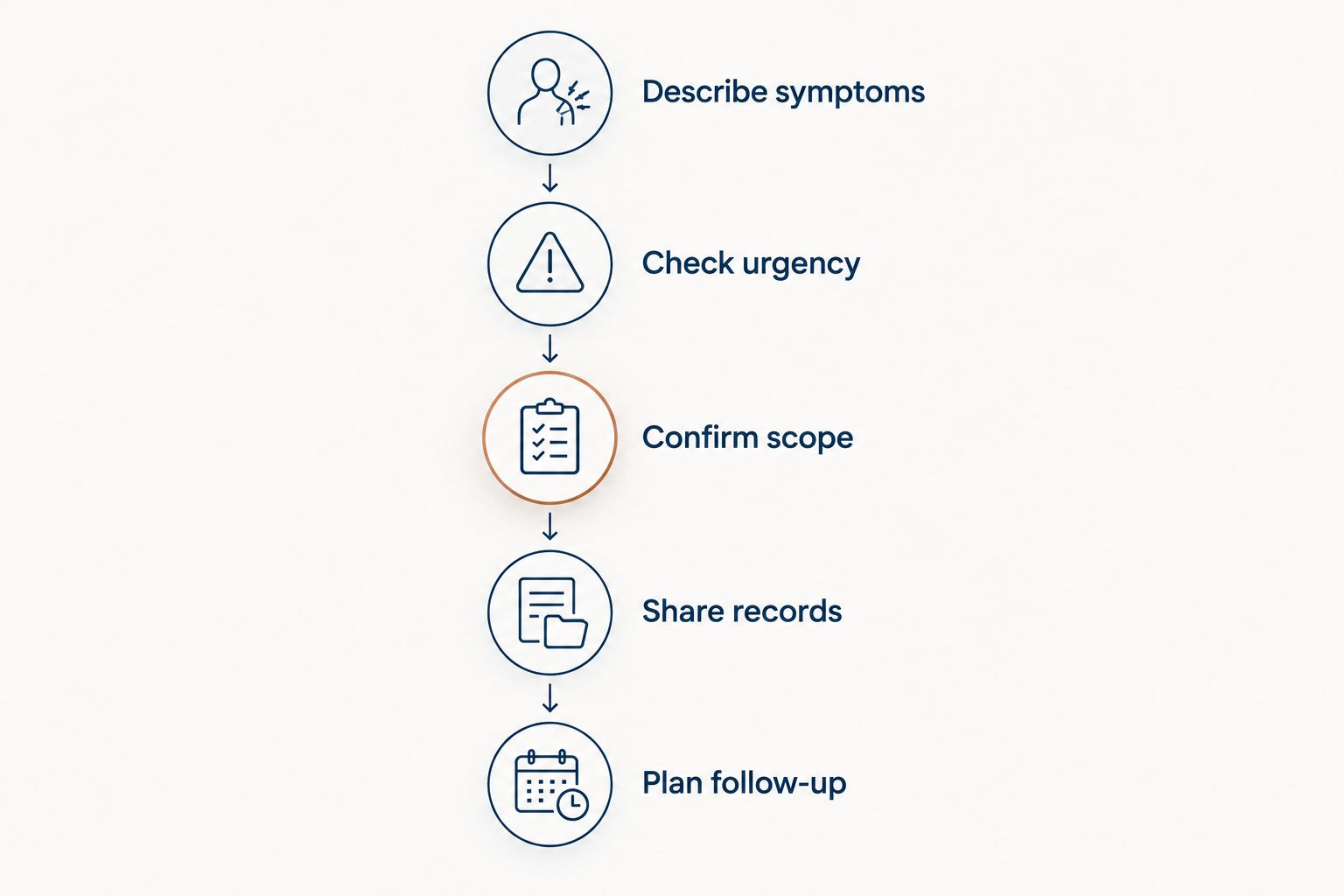
Choose an appointment around the evaluation you need, not a treatment you have already selected.
Keep the initial call practical. You can explain that you are unsure whether the symptoms belong in primary care or a focused visit and ask how the practice handles that situation. Scheduling guidance does not replace a medical assessment, but it helps establish whether you are contacting the right service.
Should I see primary care first for low testosterone symptoms?
Primary care is a good first step when fatigue, low mood, or reduced sex drive has no established explanation. A physician-led testosterone practice can also evaluate these concerns, provided the assessment considers other causes rather than assuming testosterone deficiency.
Low testosterone is not diagnosed from symptoms alone. Established clinical guidance calls for compatible symptoms and consistently low testosterone levels, generally confirmed with testing on 2 separate mornings. Your clinician interprets results in context, including illness, sleep patterns, medicines, and the laboratory method.
That distinction matters in 2026 just as much as the choice of clinic. A single result does not explain every symptom, and a normal result is not a reason to stop investigating symptoms that continue.
If treatment is appropriate, ask about benefits, risks, fertility, monitoring, and what would prompt a change or discontinuation. The aim is a justified medical plan—not simply a higher laboratory number.
Can I use a men's clinic and keep my primary care doctor?
Yes. A men's clinic and primary care can have separate, coordinated roles. The important step is agreeing who manages each part of your care rather than assuming both practices have the same information.
For testosterone treatment, discuss which clinician orders monitoring, reviews results, and responds to concerns. For ED or weight treatment, make sure both practices know your prescriptions and relevant diagnoses.
The practical questions in testosterone therapy in St. Louis: coordinating with primary care apply before treatment starts, not only after a problem develops. Ask how records are shared and whether you need to request their transfer yourself.
Bring reports with dates and laboratory reference ranges rather than relying on remembered numbers. If recommendations differ, ask the clinicians to clarify the disagreement before changing or combining treatment on your own.
Where should I start for medical weight management?
Start with primary care if weight change accompanies unexplained symptoms or you need a broad review of your health. A physician-led weight-management appointment also fits when weight treatment is your main concern and the clinician can assess your history, medicines, and suitability for treatment.
The clinical question behind medical weight loss for men is broader than choosing a prescription: your plan needs to account for health conditions, nutrition, activity, side effects, and follow-up. A treatment name alone does not establish that those needs are covered.
Ask what happens when appetite becomes difficult to manage, side effects interfere with eating, or progress changes. Also ask who handles questions between appointments and how the plan connects with your existing medical care.
When comparing programs in 2026, separate the medical evaluation from the sales conversation. A responsible discussion includes reasons not to prescribe, alternatives to medication, and the limits of what treatment can promise.
When should you skip both routine appointments?
Do not use a routine men's clinic search to manage a medical emergency. Call 911 for symptoms such as chest pain, severe difficulty breathing, or signs of stroke, including sudden facial drooping, arm weakness, or speech difficulty.
An erection lasting 4 hours needs emergency medical attention, whether or not you use an ED medicine. Do not wait for pain or a return call before seeking care.
Sudden severe testicular pain also needs immediate assessment. These situations differ from a longstanding concern about libido, erections, or energy that is stable enough for a scheduled evaluation.
When the situation is not clearly an emergency but symptoms are worsening, contact a clinician promptly for guidance about where to be assessed. An online article cannot determine the urgency of your individual symptoms.
What should you ask before booking in 2026?
Use the same questions whether the practice calls itself primary care, men's health, or a wellness clinic. Clear answers help you understand the service without assuming that one business model guarantees better care.
- Who performs the medical evaluation, and who makes prescribing decisions?
- What other explanations will you consider for my symptoms?
- Which visits, laboratory tests, medicines, and supplies are billed separately?
- What monitoring is needed, and who reviews it?
- What happens if treatment does not help or causes side effects?
- How will you communicate with my other clinicians?
Ask for written cost details, including exclusions. Do not assume a recurring program charge covers laboratory work, and do not compare practices using a headline charge alone.
A low-pressure next step is to call Men's Medical Institute at 314-394-1660 and describe the concern you want evaluated. Ask whether a focused appointment fits or whether primary care should come first. Calling does not commit you to treatment.
FAQ
What's the best way to choose a mens clinic near me?
Choose by clinical scope, who evaluates you, and how follow-up works—not location alone. Confirm that the practice considers other causes of your symptoms and explains costs and exclusions.
Do I need a men's clinic if I already have a primary care doctor?
Not necessarily. Your primary care clinician may evaluate and manage the concern; a focused clinic is another option when you need services or expertise outside that practice's scope.
Can I book a testosterone appointment without blood tests?
You can ask for an evaluation before having laboratory results. The clinician decides which tests are appropriate; testosterone deficiency is not diagnosed from symptoms alone.
Does erectile dysfunction mean I have low testosterone?
No. Erectile dysfunction has several possible contributors, including vascular disease, diabetes, medication effects, and psychological factors. An evaluation should not assume a hormone cause.
Will a men's clinic replace my annual physical?
Do not assume a focused men's health visit replaces preventive care. Ask which screenings and general medical needs the practice covers and which remain with primary care.
Are NAD+ injections proven to help men live longer?
No. Injectable NAD+ is not a proven longevity treatment, and evidence for broad anti-aging benefit in humans is limited. Sterile compounding quality is also a safety concern.
How long can an erection last before I need emergency care?
An erection lasting 4 hours needs emergency medical attention. Seek care even if it is not painful, and tell the emergency clinician about any ED medicines or injections you used.
One last thing
A useful appointment can end without a prescription. Further testing, treating another condition, or deciding against a requested treatment can all be appropriate outcomes of an individualized evaluation.
Before you leave, ask: What are we evaluating, what happens next, and who is responsible for follow-up? This article provides general education, not individual medical advice or a diagnosis.