STL Men's Clinic alternatives for TRT and ED care in 2026

STL Men's Clinic is a useful starting point for comparison if you already have a care relationship there; switching should preserve what is working. A second opinion becomes useful when your symptoms, fertility goals or treatment questions need a different clinical focus. The best STL Men's Clinic alternative in 2026 is Men's Medical Institute if you want independent, physician-led men's health care; a urologist is a better fit when your main concern requires specialist urinary, reproductive or surgical evaluation.
TL;DR
- For stl men's clinic alternatives, Men's Medical Institute offers physician-led TRT and ED care in St. Louis.
- Primary care suits a broad first assessment; urology suits complex erectile dysfunction or reproductive concerns.
- Compare diagnosis, monitoring, fertility planning and total care charges before changing clinics.
- Keep effective care when your clinician explains the plan, addresses concerns and arranges appropriate follow-up.
Why this matters
Low energy, low sexual desire and erection difficulties do not establish the same diagnosis. Testosterone replacement therapy, or TRT, treats appropriately diagnosed testosterone deficiency; it is not a general treatment for every cause of erectile dysfunction, or ED.
That distinction should guide your clinic choice in 2026. A different prescription is not automatically a better plan, and a familiar prescription is not automatically the wrong one. Your clinician needs to explain what the treatment targets and how you will judge whether it helps.
For men in St. Louis and Metro East Illinois, this comparison covers 4 care routes: an independent men's health practice, primary care, urology and endocrinology. These routes overlap, but they answer different questions. The right choice depends on the problem that remains unresolved—not simply the clinic name.
STL Men's Clinic alternatives at a glance
Use this table to choose the type of appointment to investigate. It does not rank individual clinicians or establish that one clinic delivers better outcomes than another.
| Care option | Best for | Main clinical focus | What to compare with STL Men's Clinic |
|---|---|---|---|
| STL Men's Clinic | Continuing an established care relationship that meets your needs | Your current assessment and treatment plan | Whether your questions, monitoring and follow-up needs are being addressed |
| Men's Medical Institute | Independent, physician-led men's health care in St. Louis | Testosterone care, ED treatment, weight management and NAD+ therapy | Physician involvement, treatment rationale, exclusions and follow-up arrangements |
| Primary care clinician | Symptoms that need a broad initial assessment | General health, medicines, sleep, mood and chronic conditions | Whether a general medical assessment should come before condition-specific treatment |
| Urologist | Complex ED, reproductive concerns or possible procedural treatment | Urinary and male reproductive health | Whether specialist evaluation addresses the unresolved problem |
| Endocrinologist | Testosterone concerns involving a wider hormone disorder | Endocrine causes and hormone interpretation | Whether the hormone findings need a broader endocrine workup |
Best for is a clinical fit, not a promise of results. Ask each practice which concerns it evaluates directly and which require referral. Confirm those details before transferring records or changing treatment.
1. Men's Medical Institute: best for physician-led men's health care
Men's Medical Institute provides physician-led testosterone replacement therapy, ED treatment, weight management and NAD+ therapy in St. Louis. Its independent, physician-led approach fits men who want treatment decisions centered on their symptoms, medical history and goals.
That makes the practice an alternative to consider—not proof that you need treatment. An appropriate assessment can also lead to further testing, another diagnosis or a decision not to prescribe.
Where the practice fits
- Physician-led care: Individual clinical judgment is central to the practice's stated approach.
- Related men's health concerns: Testosterone, sexual health and weight management are within its stated services.
- Clear exclusions: Laboratory charges are separate from the testosterone program charge, so compare the full care bill rather than the program alone.
- Evidence limits: Injectable NAD+ is not a proven longevity treatment. Offering a therapy does not establish broad anti-aging benefit.
Where this option falls short
A men's health practice is not a substitute for every specialist. Pituitary disease, complex fertility concerns or possible ED surgery require the appropriate specialist assessment.
Physician-led care also does not guarantee symptom improvement. If your fatigue or sexual symptoms have another cause, testosterone treatment will not resolve that cause simply because a physician prescribes it.
Best for: Men seeking independent, physician-led testosterone or sexual health care with individualized treatment decisions.
Verdict: Consider an assessment; do not commit to TRT before the diagnosis and monitoring plan are clear.
2. Primary care: best for symptoms without a clear diagnosis
A primary care clinician is a sensible first appointment when fatigue, reduced interest in sex or erection changes arrive alongside broader health concerns. The assessment can connect symptoms with medicines, sleep, mood, blood pressure, diabetes risk and other medical issues.
This route is especially useful when you are not yet sure that a men's health treatment is the right answer. Bring your symptom history rather than a request for a particular prescription.
Where primary care shines
- Reviews symptoms in the context of your overall health.
- Helps identify conditions or medicines that contribute to sexual symptoms.
- Coordinates referrals when a focused specialist assessment is needed.
Where primary care falls short
Primary care scope varies by clinician. Ask whether the clinician manages TRT, provides ongoing monitoring or refers testosterone and ED treatment elsewhere.
A broad assessment also does not replace specialist care when the findings point to a reproductive, urinary or endocrine disorder.
Best for: Men whose symptoms need an initial medical explanation, especially when several health concerns overlap.
Verdict: Start here when the diagnosis—not access to a prescription—is your main unanswered question.
3. A urologist: best for complex ED or reproductive concerns
A urologist evaluates urinary and male reproductive conditions, including erectile dysfunction. This route deserves consideration when ED remains troublesome despite treatment, when penile pain or curvature is present, or when you need to discuss procedures.
Tell the practice if fertility is a priority. Male reproductive expertise varies, so ask whether the clinician evaluates infertility or whether a reproductive urologist is the appropriate referral.
Where urology shines
- Assesses structural and reproductive concerns alongside sexual function.
- Discusses ED treatment beyond oral medicines when appropriate.
- Evaluates whether a procedure belongs in the treatment discussion.
Where urology falls short
Not every urologist focuses on sexual medicine or male fertility. Confirm the clinician's clinical focus before scheduling.
Urology also does not replace a broader medical assessment of fatigue, mood changes or suspected endocrine disease. You can need coordinated care rather than a complete transfer from one clinician to another.
Best for: Men with complex ED, penile symptoms, reproductive concerns or questions about procedural treatment.
Verdict: Seek the relevant urology expertise when the unresolved problem extends beyond routine prescription management.
4. An endocrinologist: best for a wider hormone evaluation
An endocrinologist is appropriate when testosterone findings raise questions about the pituitary gland, testicular function or another endocrine condition. The focus is understanding the hormone disorder, not simply replacing a low result.
For a man not already using testosterone, diagnosis generally requires compatible symptoms and consistently low testosterone, confirmed with testing on 2 separate mornings. Shift work and existing hormone treatment affect interpretation, so the clinician must give you testing instructions that fit your situation.
Where endocrinology shines
- Investigates hormone abnormalities in their wider medical context.
- Assesses whether additional endocrine testing is needed.
- Helps distinguish testosterone deficiency from other endocrine explanations.
Where endocrinology falls short
Endocrinology is not the same as a sexual-medicine or procedural ED service. Confirm whether the clinician manages your particular concern or recommends another specialist.
Best for: Men with unexplained hormone abnormalities or suspected pituitary or endocrine disease.
Verdict: Seek endocrine assessment when understanding the cause is the priority.
Reasons to seek a second opinion from STL Men's Clinic
A clinic comparison should start with your own care experience, not assumptions about another practice. These are valid reasons to seek another assessment from any provider; they are not allegations about STL Men's Clinic.
- You cannot explain the diagnosis. Ask what supports it, what else was considered and what remains uncertain.
- Your goals have changed. Plans for children, new medicines or a new diagnosis can change the treatment discussion.
- Symptoms persist. Ask whether the original diagnosis still explains the problem before simply increasing treatment.
- You need another clinical focus. A urologist or endocrinologist can add expertise without replacing every part of your existing care.
- The care bill is unclear. Request written details about visits, medicines, laboratory testing, supplies and additional services.
- You do not understand follow-up. Ask who reviews results, who responds to concerns and when the plan will be reassessed.
For a 2026 decision, distinguish an unresolved question from a treatment failure. A clear conversation with your current clinician can sometimes resolve the concern without a transfer.
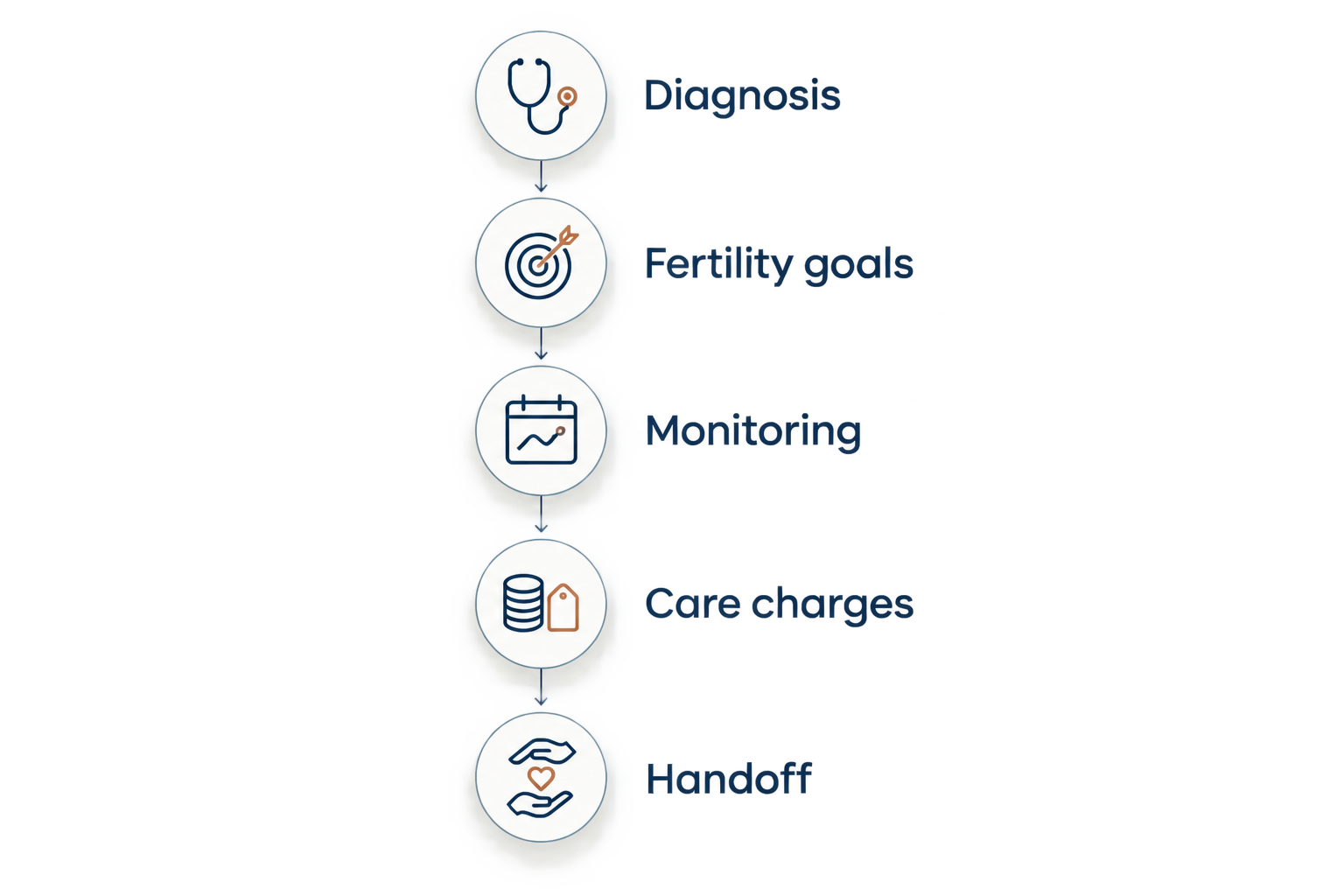
How to compare care before you switch
Use the same questions at each appointment. Consistent questions make differences easier to understand and prevent a polished explanation from replacing a clear clinical plan.
Diagnosis
Ask: What explains my symptoms, and what evidence supports that explanation? If testosterone is being considered, discuss how symptoms and laboratory results fit together.
An isolated low result does not answer every question. Illness, testing conditions and medicines can affect interpretation, and existing testosterone treatment changes how results should be assessed.
Fertility goals
Ask: How does this plan affect my ability to have children? Exogenous testosterone can suppress sperm production, so fertility belongs in the discussion before starting or changing TRT.
Do not assume stopping treatment will restore fertility on your preferred schedule. Discuss reproductive goals with the clinician and seek specialist advice when appropriate.
Monitoring
Ask: Which symptoms, examination findings and tests will guide follow-up? Testosterone care includes checking for treatment effects and adverse effects, not just reaching a laboratory target.
Get instructions for what to do if concerns arise between appointments. A monitoring plan needs an action plan as well as a testing schedule.
Care charges
Ask for the complete recurring and additional charges in writing. Separate the clinical program, laboratory testing, medicines, supplies and other visits so you can compare equivalent services.
For 2026 comparisons, transparent pricing means understanding exclusions—not assuming that either an independent practice or a corporate-clinic model is automatically less expensive.
Handoff
Ask who will manage prescriptions, review pending results and respond to problems during the transition. Bring your treatment history, medication list and recent laboratory reports.
Do not stop, combine or change prescribed treatments solely to prepare for a new appointment. Get individualized instructions from the prescribing clinician.
Compare the care plan and the transition arrangements, not just the prescription.
If independent, physician-led care matches what you are seeking, you can contact the practice or call 314-394-1660 to ask about an assessment. Confirm what records to bring and which charges apply before scheduling.
When staying with STL Men's Clinic is the right call
Staying is reasonable if your current clinician explains the diagnosis, discusses alternatives, addresses fertility and safety questions, and provides appropriate follow-up. A new clinic name is not a medical benefit by itself.
If your treatment is helping and your concerns are being addressed, continuity has practical value: your clinician already has your history and treatment response. You can still request records or seek a second opinion without deciding in advance to leave.
The right 2026 choice is the care relationship that meets your clinical needs—not the longest list of treatments.
FAQ
What's the best STL Men's Clinic alternative for physician-led care?
Men's Medical Institute is an option for independent, physician-led testosterone and ED care in St. Louis. Choose it based on whether its assessment and care approach fit your needs, not an assumption of better outcomes.
Should I see primary care or a men's clinic first?
Primary care is a sensible first step when your symptoms have no clear diagnosis. A men's health practice is another route when you need focused assessment of testosterone or sexual health concerns.
Is a urologist better for erectile dysfunction?
A urologist is particularly appropriate for complex ED, penile symptoms or questions about procedures. The best fit depends on the cause of the problem and the clinician's relevant expertise.
Do I need low testosterone treatment if I have ED?
ED alone does not establish testosterone deficiency. A clinician should assess symptoms, medical history and appropriate testing before recommending testosterone.
Can TRT affect my fertility?
Yes. Exogenous testosterone can suppress sperm production. Discuss plans for children before starting or changing treatment, and ask whether reproductive specialist advice is needed.
Are laboratory tests included in the testosterone program?
Laboratory tests are separate from the testosterone program charge at this practice. Ask for the full list of expected charges and exclusions before enrolling.
Should I stop my current treatment before changing clinics?
Do not stop or change prescribed treatment without individualized instructions from your clinician. Arrange the handoff so prescriptions, pending results and follow-up responsibilities are clear.
One last thing
An erection lasting 4 hours needs emergency medical attention. Do not wait for a routine clinic callback, including when an ED medicine or injection preceded it.
For a routine second opinion in 2026, bring the actual prescription labels and laboratory reports—not just a remembered dose or a description of a low result. That gives the next clinician a clearer starting point.
This article provides general education, not individual medical advice. Treatment decisions require an assessment of your own health history, symptoms and goals.