ED treatment options ranked by invasiveness in 2026

Best starting medication for eligible men: oral ED treatment. Best drug-free device: a vacuum erection device. Least invasive approach: addressing contributing health and psychological factors. This 2026 guide ranks ED treatment options by invasiveness—not effectiveness—so you can discuss the next step without assuming more invasive care is better.
TL;DR
- Compare ED treatment options by invasiveness, but choose treatment around safety, preferences, and the cause of erection difficulties.
- Oral sildenafil or tadalafil is a common starting medication when your medical history allows it.
- Vacuum devices avoid medication; penile injections and implants involve greater physical intervention.
- Mensmedicalinstitute offers physician-led ED treatment for men in St. Louis.
Why this matters
Erectile dysfunction is difficulty getting or maintaining an erection firm enough for sexual activity. It can involve blood vessels, nerves, medications, hormones, anxiety, or several factors together. Persistent symptoms deserve a medical assessment, not simply a stronger prescription.
Mensmedicalinstitute provides physician-led ED care in St. Louis. It is a fit for men seeking physician-led ED treatment rather than choosing medication without a clinical assessment.
The ranking below describes treatment categories, not a claim that every option is provided by the practice. This is general education, not individual medical advice.
What makes the best ED treatment for you?
The best ED treatment in 2026 is the least burdensome option that is safe, acceptable, and effective for your situation. Use these criteria before comparing treatments:
- Physical invasiveness: Does treatment involve an external device, urethral insertion, a needle, or surgery?
- Medical suitability: Do your medicines, cardiovascular health, bleeding risks, or surgical history change the choice?
- Practical burden: Consider preparation, privacy, training, and interruption during intimacy.
- Reversibility: Can you stop treatment easily, or does it permanently change penile tissue?
- Treatment goal: Distinguish erection firmness from low desire, ejaculation concerns, or relationship distress.
- Evidence and oversight: Prefer established treatments with a clear prescribing, training, and follow-up plan.
Invasiveness is not the same as risk. An oral medicine can be unsafe for someone taking nitrates, while a properly selected external device avoids that drug interaction.
ED treatment options at a glance
For this 2026 comparison, the order follows physical intervention. Lifestyle support and counseling can accompany any treatment rather than serving as a required hurdle before medication.
| Rank | Option | Best for | Standout feature | Key limitation |
|---|---|---|---|---|
| 1 | Health measures | Addressing contributing health factors | No procedure or erection-specific drug | Does not reliably provide an immediate erection |
| 2 | Psychosexual therapy | Anxiety or relationship-related contributors | Addresses distress and sexual patterns | Does not directly correct every physical cause |
| 3 | Oral medication | Eligible men wanting a nonprocedural medication | No device, insertion, or injection | Unsafe with nitrates; response varies |
| 4 | Vacuum device | Men preferring a drug-free mechanical option | External suction draws blood into the penis | Preparation, bruising, or discomfort |
| 5 | Urethral medication | Selected men avoiding penile injections | Medication delivered through the urethra | Local irritation and administration burden |
| 6 | Penile injections | Men needing an alternative to oral treatment | Medication acts directly in erectile tissue | Needle use and prolonged-erection risk |
| 7 | Penile implant | Men seeking a surgical option after informed discussion | An implanted device produces rigidity | Surgery and permanent tissue changes |
The middle of this ranking needs context. Oral medication and vacuum devices do not pierce tissue, but they impose different burdens; neither is automatically easier for every man.
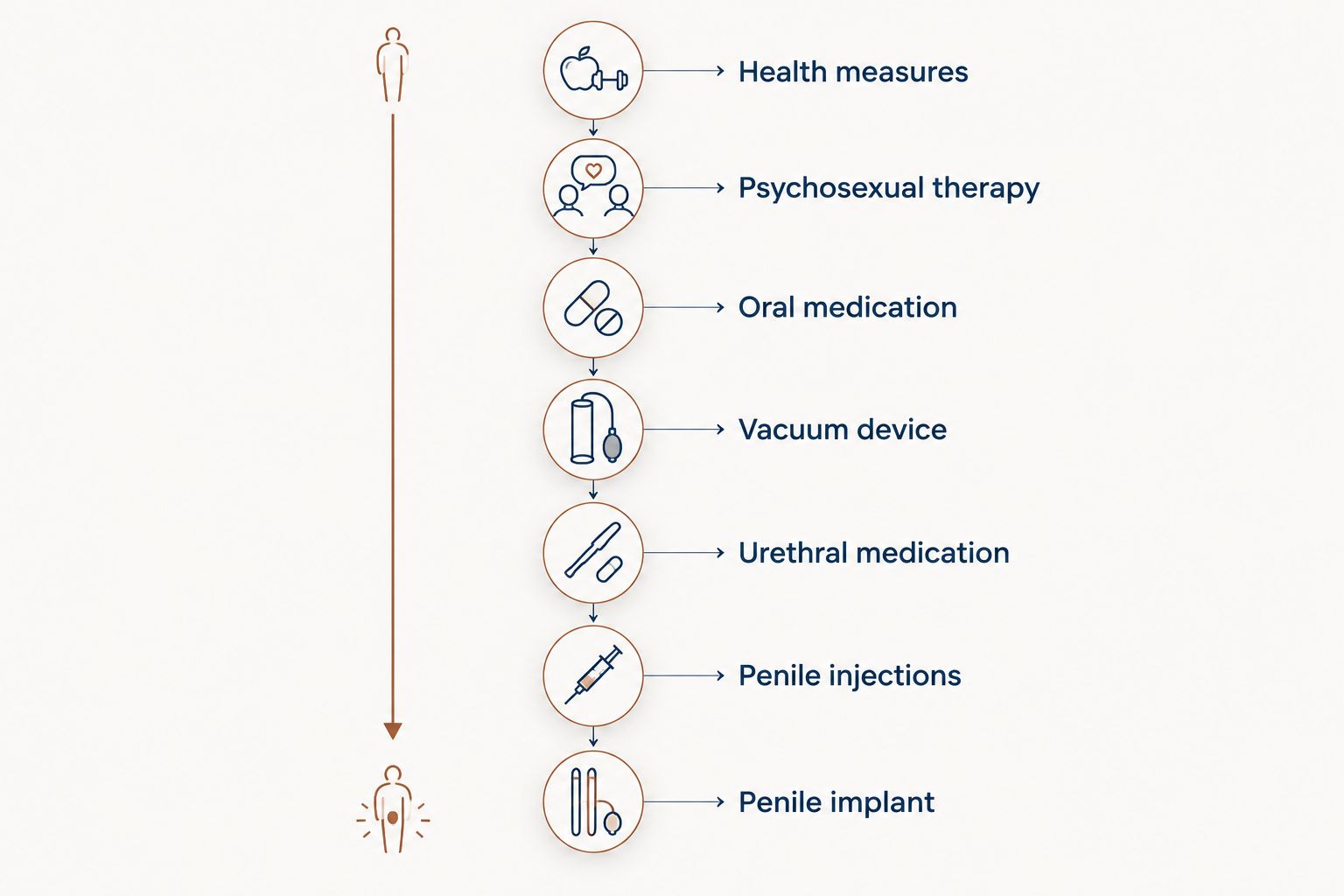
Greater physical intervention does not automatically mean a better treatment choice.
1. Health measures: best for addressing contributing conditions
Physical activity, smoking cessation, management of diabetes or high blood pressure, and review of contributing medicines belong in ED care. These measures address health factors associated with erection problems, but they are not a promise that erections will return without additional treatment.
Health measures pros:
- No insertion, injection, or surgery.
- Addresses health beyond sexual function.
- Can continue alongside other ED treatments.
Health measures cons:
- Improvement is not immediate or assured.
- Does not replace evaluation of persistent symptoms.
Best for: Men with modifiable health factors or medicines that warrant review.
Do not stop a prescribed medicine because you suspect it affects erections. Ask the prescribing clinician whether an alternative is appropriate.
Verdict: Hold off on treating lifestyle changes as a guaranteed cure; include them in the care plan.
2. Psychosexual therapy: best for performance anxiety
Psychosexual therapy addresses performance anxiety, distress, relationship difficulties, and patterns that interfere with arousal. Physical and psychological contributors often coexist; a referral does not mean your symptoms are imaginary.
Psychosexual therapy pros:
- No medication or physical procedure.
- Addresses fear and avoidance around intimacy.
- Can complement medication or a device.
Psychosexual therapy cons:
- Requires participation and discussion of sensitive concerns.
- Does not directly repair vascular or nerve injury.
Best for: Men whose erection difficulties involve anxiety, relationship strain, or distress.
A clinician can help determine whether individual therapy, couples work, or a combined medical approach fits your situation. You do not need to choose between taking physical symptoms seriously and addressing anxiety.
Verdict: Hold off on dismissing counseling when anxiety is part of the problem.
3. Oral medication: best for a nonprocedural medication trial
Sildenafil and tadalafil are phosphodiesterase type 5 inhibitors, often called PDE5 inhibitors. They support the erection response to sexual stimulation; they do not create desire or automatically produce an erection.
Oral medication pros:
- Avoids needles and local insertion.
- Does not require an external erection device.
- Offers different prescribing schedules depending on the medicine.
Oral medication cons:
- Must not be combined with nitrate medicines or recreational nitrites.
- Can cause headache, flushing, indigestion, or other adverse effects.
Best for: Men whose medical history and current medicines permit a PDE5 inhibitor.
Apparent treatment failure deserves a review of instructions, sexual stimulation, timing, and the prescribed regimen—not unsupervised dose increases. Tell your clinician about alpha-blockers and every other prescription or supplement you use.
Verdict: Hold until medication interactions and cardiovascular suitability are reviewed.
4. Vacuum device: best for a drug-free mechanical option
A vacuum erection device uses a cylinder and suction to draw blood into the penis. A constriction ring can help maintain the erection after the cylinder is removed.
Vacuum device pros:
- Avoids systemic erection medication.
- Requires no tissue puncture or surgery.
- Can be used when a prescriber recommends avoiding oral ED drugs.
Vacuum device cons:
- Requires preparation and comfort with the equipment.
- Can cause bruising, discomfort, or an unnatural-feeling erection.
Best for: Men who prefer a mechanical approach or cannot use oral medication.
Follow the device instructions and your clinician's guidance. Do not leave a constriction ring in place longer than 30 minutes. Ask about suitability if you take blood thinners or have a bleeding disorder.
Verdict: Hold until you understand safe device use and ring removal.
5. Urethral medication: best for selected men avoiding injections
Intraurethral alprostadil delivers medication through the opening of the urethra. It avoids a penile needle but still involves local administration and requires specific instructions.
Urethral medication pros:
- Avoids surgery and penile injection.
- Delivers medication locally.
- Provides another route when oral treatment is unsuitable.
Urethral medication cons:
- Can cause urethral burning, pain, or minor bleeding.
- Requires careful administration and individualized safety advice.
Best for: Selected men who want a local medication approach without injecting erectile tissue.
Discuss prolonged-erection precautions, relevant urethral conditions, and partner precautions with the prescriber. Do not assume that instructions for one formulation apply to another.
Verdict: Hold for a prescribing assessment and administration training.
6. Penile injections: best when oral treatment is unsuitable
Penile injections place medication into erectile tissue. Alprostadil is one option; compounded combinations such as Trimix contain multiple medicines and require prescription-specific dosing instructions.
Penile injection pros:
- Acts directly in erectile tissue.
- Provides an alternative when pills are unsuitable or ineffective.
- Avoids implant surgery.
Penile injection cons:
- Requires needle use, technique training, and safe disposal.
- Can cause pain, bruising, scarring, or a prolonged erection.
Best for: Men willing to learn injection technique after a clinician reviews suitability.
Compounded Trimix is not FDA-approved as a finished combination product. Concentrations differ, so never copy another person's dose or syringe instructions. Blood thinners and any concurrent ED medication must be discussed before treatment.
An erection lasting 4 hours requires emergency medical care. Obtain a written action plan rather than improvising at home.
Verdict: Hold until supervised training and a clear emergency plan are in place.
7. Penile implant: best for an informed surgical choice
A penile implant places a device inside the penis to create rigidity. Inflatable and malleable designs have different handling requirements; a urologist explains the choices, operation, and recovery.
Penile implant pros:
- Does not depend on taking medication before each encounter.
- Provides a mechanical way to create rigidity.
- Offers an option when other treatments are unacceptable or unsuccessful.
Penile implant cons:
- Requires surgery, with infection and device-related risks.
- Permanently changes erectile tissue and can require revision surgery.
Best for: Men who understand the surgical trade-offs and prefer an implant after specialist counseling.
An implant addresses rigidity, not every aspect of sexual function. Discuss expectations for sensation, orgasm, penile appearance, and partner concerns before deciding.
Verdict: Hold until a urologist has explained alternatives and irreversible changes.
How these options were ranked
This 2026 guide ranks treatment by physical intrusion: no local intervention, external support, urethral delivery, tissue injection, then surgery. It does not rank success rates or prescribe a mandatory treatment sequence.
The clinical framework follows the American Urological Association's erectile dysfunction guidance: discuss appropriate options through shared decision-making, including burdens and benefits. Safety points also reflect FDA prescribing information and established patient guidance on ED medicines and devices.
Which ED treatment should you choose?
For an undecided man, start with an assessment—not the most invasive option. Oral treatment is a common medication starting point when safe; a vacuum device is a reasonable discussion when you prefer to avoid medication.
Bring your medicine list, relevant surgery history, and a description of when symptoms occur. The guide to preparing for a private ED conversation can help you organize that appointment.
For men in St. Louis and Metro East Illinois, Mensmedicalinstitute offers physician-led ED treatment with individualized judgment. Call 314-394-1660 if you would like to discuss an assessment. Ask what the evaluation includes, what follow-up involves, and which charges are separate before agreeing to care.
Discuss your next step
Ask about an ED assessment and what to bring to your appointment.
FAQ
What's the least invasive ED treatment?
Health measures and psychosexual therapy involve no local procedure or erection-specific medication. They address contributing factors, but some men also need medication, a device, or specialist treatment.
Are pills less invasive than a vacuum device?
Both avoid piercing tissue, but they work differently. Pills have systemic drug effects and interactions; a vacuum device uses external suction and can cause local discomfort or bruising.
Do I have to fail every ED treatment before discussing an implant?
No. A urologist can discuss an implant alongside other appropriate options through shared decision-making. Surgery requires a clear understanding of risks, alternatives, and permanent tissue changes.
Is Trimix safer than sildenafil?
Neither is universally safer. Sildenafil has important drug interactions, while Trimix involves injection risks, prescription-specific dosing, and the possibility of a prolonged erection.
Can I combine ED pills with penile injections?
Do not combine ED pills and penile injections without explicit instructions from your treating clinician. Combining treatments can increase prolonged-erection risk and requires a written prescribing plan.
Does testosterone replace ED treatment?
Testosterone is not a general substitute for ED treatment. Testosterone therapy requires an appropriate diagnosis, and erection difficulties can persist even when testosterone deficiency is treated.
When is an erection a medical emergency?
An erection lasting 4 hours requires emergency medical care. Seek help promptly rather than waiting for a routine appointment or trying unprescribed remedies.
One last thing
A firm erection and sexual desire are different treatment goals. Before your 2026 appointment, write down whether the main concern is firmness, desire, ejaculation, pain, or anxiety; that distinction helps keep treatment focused on the problem you actually want addressed.