TriMix injections and blood thinners: what to tell your clinician

Taking a blood thinner does not automatically rule out TriMix injections, but your prescribing clinician must assess your bleeding risk before you use them. For your 2026 medication review, disclose every prescription, over-the-counter medicine and supplement, and do not stop a blood thinner on your own to make an injection seem safer.
TL;DR
- TriMix injections require an individual bleeding-risk review when you take anticoagulants or antiplatelet medicines.
- Never skip a prescribed blood thinner without instructions from the clinician managing it.
- An erection lasting 4 hours is an emergency, even without pain.
- Men's Medical Institute offers physician-led ED care for men in St. Louis.
Why this matters
An injection can cause bleeding or bruising where the needle enters the penis. Medicines that reduce clotting can make that bleeding harder to stop; the reason you take those medicines also matters when your clinician considers treatment.
Your goal is not simply permission to inject. You need clear instructions about whether injections fit your health history, how to manage the injection site and when to seek help. If discussing erections feels uncomfortable, this guide to preparing for a private ED conversation helps you organize the visit.
Can you use TriMix injections while taking blood thinners?
Some men taking blood thinners can use penile injections under clinical supervision. The decision depends on your medicine, bleeding history, injection training and overall health—not on the treatment name alone. A blood thinner is neither an automatic rejection nor a reason to proceed without assessment.
Use this sequence before starting treatment or after a medication change:
- List medicines. Bring the names, doses, schedules and reasons for every medicine you take.
- Explain bleeding. Describe previous prolonged bleeding, large bruises, a bleeding disorder or an injection-site problem.
- Review technique. Ask the prescriber to teach or reassess injection placement and pressure afterward.
- Confirm instructions. Get a written plan for bleeding, prolonged erections and contact outside office hours.
A previous uneventful injection does not establish that the next injection is appropriate after your medicines change. Tell the injection prescriber when another clinician starts, stops or adjusts an anticoagulant or antiplatelet medicine.
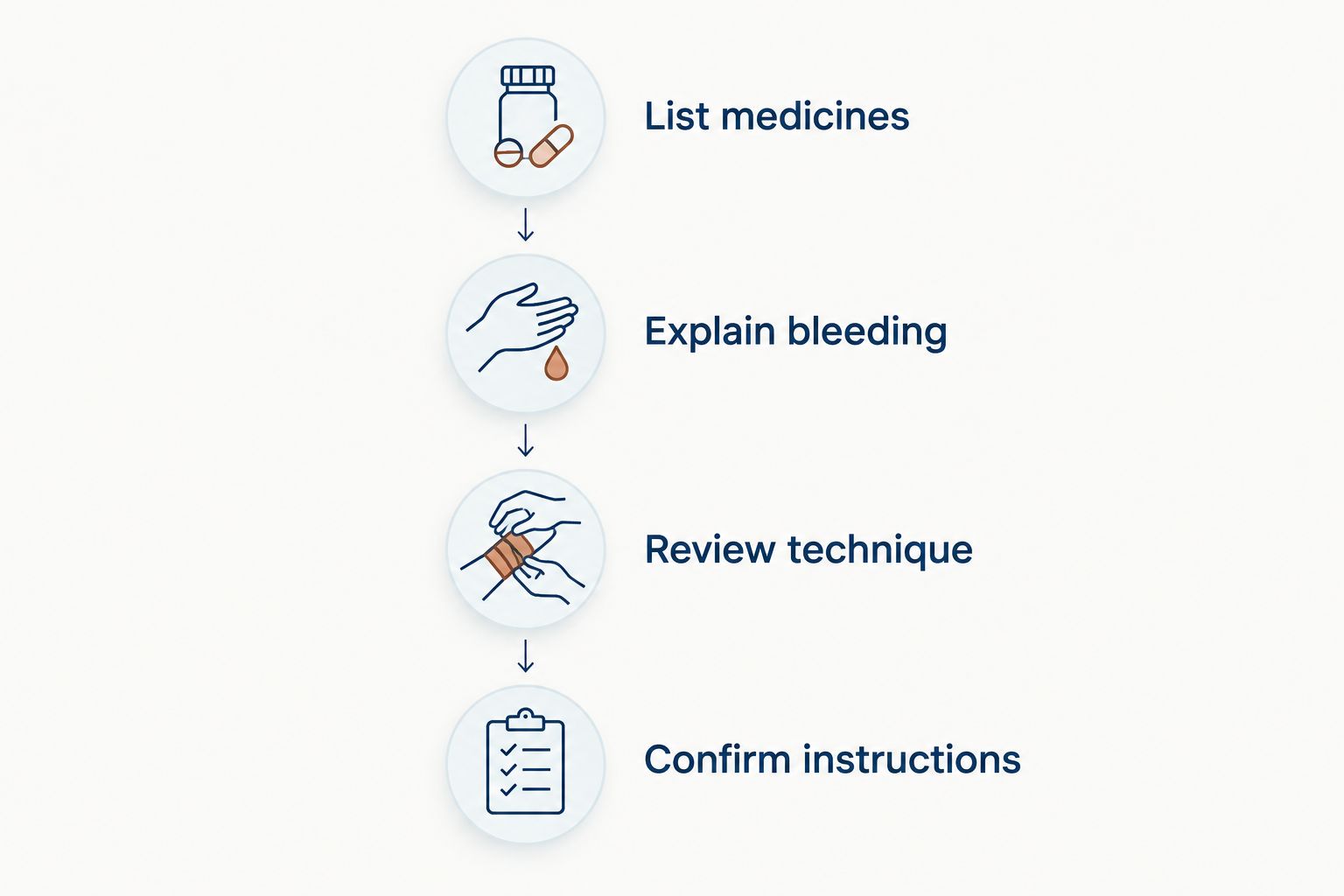
Medication review and a written safety plan belong before the injection.
Which medicines should you tell your clinician about?
Bring an updated medication list to your 2026 appointment, including medicines you take only occasionally. The term blood thinner covers different treatments, and your clinician needs the actual names rather than a general description.
| Medicine group | Examples to disclose | Main benefit | Concern for injection planning |
|---|---|---|---|
| Anticoagulants | Warfarin, apixaban, rivaroxaban, dabigatran, edoxaban, heparin or enoxaparin | Treat or help prevent harmful blood clots when prescribed for an appropriate condition | Can prolong bleeding after a needle puncture |
| Antiplatelet medicines | Aspirin, clopidogrel, prasugrel or ticagrelor | Reduce platelet-driven clotting in conditions such as coronary artery disease | Can increase bleeding or bruising at the injection site |
| Nonsteroidal anti-inflammatory medicines | Ibuprofen or naproxen | Treat pain and inflammation | Can add bleeding risk, particularly alongside blood thinners |
| Supplements and nonprescription products | Bring every product label | Benefits and reasons for use vary by product | Some products affect bleeding or interact with prescribed medicines |
These are disclosure categories, not alternatives to choose between. The best medicine for preventing a clot is determined by the condition being treated, not by convenience for ED injections.
Tell your clinician if you take aspirin and an anticoagulant together, or if different specialists prescribe your medicines. Do not assume the injection prescriber can see every outside prescription, recent hospital instruction or nonprescription purchase.
What details belong in your medication review?
A useful list explains how you actually take each medicine. Include missed doses and recent changes without embarrassment; an accurate account supports safer decisions.
For your 2026 review, record:
- Medicine and dose: Copy the name and strength from the current label.
- Schedule: Note when you take it and whether the schedule recently changed.
- Reason for treatment: Examples include atrial fibrillation, a previous blood clot, a mechanical heart valve or a coronary stent.
- Prescribing clinician: Identify who manages the medicine and how to contact that office.
- Relevant monitoring: If you take warfarin, bring your latest INR result and the target range your clinician gave you.
- Previous reactions: Describe prolonged bleeding, unusual bruising or prior injection problems.
An INR result helps clinicians monitor warfarin; it is not a general measure of the effect of every blood thinner. Do not use a normal INR as permission to inject while taking a different anticoagulant.
Also disclose other ED treatments. Combining penile injections with oral ED medicines requires explicit prescribing instructions because the combination can increase the risk of a prolonged erection.
Why bleeding risk varies
No single rule about blood thinners fits every man using penile injections. Your clinician needs to consider both the chance of bleeding and the consequences of changing treatment that protects you from a clot.
The main factors to discuss are:
- The medicine involved. Anticoagulants and antiplatelet medicines affect clotting in different ways.
- Combined treatments. Multiple medicines that affect bleeding require attention, including nonprescription pain relievers.
- Your bleeding history. Previous prolonged bleeding or a diagnosed bleeding disorder changes the discussion.
- Kidney and liver health. These conditions can affect clotting or the handling of certain medicines.
- Injection technique. Placement, repeated punctures and pressure afterward affect local bleeding.
- Recent health changes. Surgery, hospitalization, a new clot or a new prescription can make an older instruction sheet insufficient.
There is no reliable personal risk estimate from a medication name alone. A clinician must connect the medicine with your health history and the proposed injection plan.
How long should you hold pressure after an injection?
UCSF Health's patient education on penile injections advises 5 minutes of pressure after injection, or 10 minutes for people taking blood-thinning medicines. These are general aftercare instructions, not clearance to use injections or a substitute for your own prescriber's plan.
Ask your clinician to demonstrate where and how firmly to press. Use steady pressure at the injection site as taught, rather than repeatedly lifting your finger to check it.
If you take a blood thinner, confirm whether your clinician wants a longer period based on your situation. Do not assume bleeding that continues after the recommended pressure period is harmless.
Before leaving the appointment, be able to answer these questions:
- Where exactly should I apply pressure?
- What should I do if bleeding continues?
- Which bruising changes require a call?
- Who should I contact if the office is closed?
Do not repeat an injection because bleeding made you uncertain whether the dose went in. Contact the prescriber for instructions instead of guessing.
When does bleeding need medical attention?
A small bruise can occur after a penile injection. Persistent bleeding, an enlarging swelling or substantial pain needs prompt clinical assessment, particularly when you take a blood thinner.
Contact the prescribing team promptly if bleeding does not stop with the instructed pressure, bruising keeps spreading or a firm swelling develops. Seek emergency care for uncontrolled bleeding, rapidly increasing swelling, fainting or severe pain.
Describe what happened plainly: the medicine injected, when you injected it, the blood thinner you take and how the symptoms changed. Bring your medication list if you need urgent care.
Do not independently stop the blood thinner in response to bruising. The clinician managing that medicine must weigh the bleeding against the reason you need clot protection.
What if an erection lasts too long?
An erection lasting 4 hours is an emergency, even if it is not painful. The American Urological Association and Sexual Medicine Society of North America identify prolonged ischemic priapism as a condition requiring urgent treatment because delayed care can damage erectile tissue.
Your injection prescriber should give you an earlier action plan for a persistent erection. Follow that plan, but do not let an unanswered message or an attempted home remedy delay emergency care at 4 hours.
Tell emergency staff that you used a penile injection and that you take a blood thinner. Both facts matter to assessment and treatment.
Do not take an extra injection, and do not improvise with oral medicines to reverse the erection. Ask about a rescue plan before treatment begins, especially if you have heart disease or take medicines that affect blood pressure.
Should you stop your blood thinner before TriMix injections?
Do not stop a prescribed blood thinner unless the clinician managing it gives you specific instructions. Interrupting anticoagulant or antiplatelet treatment can expose you to the very clotting problem it was prescribed to prevent.
Skipping a dose also does not create a predictable safe window for an injection. Different medicines remain active for different lengths of time, and kidney function or other health factors can affect that timing.
Ask the injection prescriber and the blood-thinner prescriber to coordinate when instructions are unclear. A useful question is: Who is responsible for the final plan, and where will it be documented?
What should you ask at a St. Louis ED appointment?
For a 2026 ED appointment, bring your medication list and ask whether penile injections fit your situation before discussing a dose. The consultation should address the man behind the medication list, including your goals, comfort with injections and ability to follow the safety plan.
Men's Medical Institute is an option for men in St. Louis seeking physician-led ED care. Men in St. Louis and Metro East Illinois can use the visit to discuss treatment choices without assuming injections are the necessary next step.
Ask directly:
- Is an injection appropriate with my current medicines and bleeding history?
- Who will teach me the technique and check that I understand it?
- Which symptoms mean I should call, and which mean emergency care?
- Who coordinates with the clinician prescribing my blood thinner?
- What follow-up is needed before any change in treatment?
If you would like to discuss ED care at Men's Medical Institute, call 314-394-1660. You do not need to decide on an injection treatment before asking questions.
FAQ
Can I use TriMix injections if I take Eliquis or Xarelto?
Taking apixaban or rivaroxaban does not automatically exclude penile injections, but you need an individual bleeding-risk assessment. Do not skip doses to prepare for an injection unless the clinician managing your anticoagulant specifically directs it.
Does daily aspirin count as a blood thinner for TriMix?
Yes. Aspirin affects platelet function and belongs on the medication list you give your injection prescriber. Disclose it even if you buy it without a prescription.
How long should I press after a penile injection if I take blood thinners?
UCSF Health's general patient instructions advise 10 minutes of pressure for people taking blood-thinning medicines. Ask your prescriber to demonstrate the technique and confirm the instructions for your situation.
Should I skip warfarin before a TriMix injection?
No—not unless the clinician managing your warfarin specifically instructs you to do so. Bring your latest INR result and discuss the injection plan with both prescribers.
When should I go to the emergency room after a TriMix injection?
An erection lasting 4 hours requires emergency care, even without pain. Uncontrolled bleeding, rapidly increasing swelling, fainting or severe pain also requires emergency assessment.
What should I bring to an ED appointment in 2026?
Bring your current medication list, supplement labels, relevant monitoring results and a description of previous bleeding or injection problems. Include the name of the clinician who manages your blood thinner.
One last thing
A safe injection plan needs a name beside each responsibility. Know who manages your blood thinner, who answers injection questions and where you should go when waiting is unsafe.
Keep those instructions with your medication list rather than relying on memory. This article provides general education, not individual medical advice; your prescribing clinicians must determine whether injections are appropriate for you.