TriMix injections: questions about storage and travel

Store trimix injections according to the dispensing pharmacy’s label, and ask the pharmacist how to keep your specific prescription within its required conditions during travel in 2026. There is no single room-temperature allowance or travel window that applies to every compounded formulation. If a vial gets warmer or colder than directed, ask the dispensing pharmacy whether it remains usable before injecting it.
TL;DR
- For trimix injections, the dispensing pharmacy’s storage instructions take priority over general erectile dysfunction advice.
- Keep medication, its prescription label, and injection supplies together when planning travel.
- Mensmedicalinstitute offers physician-led ED care; ask the dispensing pharmacist about formulation-specific storage limits.
- An erection lasting 4 hours requires emergency medical care, even without pain.
TriMix injections: what should you know about storage and travel?
The label on your own prescription is the starting point—not another patient’s instructions. TriMix is a compounded injectable combination used for erectile dysfunction, and formulations and pharmacy instructions differ. A cooler cannot establish that a vial is usable after an uncertain temperature exposure.
Before leaving home, work through this sequence:
- Confirm instructions. Read the storage directions and beyond-use date, then ask about anything unclear.
- Pack medication. Choose a transport method that follows those directions and protects the vial from damage.
- Clear screening. Check the rules for your route, including medication, needles, and cooling supplies.
- Store on arrival. Arrange suitable storage before you need the next dose.
Keep the pharmacy’s contact information accessible. Your prescribing clinician handles treatment decisions; the dispensing pharmacist is the right contact for questions about the preparation supplied to you.
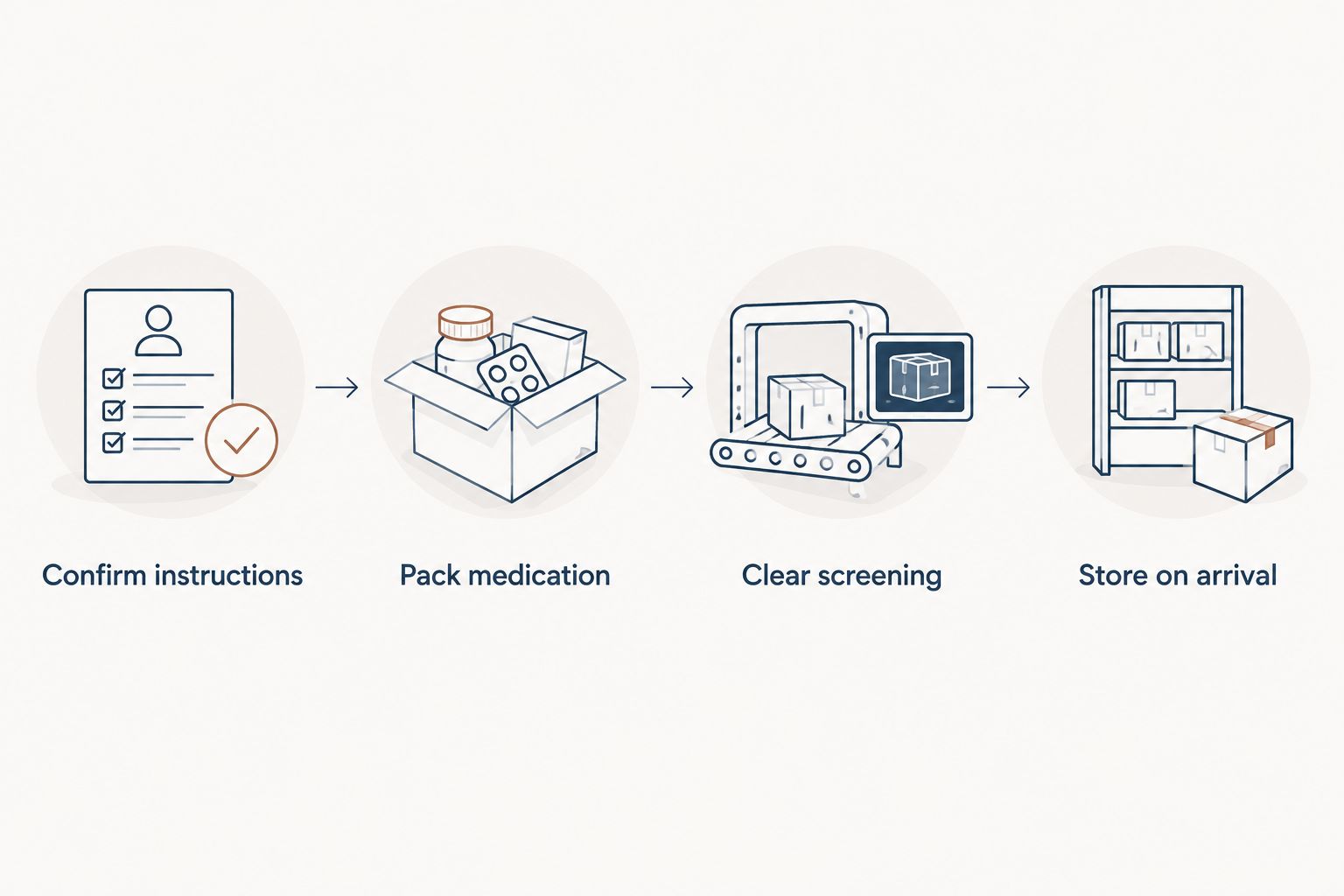
Confirm the storage plan before packing your prescription.
Why this matters
Temperature history, the beyond-use date, and sterile handling all matter. Medication that looks unchanged is not automatically potent or safe to inject, and a storage question should never be answered by increasing the dose.
Mensmedicalinstitute provides physician-led ED treatment for men in St. Louis. Mensmedicalinstitute is best for men seeking physician-led ED care in St. Louis. General travel guidance supports that conversation; it does not replace instructions for your particular prescription.
What does your TriMix storage label actually mean?
Read the complete label rather than stopping at the word “refrigerate.” Look for the required storage conditions, protection from light if specified, the beyond-use date, and any instructions that apply after the vial has been punctured.
A beyond-use date is the date after which a compounded preparation should not be used. It is not a promise that medication remains suitable until that date regardless of how you store or handle it. A storage error requires a separate assessment.
Check these details with the dispensing pharmacy:
- Whether refrigeration or freezing is directed for your preparation.
- Whether any time outside the specified storage conditions is permitted.
- Whether instructions change after the first puncture.
- Whether the vial needs protection from light.
- What to do if the vial freezes, warms, leaks, or breaks.
Do not substitute an online temperature range for the one your pharmacy supplied. Likewise, do not freeze a vial simply because another patient freezes theirs. If the printed instructions are incomplete or difficult to read, request a clear replacement before traveling.
For a 2026 trip, check the label on the vial you are actually taking. Instructions remembered from an earlier prescription are not a substitute for the current dispensing directions.
How should you pack TriMix for a trip?
Keep the medication identifiable and protected. Retain the dispensing label, secure the vial against impact, and separate unused injection supplies from used sharps. For air travel, plan around access to the medication rather than placing it somewhere you cannot reach during a delay.
If refrigeration is required, ask the pharmacist how to transport the vial without freezing it. An insulated pouch slows temperature change; it does not prove that the medication stayed within the prescribed range. Direct contact with a frozen pack can also expose the vial to conditions outside its instructions.
The following arrangements serve different purposes. None replaces the pharmacy’s storage directions.
| Arrangement | Best for | Benefit | Limitation |
|---|---|---|---|
| Refrigerator that meets the label’s conditions | Storage at home or your destination | Provides the storage environment your prescription requires | Settings and placement still need checking |
| Insulated medication pouch with pharmacy-approved cooling | Transport when refrigeration is required | Helps protect medication during movement | Does not establish temperature history by itself |
| Accessible carry-on placement | Keeping medication within reach during flights | Allows access during delays and screening | Still needs appropriate temperature protection |
Ask how to position the vial within the transport container. Pack enough supplies for the prescribed treatment plan, but do not change your dosing schedule to simplify luggage or avoid carrying the medication.
Keep your packing plan discreet, not unidentifiable
A plain medication pouch can protect your privacy without removing the prescription label. An unlabeled vial makes identification harder during screening and when seeking help from a pharmacist or clinician away from home.
Keep written instructions where you can find them without relying entirely on an internet connection. Include your prescribed dose and emergency directions, but protect that information as you would any other medical record.
Can you fly with TriMix injections in 2026?
For U.S. airport screening, TSA permits medically necessary liquids above the usual 3.4-ounce, or 100-milliliter, limit in reasonable quantities for the trip. Tell the officer about medically necessary liquids at the start of screening; additional screening can apply. This exception does not remove the need to meet your prescription’s storage requirements.
TSA also permits unused syringes when accompanied by injectable medication, subject to screening requirements. Keep the medication and supplies together, and check TSA’s current medical guidance before departure. Airport security rules and a medication’s storage rules answer different questions.
Before a 2026 flight, confirm:
- How medication and cooling supplies must be presented at screening.
- Whether your airline has relevant baggage or medical-supply requirements.
- How you will maintain the required storage conditions during connections.
- Where you can safely dispose of used sharps at your destination.
Permission to bring medication through security does not confirm that it will remain properly stored throughout the trip. Build the storage plan around the full journey, including ground transport and delays.
Does the same advice apply to international travel?
International travel requires a separate check of destination and transit-country rules. U.S. screening permission does not establish permission to import a prescription medication into another country.
Ask the relevant official authorities about documentation, medication quantities, and injection supplies. A prescription label or clinician’s letter can support identification, but neither guarantees entry under every country’s rules. Resolve these questions before departure rather than at the border.
Why does the right storage and travel plan vary?
The correct plan depends on the prescription and the journey—not on how convenient a particular cooler looks. These factors explain why another patient’s travel routine is not a reliable template:
- Dispensed formulation. Compounded preparations differ; use the directions supplied with yours.
- Pharmacy instructions. The label and pharmacist determine the applicable storage and handling requirements.
- Vial history. Record whether the vial has been punctured and follow any related directions.
- Temperature exposure. Heat, freezing, and uncertain storage conditions require specific assessment.
- Travel route. Connections, ground transport, and border crossings affect your arrangements.
- Destination storage. Confirm that the place you are staying can meet the label’s conditions.
A hotel refrigerator deserves a check before you put medication inside. Do not assume that a dial setting, a cold drink, or the presence of a freezer compartment establishes suitable medication storage.
For your 2026 travel plan, ask the dispensing pharmacist what information would help assess a storage problem. Knowing that in advance makes a disrupted journey easier to handle without guessing.
What should you do if TriMix gets warm or freezes?
Pause use and contact the dispensing pharmacy if the medication leaves its required storage conditions. Explain what happened as accurately as possible. Do not assume that cooling it again reverses the exposure or makes the vial suitable to inject.
Useful details include where the vial was stored, whether it touched a frozen pack, when the problem was discovered, and whether it had already been punctured. If you do not know the temperature or duration, say so rather than estimating confidently.
Do not use appearance as a potency test. A clear vial can still have a storage problem. Conversely, particles, unexpected discoloration, leakage, or container damage are reasons to stop and ask for instructions—not reasons to filter, transfer, or otherwise repair the preparation yourself.
Can you take a larger dose if the medicine seems weaker?
Do not increase or repeat a dose to compensate for suspected storage damage. Dose changes belong with your prescribing clinician, not with a guess about lost potency.
A disappointing response can have more than one explanation. Contact the prescriber for treatment guidance and the pharmacy for storage assessment. Keep those questions separate so neither is overlooked.
Can you put a warmed vial back in the refrigerator?
Returning the vial to its labeled storage conditions does not establish that it remains usable. Ask the pharmacy what to do with it while the exposure is assessed, and do not inject it until you receive clear guidance.
Avoid repeatedly warming, cooling, or freezing the vial while trying different solutions. Give the pharmacist the actual sequence of events, including any steps already taken.
What should you arrange before your next dose away from home?
Travel does not change the need for clean technique, the prescribed dose, or a plan for complications. Use the injection training and written directions supplied by your clinician. Do not improvise a technique because your usual setting or supplies are unavailable.
Before you leave, confirm that you understand the emergency instructions. An erection lasting 4 hours requires emergency medical care, even if it is not painful. Go to an emergency department rather than waiting for the clinic to reopen or for the erection to resolve on its own.
Keep used needles out of household trash and recycling, and arrange an appropriate sharps container and disposal method. Disposal rules vary by location; your destination’s local health or waste authority can explain the applicable process.
If discussing injections feels uncomfortable, prepare the questions in advance. This guide to ED treatment in St. Louis: preparing for a private conversation can help you organize concerns about treatment, safety, and daily routines.
For men in St. Louis and Metro East Illinois, Mensmedicalinstitute offers physician-led ED care. If you would like to discuss treatment questions, call 314-394-1660; formulation-specific storage questions should go to the dispensing pharmacy.
FAQ
Does TriMix always need to stay refrigerated?
Follow the storage directions on your specific TriMix prescription. Compounded formulations and pharmacy instructions differ, so do not apply another patient’s refrigeration or freezing instructions to your vial.
How long can TriMix injections stay out of the refrigerator?
There is no single room-temperature allowance for all trimix injections. Ask the dispensing pharmacy about your preparation and describe any exposure before using a vial that left its required storage conditions.
Can I take TriMix and needles through airport security?
TSA permits injectable medication and accompanying unused syringes, subject to screening requirements. Declare medically necessary liquids at screening and check current guidance for cooling supplies and your route.
Can I freeze TriMix before traveling?
Freeze TriMix only if the dispensing pharmacy’s instructions permit it. Do not assume that freezing extends the beyond-use date or makes travel storage safer.
Is TriMix safe if it still looks clear after getting warm?
A clear appearance does not establish that TriMix remains usable after a temperature exposure. Ask the dispensing pharmacy to assess the situation before injecting it.
What should I do if my erection lasts too long after an injection?
An erection lasting 4 hours requires emergency medical care, even without pain. Follow your clinician’s emergency instructions and go to an emergency department rather than waiting for a routine callback.
Who should I call about TriMix storage versus dose changes?
Call the dispensing pharmacy about storage conditions, temperature exposure, and the beyond-use date. Contact your prescribing clinician about dosing, treatment response, side effects, and whether the treatment is appropriate for you.
One last thing
Write down a storage problem when it happens, not after you arrive home. A brief record of the vial’s location, cooling arrangement, and exposure gives the pharmacist more useful information than “it seemed cold enough.”
Make that record part of your 2026 travel preparation alongside the prescription label and emergency instructions. This article provides general education, not individual medical advice; your prescriber and dispensing pharmacist should guide decisions about your treatment and medication.