ED treatments ranked by effectiveness for severe ED in 2026

Best for dependable erections after other treatments fail: a penile implant. Best nonsurgical escalation after pills fail: penile injections. Best medication-free option: a vacuum erection device. This 2026 guide from Men's Medical Institute explains how to choose the best ED treatment for severe ED without confusing effectiveness with the right first step.
TL;DR
- The best ED treatment for severe ED depends on prior treatment response, medical risks, and your preferences.
- Penile implants offer dependable mechanical erections but require surgery and permanently change erectile tissue.
- Penile injections are an effective nonsurgical option when properly used ED pills do not work.
- Men's Medical Institute provides physician-led ED treatment; this ranking is education, not an individual treatment recommendation.
Why this matters
Severe erectile dysfunction means difficulty getting or keeping an erection firm enough for sex, despite adequate stimulation. The cause matters: diabetes, vascular disease, nerve injury, medications, and psychological distress can require different treatment decisions.
The most dependable treatment is not automatically the treatment you should try first. A penile implant bypasses much of the erection process, but surgery brings lasting trade-offs. A pill is less invasive, yet it still depends on a functioning response to sexual stimulation.
For men in St. Louis and Metro East Illinois, Men's Medical Institute offers physician-led ED treatment. If discussing symptoms feels uncomfortable, use this guide to prepare for a private ED treatment conversation.
What makes the best treatment for severe ED?
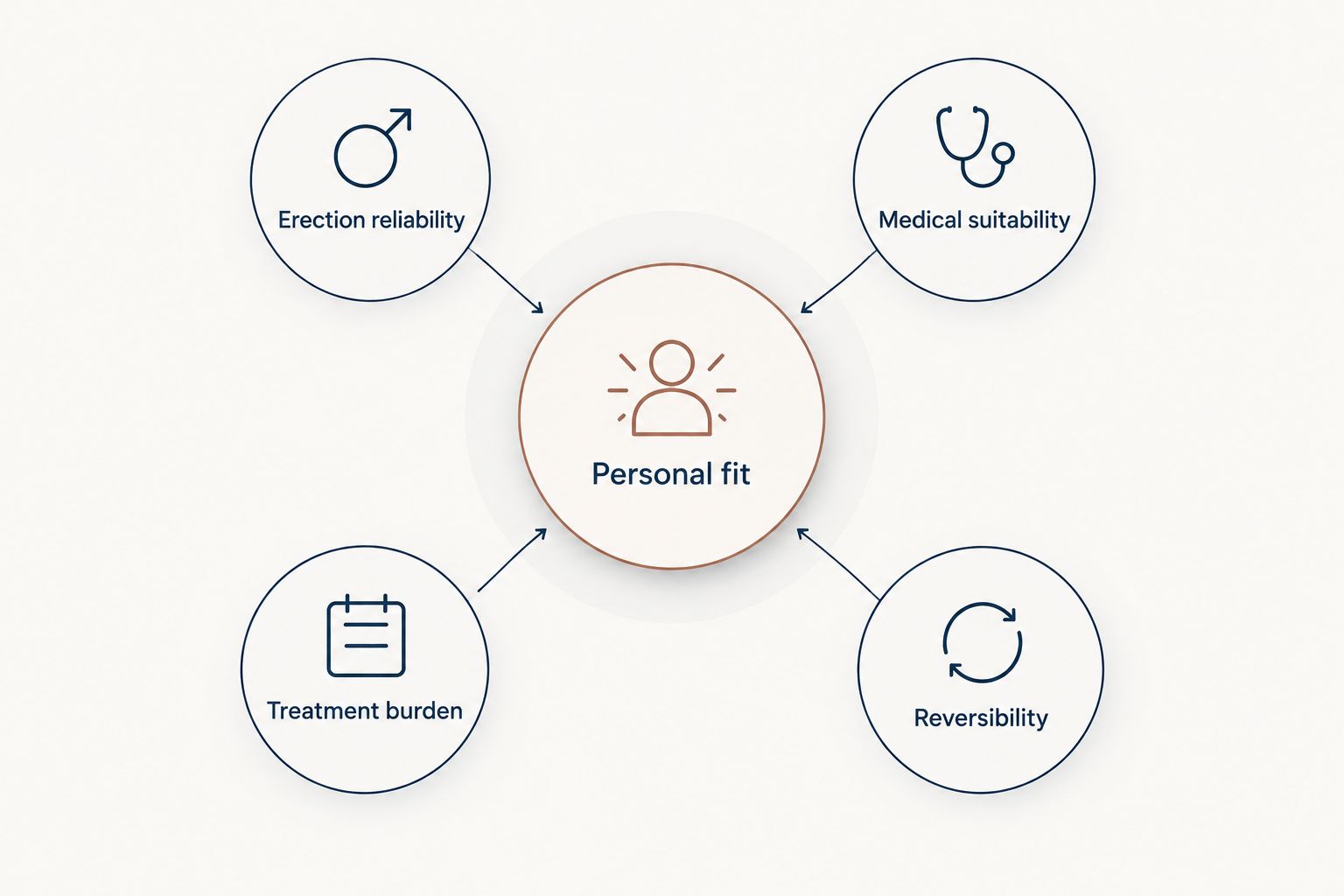
Use these criteria to assess treatment in 2026—not a promise that one option works for everyone:
- Erection reliability: Does it produce enough firmness for the sexual activity you want?
- Medical suitability: Do heart health, bleeding risk, medications, or previous surgery change the choice?
- Treatment burden: Can you comfortably manage pills, injections, a device, or surgery?
- Reversibility: Can you stop treatment without permanently changing erectile tissue?
- Personal fit: Do preparation, sensation, partner preferences, and spontaneity fit your life?
Write down your priorities before the appointment. A treatment you cannot comfortably use is not a useful answer, even when it can produce an erection.
Severe ED treatments at a glance
This ranking emphasizes dependable erections when severe ED persists. It is not a universal treatment sequence or a head-to-head success-rate table; suitability changes with the cause of ED and previous treatment response.
| Rank and treatment | Best for | Standout feature | Key limitation |
|---|---|---|---|
| 1. Penile implant | Persistent ED when other options fail or are unacceptable | Mechanical rigidity without relying on medication response | Surgery and permanent tissue changes |
| 2. Penile injections | Escalation after adequately tried pills fail | Delivers medication directly into erectile tissue | Training, needles, and prolonged-erection risk |
| 3. Vacuum erection device | Avoiding ED medication | Draws blood into the penis mechanically | Setup and a constriction ring can affect comfort |
| 4. Oral PDE5 inhibitors | An adequately supervised medication trial | No procedure or injection | Response can be inadequate in severe ED |
| 5. Intraurethral alprostadil | Avoiding penile injections when appropriate | Places medication in the urethra | Local discomfort and less reliable response than injections |
1. Penile implant: best for dependable mechanical erections
A penile implant is a surgically placed device that provides rigidity. Inflatable and malleable designs work differently; a urologist explains which design fits your anatomy, hand function, and preferences.
For severe ED that has not responded to acceptable nonsurgical treatment, an implant offers a direct mechanical solution. It does not treat low desire or guarantee satisfaction, penile length, or a particular sexual experience.
Penile implant pros:
- Does not rely on a response to ED medication.
- Avoids preparing an injection before each sexual encounter.
- Provides a treatment option after significant nerve or vascular injury.
Penile implant cons:
- Requires surgery, with infection and other operative risks.
- Permanently changes erectile tissue; returning to prior natural function is not expected.
- Mechanical problems can require another operation.
Best for: Men with persistent ED who understand the permanent trade-offs and want a surgical solution.
Verdict: Hold until a urologist has reviewed the alternatives and surgical risks. Dependability alone is not a reason to skip informed decision-making.
2. Penile injections: best nonsurgical escalation after pills fail
Intracavernosal injections deliver erection-producing medicine directly into penile erectile tissue. They can work when oral medication does not provide enough firmness, including after some nerve injuries.
Alprostadil is an FDA-approved injectable ED medicine. Trimix is a compounded combination, not an FDA-approved finished drug; its formulation and instructions require individual review.
Penile injection pros:
- Acts locally rather than depending on the same pathway as pills alone.
- Avoids implant surgery.
- Allows a clinician to adjust treatment to your response.
Penile injection cons:
- Requires hands-on training and comfort with injections.
- Can cause pain, bruising, scarring, or a prolonged erection.
- Requires exact instructions for the prescribed formulation.
Tell your clinician about anticoagulants and antiplatelet medicines. The guide to Trimix injections and blood thinners explains what to disclose; do not stop a prescribed blood thinner yourself.
Best for: Men seeking a nonsurgical option after an adequate pill trial fails.
Verdict: Hold until supervised training and a written prolonged-erection plan are complete. Never copy someone else's dose or increase yours without instructions.
3. Vacuum erection device: best medication-free option
A vacuum erection device draws blood into the penis using negative pressure. A constriction ring helps maintain the erection after the cylinder is removed.
The device does not require a medication response, which makes it a useful alternative when drug interactions or personal preferences rule out medicine. Comfort and willingness to use the equipment matter as much as obtaining initial firmness.
Vacuum erection device pros:
- Avoids systemic ED medication.
- Does not require penile injections or implant surgery.
- Can be stopped without a permanent surgical change.
Vacuum erection device cons:
- Requires preparation and correct ring use.
- Can cause bruising, discomfort, coolness, or altered sensation.
- The erection can feel different from a naturally occurring erection.
Use a medical-purpose device with a pressure limiter and follow its instructions. Ask your clinician whether bleeding risk, reduced sensation, or another condition makes use unsafe.
Best for: Men who prioritize avoiding medication and accept device-based preparation.
Verdict: Hold until you understand safe pressure and ring use. Do not assume that stronger suction produces a better result.
4. Oral PDE5 inhibitors: best for an adequate medication trial
Sildenafil and tadalafil are examples of oral phosphodiesterase type 5 inhibitors. They support the blood-flow response to sexual stimulation; they do not create sexual desire or automatically cause an erection.
An unsuccessful attempt does not establish that the entire class has failed. Your prescriber should review the prescribed dose, timing, food instructions, stimulation, and adverse effects before recommending escalation.
Oral PDE5 inhibitor pros:
- Avoids needles, devices, and surgery.
- Provides an established treatment option with different dosing approaches.
- Can fit a less procedure-focused treatment preference.
Oral PDE5 inhibitor cons:
- Can provide inadequate rigidity in severe vascular or nerve-related ED.
- Can cause headache, flushing, indigestion, and other adverse effects.
- Must not be combined with nitrates or riociguat.
Recreational nitrites, often called poppers, also create a dangerous interaction. Tell the prescriber about every prescription, supplement, and recreational substance you use.
Best for: Men who have not yet completed a medically appropriate, correctly used pill trial.
Verdict: Hold escalation until the prescriber checks whether the pill trial was adequate. Do not combine different ED pills yourself.
5. Intraurethral alprostadil: best for avoiding penile injections
Intraurethral alprostadil places medication into the urethra rather than through a needle into erectile tissue. It is an option for selected men who want a local medication approach without penile injections.
Its response is generally less reliable than intracavernosal injection therapy. For severe ED, that trade-off deserves a direct conversation rather than an assumption that avoiding a needle makes the treatments equivalent.
Intraurethral alprostadil pros:
- Avoids injection into erectile tissue.
- Does not require implant surgery.
- Offers a local medication alternative to oral treatment.
Intraurethral alprostadil cons:
- Can cause urethral burning or penile discomfort.
- Can cause dizziness and prolonged erections.
- Requires attention to administration and partner precautions.
Best for: Men who decline injections and accept a potentially less dependable local treatment.
Verdict: Hold until a clinician reviews expected benefit, administration, and precautions. A less invasive route is useful only if the result meets your needs.
How this 2026 ranking is organized
The ranking separates erection reliability from convenience and reversibility. Penile implants lead for mechanical dependability; injections are the main nonsurgical escalation discussed here; devices offer a medication-free route. Pills remain a reasonable starting point when medically appropriate, despite their lower position in this severe-ED comparison.
The clinical distinctions reflect established treatment descriptions from the American Urological Association's erectile dysfunction guideline and the National Institute of Diabetes and Digestive and Kidney Diseases' ED treatment guidance. These sources cover treatment selection, risks, and counseling—not a single comparative trial establishing this exact order.
No percentage here would tell you your individual chance of success. Cause, technique, tolerance, and the outcome you consider satisfactory all affect the decision.
Before you choose: check what the ranking cannot answer
A treatment ranking does not replace an evaluation. ED can be a sign of vascular disease, and new or worsening symptoms deserve attention beyond choosing a prescription.
Bring a 1-page medication list, previous ED treatment details, and a description of what happens: no erection, partial firmness, or loss of firmness. Include whether you have pain, curvature, reduced desire, or changes after pelvic surgery.
Testosterone treatment is not a substitute for standard ED treatment when testosterone is normal. When testosterone deficiency is suspected, diagnosis generally requires compatible symptoms and 2 separate morning testosterone measurements, interpreted with your clinical history.
For a 2026 treatment discussion, also ask about therapies advertised as restorative. Platelet-rich plasma, stem-cell treatments, and low-intensity shockwave treatment do not have the same established role as the options above; evidence and regulatory status require specific discussion. NAD+ therapy is not an established treatment for severe ED.
Which severe ED treatment should you choose?
After correctly used pills fail, discuss penile injections and a vacuum device before assuming surgery is your only choice. If those approaches fail, are unsuitable, or are unacceptable to you, ask a urologist about a penile implant.
Men's Medical Institute is a fit for men in St. Louis and Metro East Illinois seeking physician-led ED treatment. Ask which options fit your history, which require referral, and what evaluation, medication, supplies, training, and follow-up involve.
If you want help starting that conversation, call 314-394-1660. Request a clear explanation of recommended care and its separate charges before deciding.
FAQ
What's the best ED treatment for severe ED in 2026?
A penile implant offers dependable mechanical erections for persistent severe ED, but surgery is not the right first step for everyone. Penile injections are an effective nonsurgical option after adequately tried pills fail; treatment depends on your history and preferences.
Are penile injections better than Viagra for severe ED?
Penile injections can work when sildenafil, the active ingredient in Viagra, does not provide adequate firmness. Injections require training and carry risks including bruising, scarring, and prolonged erections, so they are not automatically the better choice for every man.
Can I combine Trimix with an ED pill?
Do not combine Trimix with an ED pill unless your prescriber gives you an explicit treatment plan. Combining erection medicines increases the risk of a prolonged erection, and instructions must match your exact prescription.
When does an erection need emergency care?
An erection lasting 4 hours needs emergency medical care, even if it is not painful. Follow your prescriber's earlier warning instructions as well; do not wait beyond that threshold for it to resolve.
Will testosterone treatment fix severe ED?
Testosterone is not a general treatment for severe ED when testosterone levels are normal. Men with confirmed testosterone deficiency need an individualized discussion, and some still require a separate ED treatment.
Does a penile implant restore desire and normal sensation?
A penile implant provides rigidity, not sexual desire or restored nerve function. It does not guarantee normal sensation, orgasm, or satisfaction; discuss your baseline function and expectations with the surgeon.
How should I prepare for a severe ED appointment?
Bring your medication list, medical and surgical history, and details of previous ED treatments. Men's Medical Institute provides physician-led ED treatment; call 314-394-1660 if you want to discuss arranging care in St. Louis.
One last thing
Firmness and desire are different treatment targets. If your main concern is low interest, an erection-focused treatment alone does not answer that concern. Tell your clinician which change matters most to you before choosing a treatment in 2026.
This article provides general education, not individual medical advice. Your clinician must assess safety, diagnosis, and treatment suitability.