Heart medication to testosterone therapy clearance: 2026 workflow

Instead of trying to decide whether each heart medicine is compatible with testosterone on your own, build a physician-reviewed plan that checks your medicines, cardiovascular stability, hormone results and follow-up needs together. Some men can take testosterone with heart medication, but the medication list alone does not establish that treatment is appropriate.
TL;DR
- Can you take testosterone with heart medication? Sometimes; cardiovascular stability, confirmed testosterone deficiency and medication review determine the answer.
- Mensmedicalinstitute provides physician-led testosterone care in St. Louis; bring your complete medication list and recent records.
- Never stop heart medication to start testosterone replacement therapy.
- Testosterone monitoring includes blood pressure and hematocrit, not just testosterone levels.
Why this matters
Taking a blood pressure medicine is not the same clinical situation as recovering from a heart attack. Testosterone decisions depend on the condition being treated, whether it is stable, and whether testosterone deficiency has actually been established.
Mensmedicalinstitute testosterone care is best suited to men seeking physician-led evaluation in St. Louis. The purpose of an evaluation is to decide whether treatment fits your health, not simply to obtain permission for a prescription.
At Mensmedicalinstitute, physician-led testosterone replacement therapy is part of men's medical care. For your 2026 appointment, make the goal a documented decision with clear monitoring responsibilities—not a blanket statement that testosterone is safe for everyone taking heart medication.
This guide provides general education, not individual medical advice. New chest pain, severe shortness of breath, fainting or stroke symptoms require emergency evaluation; call 911 rather than waiting for a hormone appointment.
Before you start
- Gather the actual medication list. Include names, doses, schedules, supplements, testosterone obtained elsewhere and medicines taken only when needed. Bring discharge instructions and recent cardiology notes when relevant.
- Bring the clinical background. Include available testosterone results, complete blood count, blood pressure readings and a history of heart attack, stroke, heart failure, blood clots, sleep apnea or abnormal heart rhythms. Tell the physician whether future fertility matters to you.
- Flag the easily missed medicine. Nitroglycerin carried for occasional chest pain still belongs on the list. Nitrates must not be combined with sildenafil or tadalafil; this is a separate interaction from the testosterone decision.
You do not need to order every possible test before calling. Ask which records and laboratory studies the treating physician needs so that testing matches the evaluation.
Medication reconciliation
Build a single, accurate list
- Copy each prescription from its label. Record the name, strength, amount taken and prescribing clinician. Include medicines from primary care, cardiology, urgent care and online services.
- Add nonprescription products. List supplements marketed for energy, bodybuilding or testosterone support. Include injections or hormones even if they were not prescribed.
- Mark recent changes. Explain which medicine changed, why it changed and whether symptoms followed. Do not attribute fatigue or sexual symptoms to a medicine without a clinical review.
- Ask for an interaction review. Have the prescriber or pharmacist check the proposed testosterone product against the complete list, including any planned ED treatment.
Expected result: Your clinicians have one current list, including occasional medicines, rather than conflicting versions across records.
Separate an interaction from a disease-related concern
A medicine can require monitoring without prohibiting testosterone. Conversely, the absence of a listed drug interaction does not make an unstable heart condition suitable for treatment.
| Medication group | What the review needs to address | Important limitation |
|---|---|---|
| Blood pressure medicines | Current blood pressure, symptoms and the monitoring plan | Testosterone can increase blood pressure; taking an antihypertensive does not remove that concern |
| Diuretics used for heart failure | Swelling, weight changes and heart failure stability | Testosterone can cause fluid retention |
| Warfarin | Whether closer INR monitoring is needed when testosterone starts or changes | Androgens can increase the response to oral anticoagulants |
| Nitrates, including nitroglycerin | Whether sildenafil or tadalafil is also being considered | The nitrate restriction applies to those ED medicines, not automatically to testosterone |
This table is a discussion checklist, not an interaction checker. A 2026 medication review should use the current prescribing information for the actual products involved.
Clinical assessment and treatment decision
Confirm the reason for testosterone treatment
- Describe symptoms specifically. Explain changes in sexual desire, erections, energy, sleep and physical function. Give their timing and effect on daily life.
- Complete appropriate hormone testing. Diagnosis generally requires compatible symptoms plus consistently low testosterone, confirmed with 2 separate morning blood samples. Your clinician should adapt collection timing when your sleep schedule requires it.
- Review alternative explanations. Sleep apnea, depression, thyroid disease, medication effects and other illnesses can overlap with symptoms attributed to low testosterone.
- Discuss fertility before prescribing. Testosterone treatment can suppress sperm production. A desire for future children changes the treatment discussion.
Expected result: The medical record identifies whether testosterone deficiency is established and whether other causes need attention first.
A single low result during acute illness is not a complete diagnosis. Nor does an afternoon result automatically establish the same conclusion as appropriately timed confirmatory testing.
Establish cardiovascular stability
- Describe your current symptoms. Report chest discomfort, breathlessness, fainting, palpitations, swelling and changes in exercise tolerance. Explain whether these are new or worsening.
- Identify recent cardiovascular events. Give the dates of any heart attack, stroke, hospitalization or heart failure flare. Endocrine Society guidance recommends against starting testosterone within 6 months of a heart attack or stroke and in uncontrolled heart failure.
- Request coordination when needed. Ask the testosterone prescriber to obtain relevant information from cardiology or primary care. Additional cardiac testing should follow the clinical findings, not an automatic package for every man.
- Record the decision and its conditions. Ask whether treatment can proceed, needs more evaluation or should be deferred. Document what must change before reconsideration.
Expected result: You understand the reason for the decision and which clinician owns the next action.
A cardiology opinion helps answer cardiovascular questions; it does not replace the testosterone prescriber's assessment of diagnosis, blood counts, fertility and other contraindications. The guide to coordinating testosterone therapy with primary care explains why shared records matter.
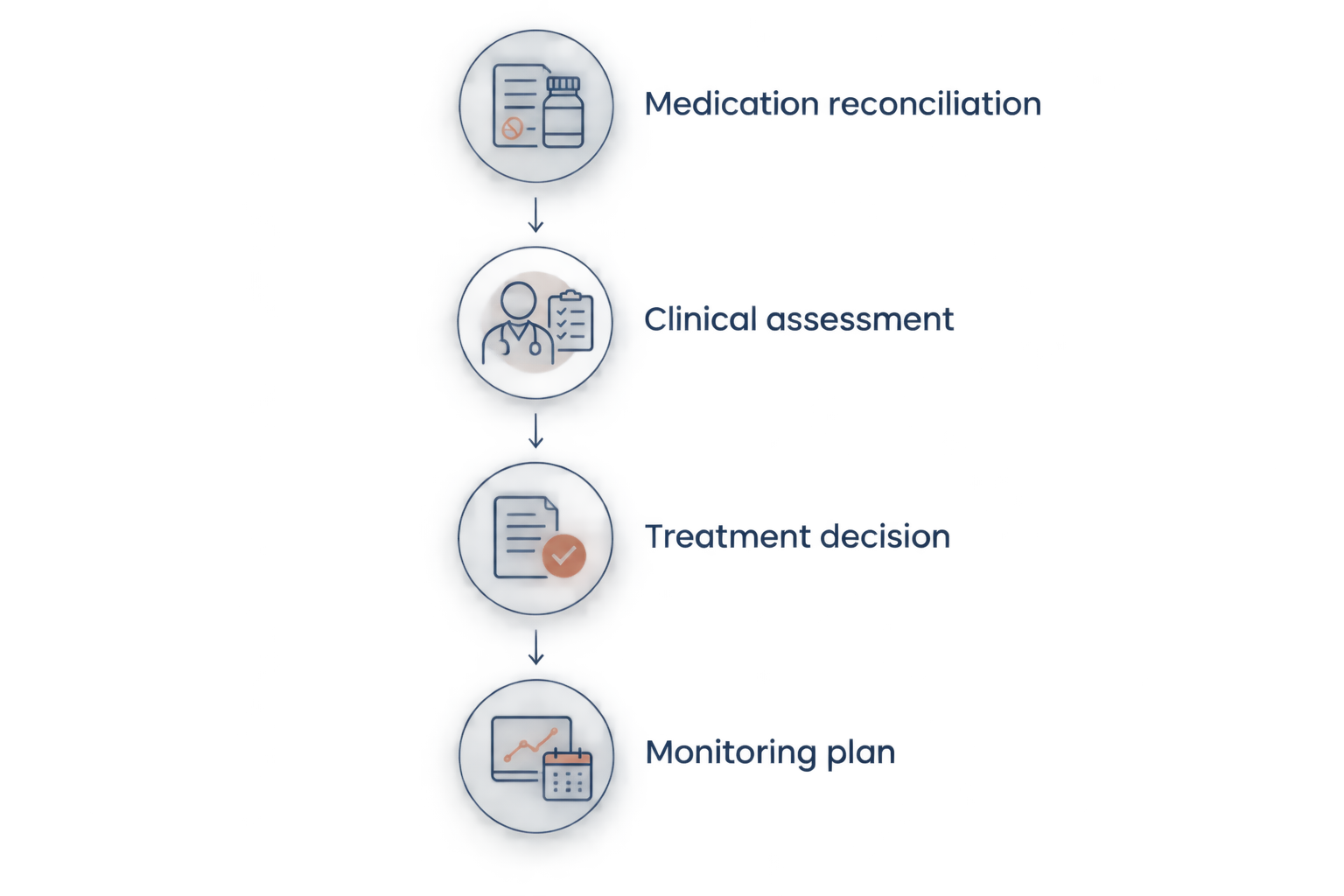
A medication check is one part of the decision, not a substitute for the full assessment.
Monitoring plan
Assign follow-up before the first dose
- Confirm baseline measurements. Ask about blood pressure, complete blood count and hematocrit, testosterone testing, and prostate assessment when appropriate for your age and risk.
- Write down the laboratory schedule. Endocrine Society guidance includes hematocrit assessment at baseline, after 3–6 months and then annually. Your physician can require closer follow-up based on your findings and treatment.
- Identify the response to abnormal results. A hematocrit above 54% requires clinician-directed interruption and evaluation rather than an unsupervised dose adjustment. Ask who contacts you and manages the next step.
- Set the symptom-reporting plan. Clarify whom to contact for rising blood pressure, swelling, worsening breathing, troublesome palpitations or other new symptoms. Emergency symptoms still require emergency care.
Expected result: You leave with a follow-up schedule, a responsible clinician and instructions for problems between appointments.
For your 2026 treatment plan, ask how testosterone blood sampling should relate to the prescribed formulation and dose timing. A result is harder to interpret when the clinician does not know when you last used the medicine.
The benefit is an individualized trial with measurable follow-up; the limitation is that treatment still requires ongoing safety checks and does not guarantee symptom improvement. Testosterone is not prescribed to prevent heart attacks or replace standard cardiovascular treatment.
When a heart medicine changes during testosterone treatment
Starting testosterone is not the only point that needs coordination. A new anticoagulant, worsening heart failure or a cardiovascular hospitalization calls for a fresh review rather than reliance on an old clearance note.
- Notify both prescribers. Send the changed medication list and the reason for the change. Include discharge paperwork after a hospital stay.
- Ask whether the existing plan still applies. The clinician should decide whether testosterone, laboratory timing or follow-up needs to change. Do not stop essential heart medication on your own.
- Confirm monitoring ownership. If warfarin is involved, make sure the anticoagulation clinician knows about testosterone initiation, discontinuation or dose changes.
- Replace outdated instructions. Keep the updated plan with your medication list so an old dose or monitoring schedule does not remain in circulation.
Expected result: The testosterone plan reflects your current cardiovascular condition, not just your condition when treatment began.
Keep cholesterol testing in context
A lipid profile measures cholesterol-related cardiovascular risk factors; it does not establish whether heart failure is controlled or whether testosterone is appropriate. Whether you are discussing a local blood draw or at-home lipid profile testing, the result belongs within the broader clinical assessment, not in place of it.
For a 2026 reassessment, send the laboratory report with its collection date and current medication list. A favorable cholesterol result does not cancel new chest pain, uncontrolled blood pressure or a concerning blood count.
Troubleshooting a stalled evaluation
“Cardiology said yes, but the prescription is still on hold”
Ask which specific question remains unresolved. Cardiovascular stability, confirmation of low testosterone and an elevated hematocrit are separate issues; approval of one does not settle the others.
Request a named next step, such as obtaining a missing record or repeating a correctly timed laboratory test. Avoid asking different offices for a general clearance letter when the unresolved question is specific.
“I forgot my as-needed chest pain medicine”
Update the medication list before using any newly prescribed ED medicine. If a nitrate and sildenafil or tadalafil are both involved, contact the prescriber or pharmacist for instructions; do not try to create your own spacing schedule.
If chest pain occurs after taking an ED medicine, call emergency services and tell responders exactly what you took and when. Do not self-administer a nitrate in that situation.
“My hematocrit rose, but I feel fine”
Contact the testosterone prescriber and follow the laboratory-response plan. Elevated hematocrit can require action even without symptoms; do not independently increase, reduce or restart treatment.
The clinician should assess the result and contributing factors, including possible low oxygen levels or sleep apnea. Feeling better does not replace blood-count monitoring.
“My blood pressure or swelling changed”
Record the readings or symptoms and contact the treating clinician promptly. Do not double a diuretic or change testosterone dosing without instructions.
Severe breathlessness, chest pain, fainting or stroke symptoms require emergency evaluation. A routine portal message is not an emergency pathway.
Customize your workflow
Best for men with several prescribers: Keep a shared medication list, laboratory dates and a named clinician for each follow-up task. The advantage is clearer responsibility; the limitation is that each office still needs updated information when something changes.
Best for men traveling from Metro East Illinois: Ask which records can be transferred before the appointment and which visits or tests require attendance. Do not assume that every part of care can be completed remotely.
Mensmedicalinstitute offers physician-led testosterone care for men in St. Louis. If you want to discuss what to bring to an evaluation, call 314-394-1660; an initial conversation does not commit you to treatment or replace a medical assessment.
FAQ
Can you take testosterone with heart medication?
Some men can take testosterone with heart medication after an individualized medical evaluation. The decision depends on the specific medicines, cardiovascular stability, confirmed testosterone deficiency and a monitoring plan.
Do blood pressure pills automatically rule out testosterone therapy?
No. Blood pressure treatment does not automatically rule out testosterone, but testosterone can increase blood pressure. Your clinician should review control and establish follow-up before prescribing.
Do I need a cardiologist's clearance before starting testosterone?
Not every man needs a separate cardiology clearance letter. Your testosterone prescriber should determine whether your history, symptoms or cardiovascular condition requires cardiology input.
Can I take testosterone if I use nitroglycerin?
Nitroglycerin use does not by itself answer whether testosterone is appropriate; the underlying heart condition needs assessment. Nitrates must not be combined with sildenafil or tadalafil, so disclose even occasional nitrate use.
Can testosterone affect warfarin treatment?
Yes. Androgens can increase the response to oral anticoagulants such as warfarin. The anticoagulation clinician should know when testosterone is started, stopped or changed so INR monitoring can be adjusted.
Should I stop my heart medicine before my testosterone appointment?
No. Do not stop prescribed heart medication to prepare for a testosterone appointment. Bring the complete medication list and ask the treating clinician about any necessary changes.
Does a normal cholesterol test mean testosterone is safe for me?
No. A normal cholesterol result does not establish testosterone treatment safety. The assessment also includes symptoms, cardiovascular stability, blood pressure, hematocrit and confirmation of testosterone deficiency.
One last thing
A clearance decision is a snapshot, not a lifetime permission slip. For the remainder of 2026 and beyond, tell both prescribers about hospitalizations, new heart symptoms and medication changes—even if your testosterone dose stays the same.