Does Testosterone Make You Infertile? What TRT Means for Fertility

Yes—testosterone replacement therapy (TRT) can suppress sperm production enough to cause infertility, but it does not make every man infertile or necessarily cause permanent infertility. TRT is not reliable birth control, and sperm recovery after treatment changes is variable rather than guaranteed.
TL;DR
- Does testosterone make you infertile? TRT can suppress sperm production, sometimes until no sperm are detected.
- A normal testosterone blood level does not prove normal sperm production; semen testing answers a different question.
- Discuss pregnancy plans and sperm banking before starting TRT, not after fertility becomes urgent.
- Men's Medical Institute provides physician-led testosterone care; fertility concerns require an individualized treatment discussion.
Does testosterone make you infertile?
Testosterone taken as medication can cause infertility by reducing the hormonal signals your testicles need to make sperm. That includes prescribed testosterone, not just anabolic steroid misuse. The effect varies: some men continue producing sperm, while others develop azoospermia, meaning no sperm are found in the ejaculate.
If having a biological child matters to you, use this sequence before starting or changing treatment:
- State your pregnancy plans. Tell your clinician whether you are trying now, considering children later, or uncertain.
- Review your starting point. Discuss symptoms, prior pregnancies, testicular history, medications, and whether baseline semen testing is appropriate.
- Choose care around both goals. Treating symptoms and protecting fertility require a coordinated plan, sometimes involving a reproductive urologist.
For men arranging testosterone care in 2026, coordinating with primary care helps keep prescriptions and health history in the same conversation. A fertility specialist adds a different assessment: whether sperm production supports your family-building goals.
Why this matters
Feeling better on testosterone does not tell you whether your sperm count has fallen. Libido, erections, testosterone blood levels, and sperm production are related, but they are not interchangeable measures.
That distinction matters when treatment improves sexual interest. You can feel more interested in sex while becoming less likely to cause a pregnancy, and you can still cause a pregnancy despite reduced sperm production.
TRT is neither a fertility treatment nor dependable contraception. If pregnancy is not wanted, use an established contraceptive method. If pregnancy is wanted, tell the prescribing clinician before treatment begins whenever possible.
How testosterone treatment suppresses sperm production
Your brain and testicles communicate through hormonal signals. The pituitary gland releases luteinizing hormone, or LH, and follicle-stimulating hormone, or FSH; those signals help support testosterone production inside the testicles and sperm development.
Taking testosterone from outside the body feeds back to the brain and pituitary. LH and FSH can fall, reducing the testicular environment needed for sperm production even when the testosterone level measured in your blood looks adequate.
The practical distinction is between testosterone circulating in your blood and the hormonal activity inside your testicles. Raising the first does not guarantee preservation of the second.
This is why changing from injections to a gel does not, by itself, establish a fertility-safe plan. Different testosterone preparations still supply testosterone from outside the body; your clinician must evaluate the actual treatment rather than assume that a different delivery method protects sperm.
What blood tests, semen testing, and symptoms actually tell you
A testosterone result answers a hormone question. A semen analysis examines sperm-related measures, including concentration, movement, and shape. Neither test, alone, guarantees that a couple will or will not conceive.
| Measure | Best for | Useful information | Important limitation |
|---|---|---|---|
| Testosterone blood testing | Evaluating suspected testosterone deficiency | Helps assess hormone status alongside symptoms | Does not measure sperm production |
| Semen analysis | Assessing male reproductive potential | Examines sperm in the ejaculate | Results vary and do not guarantee pregnancy |
| Libido and erections | Describing sexual symptoms | Helps your clinician understand sexual function | Normal sexual function does not prove fertility |
The American Urological Association's testosterone deficiency guideline calls for 2 separate early-morning testosterone measurements when establishing low testosterone. That diagnostic process is not a substitute for fertility assessment.
AUA/ASRM male infertility guidance also emphasizes variation between semen samples. When an initial result is abnormal, obtaining at least 2 semen samples, ideally at least 1 month apart, helps clinicians interpret the findings. Your clinician decides how that guidance applies to your situation.
For a 2026 fertility discussion, ask which question each test is intended to answer. Repeating a hormone panel cannot tell you what a semen analysis would show.
Why testosterone's effect on fertility varies
There is no single sperm-count response or recovery deadline that applies to every man. Your assessment needs to account for both the testosterone exposure and your reproductive health before treatment.
- Starting sperm production. A fertility problem can exist before TRT, even without symptoms or a previous diagnosis.
- Treatment exposure. Dose, duration, and the treatment history matter when a specialist evaluates suppression and recovery.
- Underlying diagnosis. Problems involving pituitary signaling and problems originating in the testicles require different evaluations.
- Other hormone use. Anabolic steroids and additional hormone-related medicines can complicate the picture.
- Reproductive history. Prior infertility, testicular injury, undescended testicles, surgery, or cancer treatment can affect the assessment.
- Your partner's circumstances. A partner's age and reproductive health influence how urgently a couple needs coordinated fertility care.
These factors explain why another man's experience is not a treatment forecast. A friend who conceived while taking testosterone does not establish that your prescription will preserve fertility.
What should you do before starting TRT if you want children?
Make fertility a treatment decision before it becomes a recovery problem. AUA/ASRM male infertility guidance advises against prescribing exogenous testosterone to men interested in current or future fertility. That recommendation deserves a direct discussion before you accept a prescription.
Bring your clinician a clear account of your goals, even if your answer is simply that you are undecided. You do not need to have a firm conception date to raise the issue.
Pregnancy plans
Say whether you are actively trying, planning for later, or uncertain. Include your partner in the discussion when appropriate, because fertility evaluation often needs to address both partners rather than focus only on a testosterone result.
Baseline assessment
Ask whether a semen analysis is appropriate before treatment. A baseline result can document sperm production before exposure, but it does not guarantee future fertility or remove the need for follow-up.
Sperm banking
Ask whether freezing sperm before treatment fits your goals. Sperm banking preserves a sample for possible future use; it does not guarantee a pregnancy, and future use can involve assisted reproductive care.
Treatment discussion
Ask whether the diagnosis is established and whether a reproductive urologist should help select treatment. Do not assume that a prescription marketed as fertility-friendly has been shown to preserve sperm production in your specific circumstances.
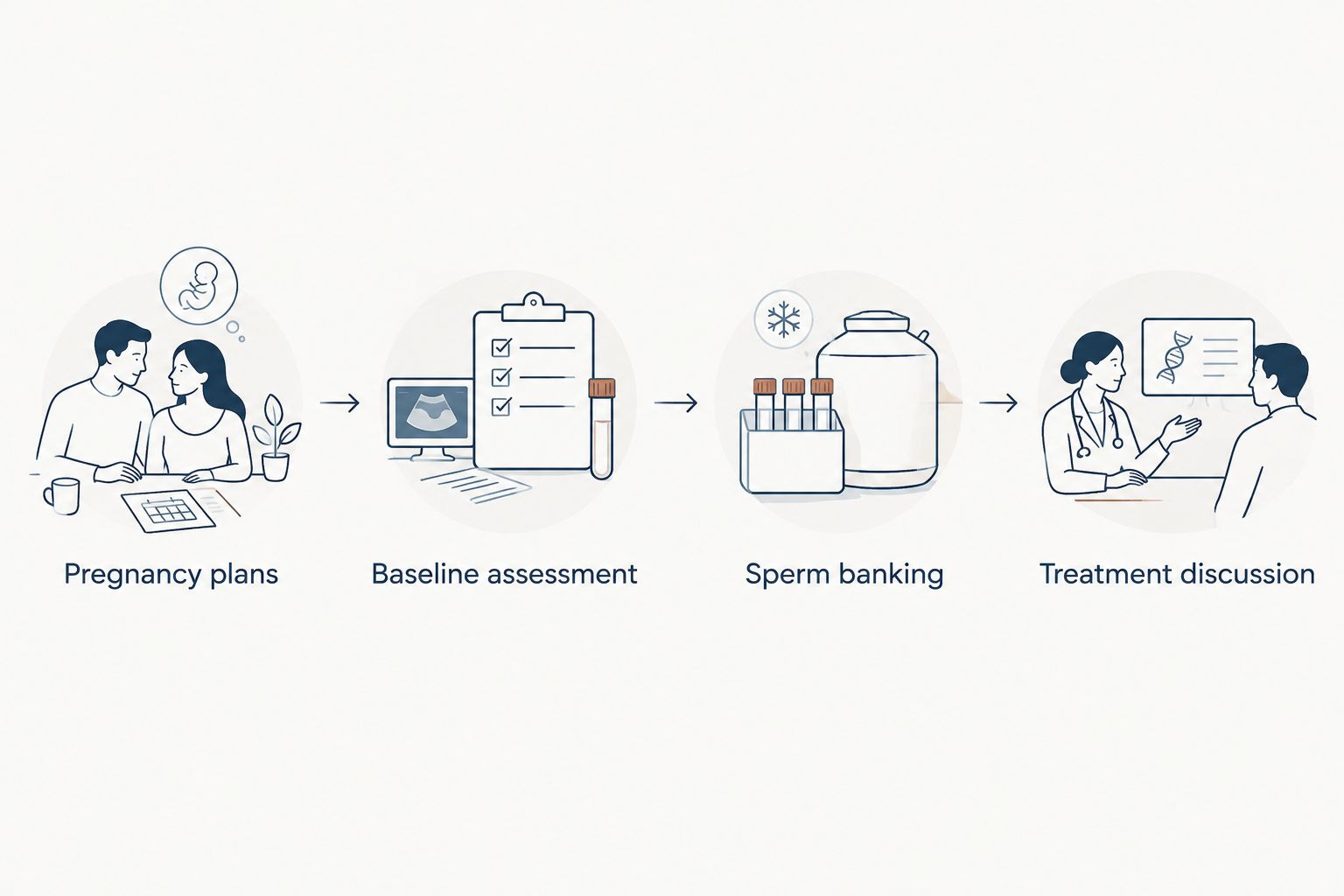
Discuss fertility before choosing a testosterone treatment plan.
Your 2026 treatment plan should record your family-building goals, not just your symptom score. Ask what finding would trigger a referral or a change in care.
Can sperm production recover after stopping testosterone?
Sperm production can recover after testosterone is stopped, but recovery is not immediate or guaranteed. The time course varies, and persistent low sperm production needs evaluation rather than an assumption that waiting will solve it.
Stopping testosterone is not the same as confirming fertility has returned. Hormone results, symptoms, and semen findings can change on different schedules; follow-up testing gives your clinician information that how you feel cannot provide.
Do not stop, restart, or adjust prescribed hormones without discussing the plan with your clinician. Symptoms can return as treatment changes, and a specialist needs your complete medication history to interpret what happens next.
If you are already trying to conceive, ask for a reproductive urology referral rather than relying on a recovery date from an online discussion. Fertility planning should account for your partner's evaluation and the couple's available time as well as your semen results.
Are there treatments for low testosterone that preserve fertility?
Selected men have treatment options that aim to support their own hormone production rather than replace testosterone directly. Specialists sometimes consider human chorionic gonadotropin, or hCG, and selective estrogen receptor modulators, or SERMs, depending on the diagnosis. These are not interchangeable medicines or suitable choices for every man.
| Approach | Best for | Potential role | Limitation |
|---|---|---|---|
| hCG | Selected men after specialist evaluation | Acts through the LH receptor to stimulate testicular testosterone production | Does not guarantee adequate sperm production or pregnancy |
| SERMs | Selected men with an appropriate hormonal pattern | Can increase the body's LH and FSH signaling | Use for male testosterone deficiency is off-label in the United States |
The potential advantage is a treatment approach that considers testicular function alongside symptoms. The limitation is that the underlying cause still determines what is likely to help; adding medication cannot guarantee fertility.
Do not add hCG or another hormone on your own to make TRT fertility-safe. A prescription combination, without appropriate assessment and monitoring, is not proof that sperm production is preserved.
What if you are already taking testosterone?
Tell the prescribing clinician about your fertility goals now, even if nobody asked when treatment started. Include testosterone obtained elsewhere, anabolic steroid exposure, supplements, and any fertility medicines.
Bring previous hormone results and semen reports if you have them. A record of the actual medication, dose, and treatment dates is more useful than saying you have been on a men's health program.
For a 2026 appointment, write down these questions:
- Is my current treatment compatible with trying to conceive?
- Do I need semen testing or a reproductive urology referral?
- What is the plan for symptom management if treatment changes?
- Which findings will guide the next decision?
- Should my partner arrange an evaluation at the same time?
Men's Medical Institute provides physician-led testosterone care for men in St. Louis who want individualized medical judgment. That care does not replace a reproductive specialist's evaluation when conception is the immediate goal.
Men in St. Louis and Metro East Illinois can call 314-394-1660 to discuss an appointment or use the contact page. Tell the team that fertility is part of your concern so it is included in the conversation.
FAQ
Does testosterone make you infertile permanently?
Testosterone can suppress sperm production, but infertility is not necessarily permanent. Recovery varies, and some men need specialist evaluation or treatment; stopping testosterone does not guarantee recovery.
Can I get my partner pregnant while taking testosterone?
Yes, pregnancy is possible while you take testosterone. Suppression is unpredictable, so TRT is not reliable birth control.
Does normal ejaculation mean I am still fertile on TRT?
No, normal ejaculation does not prove that sperm are present or that sperm production is adequate. A semen analysis assesses sperm in the ejaculate.
Are testosterone gels safer than injections for fertility?
Testosterone gels are not a reliable fertility-preserving alternative to injections. Both supply testosterone from outside the body and can suppress the signals needed for sperm production.
Will hCG guarantee that I stay fertile on testosterone?
No, hCG does not guarantee fertility during testosterone treatment. A specialist must evaluate the diagnosis and follow semen findings when fertility is a treatment goal.
Should I freeze sperm before starting testosterone?
Discuss sperm banking before testosterone if future biological children matter to you. Whether it fits your situation depends on your reproductive goals and assessment, and stored sperm does not guarantee pregnancy.
Can I have low testosterone and a normal sperm count?
Yes, a low testosterone blood result does not automatically mean a low sperm count. Hormone testing and semen analysis answer different questions.
Who should I see if I want a baby while taking TRT?
Contact your prescribing clinician and ask about evaluation by a reproductive urologist. Do not change prescribed hormones on your own, and include your partner's reproductive care in the plan.
One last thing
The amount of semen you see cannot tell you your sperm count. Much of the fluid in an ejaculate comes from glands other than the testicles, so normal-looking ejaculation is not reassurance that testosterone has left fertility unchanged.
Before accepting a reassuring answer, ask what evidence supports it: symptoms, a blood test, or an actual semen analysis. Those are different kinds of information.
Men's Medical Institute emphasizes individualized physician judgment. This article provides general education, not individual medical advice, and does not establish that testosterone or any fertility treatment is appropriate for you.