Low testosterone symptoms after anabolic steroid use

Low testosterone symptoms after anabolic steroid use include reduced sex drive, fewer spontaneous erections, fatigue, depressed mood, and reduced sperm production because external androgens can suppress your body's hormone signaling. Symptoms alone cannot confirm low testosterone, and restarting testosterone without an evaluation can prolong suppression and interfere with fertility.
TL;DR
- Low testosterone symptoms in men after anabolic steroid use need blood testing, not a self-directed restart.
- The American Urological Association recommends symptoms plus consistently low testosterone before diagnosing testosterone deficiency.
- Mensmedicalinstitute provides physician-led testosterone care for men in St. Louis; treatment requires individual medical judgment.
- Tell your physician about steroid exposure, post-cycle medicines, mood changes, and plans for children.
Why this matters
Feeling worse after stopping anabolic steroids does not mean you need lifelong testosterone replacement therapy. Suppressed hormone signaling, withdrawal-related depression, sleep problems, and other medical conditions need different responses. Treating every symptom as a testosterone problem can delay the right care.
Mensmedicalinstitute provides physician-led testosterone care for men in St. Louis. For men in St. Louis and Metro East Illinois seeking answers in 2026, the first decision is whether symptoms reflect confirmed testosterone deficiency, another condition, or both.
What are low testosterone symptoms after anabolic steroid use?
Anabolic-androgenic steroids can suppress signals from the brain that normally stimulate the testes to produce testosterone and sperm. After you stop, the external hormone effect can decline before your own production recovers. That mismatch can leave you with symptoms, but the timing and severity do not establish a diagnosis.
The symptom pattern matters more than any single complaint. Sexual symptoms deserve attention, while fatigue and difficulty concentrating have many possible explanations.
| Symptom or change | How it fits with hormone suppression | What else needs consideration |
|---|---|---|
| Reduced sexual desire | Can accompany low testosterone | Depression, relationship stress, medicines |
| Fewer spontaneous erections | Can occur with androgen deficiency | Sleep problems, vascular health, medication effects |
| Erectile difficulty | Can occur alongside low testosterone | Diabetes, cardiovascular disease, anxiety |
| Low energy or reduced training performance | Can accompany withdrawal and hormone suppression | Poor sleep, restrictive eating, overtraining, anemia |
| Depressed mood or irritability | Can occur during anabolic steroid withdrawal | Depression requiring care regardless of hormone results |
| Reduced testicular size or difficulty conceiving | Can reflect suppressed testicular function | Other causes of impaired sperm production |
A symptom list identifies reasons to seek care; it does not tell you which medicine to take. A normal-looking physique, continued gym attendance, or an occasional normal erection does not settle the question either.
Can low testosterone cause depression after stopping steroids?
Low testosterone and anabolic steroid withdrawal can accompany depressed mood, but depression deserves its own assessment. Do not wait for a hormone result before telling someone about hopelessness, loss of interest, or thoughts of self-harm.
In the United States, call or text 988 for suicidal thoughts or an emotional crisis. Call 911 or go to an emergency department if you are in immediate danger or cannot keep yourself safe.
Does erectile dysfunction mean testosterone is low?
Erectile dysfunction does not prove low testosterone. Erections depend on blood flow, nerves, sleep, psychological factors, and medication effects as well as hormones.
Tell your physician whether desire has changed, whether spontaneous erections still occur, and whether difficulty happens in every setting. Those details help separate an erection problem from reduced libido without assuming they have the same cause.
How do you confirm low testosterone after steroid use?
The American Urological Association's testosterone deficiency guideline supports diagnosis when compatible symptoms occur with consistently low testosterone. It uses a total testosterone level below 300 ng/dL as a reasonable diagnostic cutoff, not as a stand-alone instruction to prescribe treatment.
For an evaluation in 2026, the key remains appropriate testing and interpretation. A result obtained during illness, after poor sleep, or while hormones and related medicines are still affecting your system needs clinical context.
- Exposure history. Record what you used, when you started and stopped, and your last dose. Include injectable and oral steroids, testosterone, selective androgen receptor modulators, supplements, and any post-cycle medicines.
- Morning testing. Diagnosis generally requires total testosterone measurements on 2 separate mornings. Your physician determines preparation and timing, including how recent drug exposure affects interpretation.
- Hormone interpretation. Luteinizing hormone and follicle-stimulating hormone help assess the signals reaching the testes. Free testosterone, sex hormone-binding globulin, prolactin, or other testing can be appropriate depending on the findings.
- Care planning. Review symptoms, fertility goals, examination findings, and other health risks together. A low number alone does not identify the safest next step.
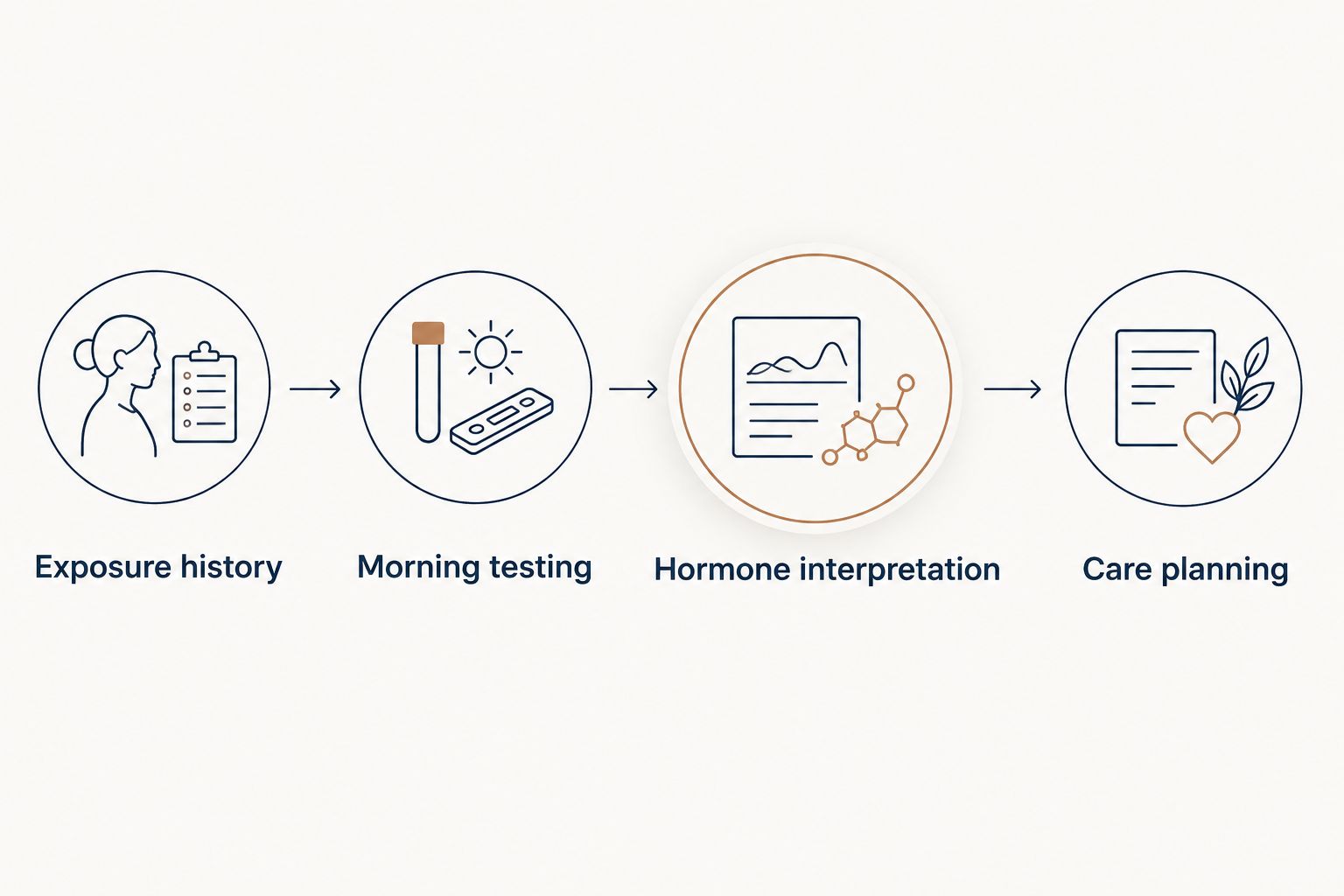
Testing becomes useful when the results are interpreted alongside exposure history and fertility goals.
Be candid if you do not know exactly what a product contained. Bring the label or a photograph rather than trying to reconstruct an ingredient list from memory. Products obtained outside regulated prescribing and dispensing channels can have uncertain contents.
Do not start, stop, or change prescribed hormone medicines just to obtain a particular test result. Ask the ordering clinician how to prepare. An accurate account of current use is more valuable than a result that appears reassuring because the exposure history is incomplete.
If results do not support testosterone deficiency, your symptoms still deserve attention. The next step is a broader assessment, as explained in low testosterone symptoms with normal labs.
Why symptoms and recovery vary
Recovery after anabolic steroid exposure does not follow a fixed calendar. The Endocrine Society's scientific statement on performance-enhancing drugs describes reproductive and psychiatric harms associated with anabolic-androgenic steroid use; it does not establish a universal recovery deadline for an individual man.
Several factors shape the evaluation:
- Exposure duration and pattern: Repeated or prolonged use changes the history your physician must interpret.
- Substances used: Different androgens and long-acting preparations affect how recent exposure relates to symptoms and testing.
- Other hormone-active medicines: Post-cycle drugs and additional testosterone can alter laboratory findings rather than reveal untreated function.
- Baseline health: Previous testosterone deficiency, testicular disease, and pituitary disorders require consideration.
- Sleep, nutrition, and mental health: These affect how you feel and can contribute to symptoms that resemble androgen deficiency.
- Fertility goals: Restoring a blood testosterone level and restoring sperm production are not interchangeable treatment goals.
Avoid comparing your recovery with someone else's gym experience. A friend's dose history, product contents, baseline hormones, and fertility status are not your medical record.
A 2026 care plan should specify what will be reassessed and which changes warrant earlier contact. Feeling better is important, but symptoms, hormone production, and sperm production do not necessarily recover together.
Is testosterone replacement the right next step?
Previous anabolic steroid use does not automatically make testosterone replacement therapy the right treatment. External testosterone can improve symptoms in appropriately selected men with confirmed deficiency, but it also suppresses the signals needed for sperm production.
Your physician must distinguish persistent testosterone deficiency from a potentially recovering suppressed system. Plans for children should be discussed before a prescription, not after treatment has started.
| Approach | Best for | Potential benefit | Limitation or concern |
|---|---|---|---|
| Clinician-supervised observation | Men whose evaluation supports monitoring without immediate hormone treatment | Allows reassessment of endogenous recovery | Symptoms can persist; follow-up and mood assessment remain necessary |
| Specialist-directed fertility care | Men seeking conception or evaluation of impaired sperm production | Focuses assessment and treatment on reproductive goals | Requires individualized testing; success is not guaranteed |
| Testosterone replacement therapy | Selected men with confirmed deficiency after risk and fertility review | Can treat symptoms attributable to testosterone deficiency | Suppresses sperm production and requires ongoing monitoring |
These are clinical pathways, not treatments you should choose from a table. Your history determines whether an endocrinologist, urologist, reproductive specialist, or another clinician should participate.
Mensmedicalinstitute provides physician-led testosterone care for men seeking an individualized assessment in St. Louis. The relevant question is not simply whether treatment is offered, but whether treatment fits your diagnosis, reproductive plans, and monitoring needs.
Why not use a self-directed post-cycle protocol?
A self-directed post-cycle protocol can obscure the diagnosis and expose you to medication risks. Medicines that change hormone signaling are not interchangeable, and a protocol shared online does not account for your examination, laboratory results, or fertility goals.
If you have already taken a post-cycle medicine, disclose it without embarrassment. Write down the name, dose if known, last use, and any new symptoms; your physician needs that information to interpret what happens next.
Can supplements restore testosterone after anabolic steroids?
Do not treat a supplement claim as evidence that suppressed hormone signaling has recovered. Rankings of testosterone support supplements by ingredient dose do not establish that those products restore hormone production or fertility after anabolic steroid use.
Correcting a documented nutritional deficiency and treating steroid-associated hormone suppression are different tasks. A supplement label cannot determine which problem you have, and adding products can make it harder to identify the cause of symptoms or abnormal results.
For decisions in 2026, ask what human evidence applies specifically to men after anabolic steroid exposure. Evidence about an ingredient in another population does not establish that it treats your situation.
Bring supplement containers or photographs to your appointment, including products marketed for muscle growth, sexual performance, or hormone support. Do not assume a product is irrelevant because it is sold without a prescription.
What should you bring to a medical appointment?
You do not need a perfect record to start the conversation. An honest timeline is enough to begin, and you can add details later if you find old labels or laboratory reports.
Bring or write down:
- The substances you used and the approximate start and stop dates.
- Your last dose and any current testosterone, post-cycle medicine, or supplement use.
- Previous testosterone results, including collection times and medicines taken around testing.
- Changes in sexual desire, erections, mood, sleep, and daily functioning.
- Whether you want children now or in the future.
- Relevant medical history and your current prescription medicines.
Ask how results will be communicated, what follow-up involves, and whom to contact if mood or physical symptoms worsen. If treatment is discussed, request a clear explanation of medication, laboratory, and follow-up charges rather than assuming they are all included.
You can call 314-394-1660 to discuss arranging an assessment. This article provides general education, not individual medical advice; no online symptom checklist can replace a clinical evaluation.
FAQ
What are the most common low testosterone symptoms in men after steroid use?
Low testosterone symptoms in men after anabolic steroid use include reduced sexual desire, fewer spontaneous erections, fatigue, and depressed mood. These symptoms require evaluation because they also occur with other medical and mental health conditions.
How many testosterone tests do I need?
Diagnosis generally requires testosterone measurements on 2 separate mornings, together with compatible symptoms. Your physician determines timing and interpretation based on recent steroid exposure, other medicines, sleep, and illness.
Does a testosterone result below 300 ng/dL mean I need TRT?
A testosterone result below 300 ng/dL does not automatically mean you need TRT. The American Urological Association uses that level as a reasonable diagnostic cutoff, but symptoms, repeat testing, cause, and fertility plans also matter.
Will my testosterone recover after I stop anabolic steroids?
Testosterone production can recover after anabolic steroid use, but recovery is variable and is not guaranteed. Persistent symptoms need follow-up rather than a promised recovery deadline.
Can I have low sperm production with normal testosterone?
Yes, a normal blood testosterone result does not establish normal sperm production. If conception is a goal, discuss reproductive evaluation and whether semen analysis is appropriate.
Should I restart testosterone if I feel worse after stopping?
Do not restart testosterone on your own because symptoms worsen. Additional testosterone can continue suppression and affect fertility; contact a clinician for an assessment and a plan.
What is the safest first step in 2026?
The safest first step in 2026 is an honest clinical assessment of your steroid exposure, symptoms, mood, and fertility goals. Seek urgent help for suicidal thoughts rather than waiting for hormone testing.
One last thing
A normal testosterone result is not a fertility test. If having children matters to you, say so before any treatment decision, even if conception is not an immediate plan.
Mensmedicalinstitute's physician-led testosterone care starts with individual clinical judgment, not a promise that every symptom needs testosterone. The most useful thing you can bring is the full story, including substances you would rather not mention.