Low testosterone symptoms in men under 40: avoiding assumptions

Low testosterone symptoms in men under 40 include reduced sexual desire, fewer spontaneous erections, fertility problems, and sometimes loss of muscle strength or persistent fatigue—but symptoms alone do not establish a diagnosis. In 2026, the practical next step remains a medical assessment and properly timed blood testing, not starting testosterone because an online checklist sounds familiar.
TL;DR
- Low testosterone symptoms in men overlap with sleep problems, depression, medication effects, and other health conditions.
- Diagnosis requires compatible symptoms and consistently low testosterone, usually assessed with two separate morning blood tests.
- Testosterone treatment can suppress sperm production; discuss fertility before starting treatment.
- Men’s Medical Institute provides physician-led testosterone care for men in St. Louis.
For men in St. Louis and Metro East Illinois, Men’s Medical Institute offers physician-led testosterone care. This guide explains what deserves evaluation, what else can cause similar symptoms, and what to discuss before treatment; it is general education, not individual medical advice.
What are low testosterone symptoms in men under 40?
Changes in sexual desire and spontaneous erections deserve attention, but no individual symptom proves testosterone deficiency. Fatigue, poor concentration, and reduced exercise performance are particularly nonspecific. Your physician needs to connect the symptom pattern with your history, examination, and laboratory results.
The American Urological Association’s testosterone deficiency guideline uses a total testosterone level below 300 ng/dL as a reasonable threshold supporting diagnosis. It also calls for two early-morning measurements on separate occasions and compatible symptoms or signs; the threshold is not a stand-alone treatment instruction.
| Symptom or sign | Why testosterone enters the discussion | Why it does not settle the diagnosis |
|---|---|---|
| Reduced sexual desire | Low testosterone can reduce libido | Depression, relationship strain, medications, and poor sleep can also affect desire |
| Fewer spontaneous erections | A persistent change can accompany testosterone deficiency | Sleep disruption and other health problems can change erection patterns |
| Difficulty getting or keeping erections | Testosterone is part of sexual function | Blood vessel health, medications, anxiety, and other factors also matter |
| Persistent fatigue or poor concentration | These symptoms can occur with testosterone deficiency | They also occur with sleep disorders, mood conditions, and other illnesses |
| Reduced strength or muscle mass | Testosterone affects muscle maintenance | Training changes, nutrition, inactivity, and illness also affect strength |
| Fertility problems | Hormonal disorders can affect sperm production | Fertility requires a separate assessment; a testosterone result does not measure sperm production |
Use the table to prepare for a conversation, not to score yourself. Several overlapping symptoms still do not replace an evaluation.
Why this matters before you turn 40
Being under 40 neither rules out testosterone deficiency nor makes it the most likely explanation for feeling unwell. The mistake is treating age as a diagnosis in either direction: dismissing symptoms because you are young, or assuming that low energy means low testosterone.
A useful 2026 approach asks two separate questions: Is testosterone consistently low, and does the overall clinical picture support testosterone deficiency? A single result or a persuasive symptom list cannot answer both.
Fertility makes this distinction especially important. Testosterone treatment can suppress the hormonal signals needed for sperm production, so plans for children belong in the first conversation—not after a prescription begins.
Which symptoms deserve a closer look?
A sustained change in sexual desire
A noticeable decline from your usual level of interest is more useful to discuss than whether your libido matches someone else’s. Explain when the change began, whether it is persistent, and whether it coincided with a medication, illness, relationship change, or disrupted sleep.
Low desire and erectile dysfunction are different problems. You can have normal desire with difficulty maintaining an erection, or reduced desire without erection difficulties; your assessment should distinguish them.
Changes in spontaneous erections
Tell your physician if spontaneous or morning erections have become less frequent compared with your usual pattern. That history contributes to the assessment, but morning erections are not a home testosterone test.
Sleep influences these erections. Missing them after poor sleep does not establish a hormone disorder, and having them does not exclude every medical cause of sexual symptoms.
Changes in strength, energy, or concentration
Persistent fatigue, reduced strength, and difficulty concentrating deserve attention when they affect daily life. They are not specific enough to identify testosterone deficiency on their own.
Describe function rather than relying only on labels. Explaining that you stopped completing your usual workouts or struggle to stay awake during meetings gives your physician a clearer starting point than saying you feel older.
Why symptoms and testosterone results vary
Symptoms and laboratory results do not always move together. These factors help explain why a physician looks beyond the number:
- Sleep: Insufficient sleep and sleep disorders can contribute to fatigue and sexual symptoms; sleep history also matters when interpreting hormone concerns.
- Illness: Acute illness can temporarily affect testosterone, making the timing of testing important.
- Medicines and substances: Opioids, glucocorticoids, and anabolic steroid use or withdrawal can affect hormone function; other medicines can affect sexual function without causing testosterone deficiency.
- Body weight and metabolic health: Obesity can affect testosterone and sex hormone-binding globulin, complicating interpretation of total testosterone.
- Mood and stress: Depression, anxiety, and ongoing stress can affect energy, concentration, desire, and erections without proving a hormone disorder.
- Testing conditions: Collection time, laboratory methods, and changes in binding proteins affect how a result should be interpreted.
Do not stop prescribed medicines to improve a testosterone result. Bring a complete medication and supplement list so your physician can assess possible effects safely.
How should you get evaluated in 2026?
The goal is to establish whether a hormone disorder is present and identify its cause. Testing is part of that process, not a substitute for it.
Symptom history
Describe what changed, when it began, and how it affects your life. Include sexual symptoms, sleep quality, weight changes, recent illness, fertility plans, and any past testosterone or anabolic steroid use.
A short record helps you distinguish a persistent pattern from an unusually difficult week. The guide to keeping a useful symptom diary provides a focused place to start without turning symptom tracking into self-diagnosis.
Morning testing
Your physician generally checks total testosterone in the early morning, when levels are typically higher. Ask about fasting instructions and explain if you work nights, because your sleep schedule matters when arranging testing.
Do not change sleep, exercise, or medication routines simply to produce a particular result. The purpose is an interpretable measurement, not passing or failing a test.
Repeat measurement
A low result usually needs confirmation with a second early-morning blood test on a separate day. Two measurements help distinguish a persistent finding from normal variation or a temporary change.
For the AUA framework, a result below 300 ng/dL supports consideration of testosterone deficiency, but symptoms and the clinical context still matter. Your physician should explain the laboratory’s reference range and how it applies to your assessment.
Cause assessment
Confirmed low testosterone is the beginning of a diagnostic discussion, not the end. Depending on your findings, a physician can use additional tests, including luteinizing hormone and sometimes prolactin, to investigate why testosterone is low.
Free testosterone assessment can help in selected cases, particularly when total testosterone is borderline or binding proteins affect interpretation. It is not an automatic replacement for a careful history and appropriately collected total testosterone measurements.
Treatment discussion
Discuss the diagnosis, fertility goals, possible benefits, risks, and monitoring before choosing treatment. Ask what improvement would look like and how your physician would reassess care if symptoms persisted.
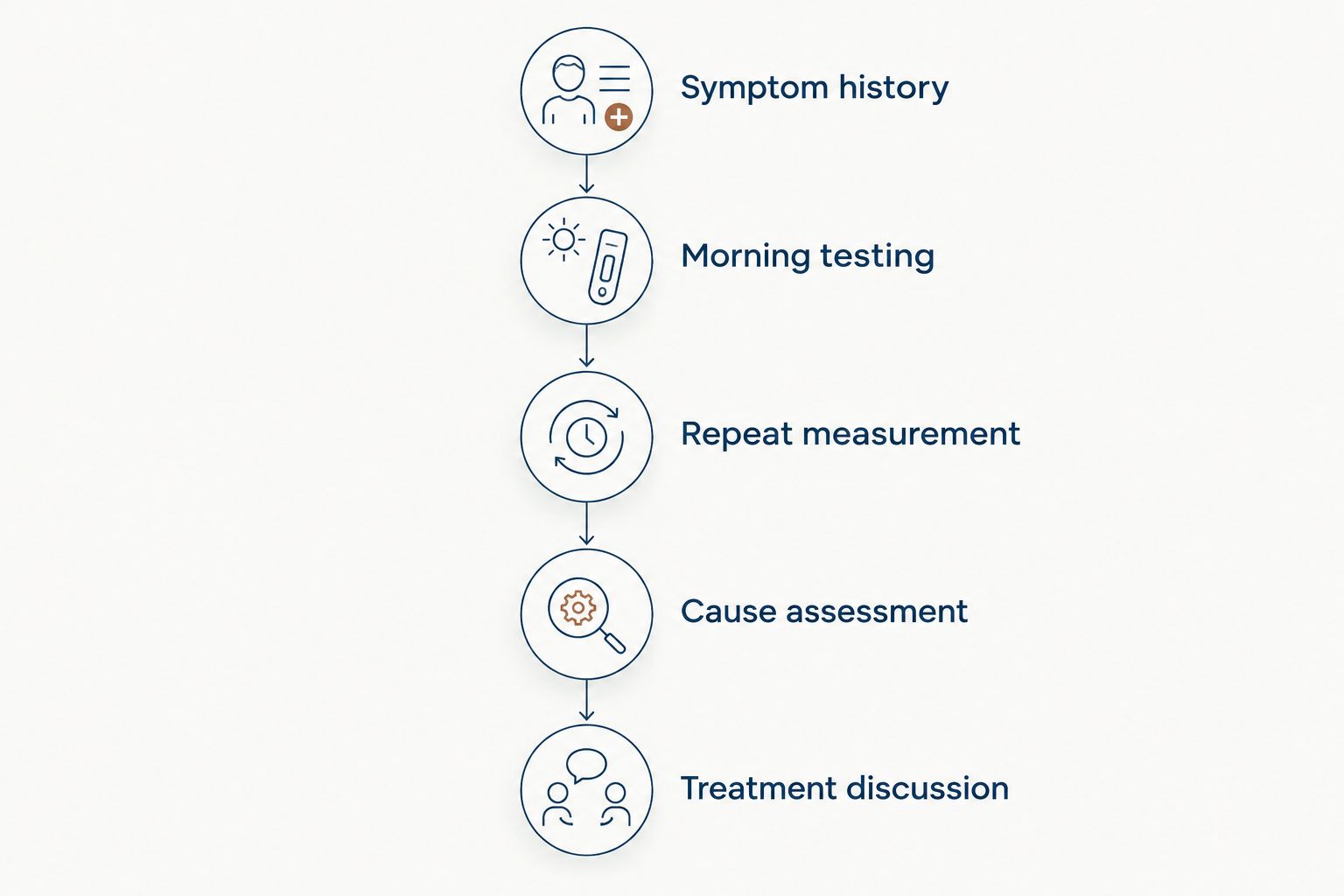
A treatment discussion follows confirmation and assessment of the cause.
Does one low testosterone result mean you need TRT?
One low testosterone result does not establish that you need testosterone replacement therapy. A result obtained during illness, after disrupted sleep, or without appropriate timing needs clinical interpretation before it drives a treatment decision.
The same caution applies to a result near a laboratory cutoff. A small difference around a threshold does not explain every symptom, and a normal result should prompt consideration of other causes rather than repeated attempts to obtain a lower number.
Bring the actual laboratory report, including collection time, units, and reference range. A screenshot showing only a flagged value leaves out information your physician needs.
Can testosterone treatment affect fertility under 40?
Testosterone treatment can suppress sperm production, including in younger men. It is not a fertility treatment, and a rise in blood testosterone does not show that sperm production has improved.
Tell your physician whether you are trying to conceive now or want children later. If fertility is a concern, the evaluation can include semen testing and referral to an appropriate specialist rather than assuming testosterone replacement is the right approach.
Do not assume stopping testosterone immediately restores fertility. Recovery varies, so fertility planning belongs before treatment starts.
What if testosterone is normal but you still feel unwell?
Normal testosterone does not mean your symptoms are imaginary. It means testosterone deficiency has not been established as their explanation, and the assessment needs to address other possibilities.
Sleep apnea, depression, thyroid disease, anemia, medication effects, and cardiovascular or metabolic conditions can produce overlapping concerns. Your symptoms and history guide which possibilities warrant testing; ordering every available hormone test is not a substitute for clinical judgment.
For erectile difficulties, a separate sexual-health assessment remains useful even when testosterone is normal. Treating an erection problem and treating confirmed testosterone deficiency are not interchangeable decisions.
Choosing physician-led care in St. Louis
Men’s Medical Institute is best for St. Louis men seeking physician-led testosterone care. The useful question at an initial visit is not simply whether treatment is available, but how the diagnosis, fertility discussion, follow-up, and monitoring will fit your situation.
For a 2026 appointment, bring your laboratory reports, medication list, symptom history, and questions about future children. Ask which services are included, which tests are billed separately, and what happens if the evaluation points away from testosterone treatment.
Physician-led care still has limits: it does not guarantee that testosterone explains your symptoms or that treatment will resolve them. If you would like to discuss an assessment, call 314-394-1660 without assuming you need a prescription.
FAQ
What are the most useful low testosterone symptoms in men to discuss with a doctor?
Reduced sexual desire, fewer spontaneous erections, and fertility concerns are useful symptoms to discuss, alongside fatigue or strength changes. None establishes testosterone deficiency without an appropriate evaluation.
Can I have low testosterone before age 40?
Yes, testosterone deficiency can occur before age 40. Age alone neither confirms nor excludes it; your symptoms, medical history, and properly collected blood tests determine the next step.
Is a testosterone level below 300 ng/dL always a reason to start treatment?
A testosterone level below 300 ng/dL is not automatically a reason to start treatment. The American Urological Association uses it as a supporting threshold alongside compatible symptoms and two separate early-morning measurements.
Can poor sleep feel like low testosterone?
Poor sleep can cause fatigue, concentration problems, and sexual symptoms that overlap with testosterone deficiency. Tell your physician about snoring, daytime sleepiness, and shift work rather than assuming hormones explain everything.
Will testosterone treatment help me have children?
Testosterone treatment can suppress sperm production and is not a fertility treatment. Discuss current and future pregnancy plans before starting it, and ask whether a fertility-focused evaluation is needed.
Should I try a testosterone booster before seeing a physician?
Do not use a testosterone booster as a diagnostic trial. Supplement response cannot confirm testosterone deficiency, and products marketed for hormone support can introduce safety concerns or complicate the assessment.
What should I bring to a testosterone appointment in 2026?
Bring your laboratory reports, medication and supplement list, symptom history, and fertility questions to a testosterone appointment in 2026. Include the collection time and reference range for any previous testosterone test.
One last thing
Keep separate notes for desire, erections, and energy. These concerns often get grouped together as low testosterone, but they are different clinical clues and do not always share a cause.
Before your visit, write down what you most want to change in daily life. That gives the conversation a useful goal beyond raising a laboratory number.