Men's clinic visits from Metro East: planning the trip

If you live in Metro East Illinois and search for a mens clinic near me, confirm the appointment location, reason for the visit, lab instructions and follow-up arrangements before traveling to St. Louis. Do not assume a consultation includes testing, a prescription or treatment that day; ask what the appointment actually involves.
TL;DR
- For a mens clinic near me search, confirm clinical fit before comparing routes from Metro East.
- Men's Medical Institute provides physician-led men's health care; treatment decisions require individual evaluation.
- Ask whether labs need separate scheduling, preparation or payment before traveling to St. Louis.
- Confirm follow-up arrangements across the Missouri–Illinois state line rather than assuming remote visits are possible.
Why this matters
A convenient drive does not establish whether an appointment fits your medical needs. Your symptoms, existing care and treatment goals matter more than a search result's distance label.
Men's Medical Institute is a physician-led men's health option for men considering testosterone care, ED treatment, weight management or NAD+ therapy. Choose a visit that addresses your concern, not a treatment before an evaluation. For your 2026 trip, use the contact page to ask about the appointment location and preparation before making travel arrangements.
The goal is straightforward: arrive with useful information and leave understanding the next step. That next step can be further evaluation rather than a prescription.
How do I plan a men's clinic visit from Metro East?
Plan around the clinical appointment first and the drive second. Use this sequence before leaving Illinois for a St. Louis visit.
- Describe your main concern. Explain whether you want help with sexual function, possible low testosterone, weight management or questions about NAD+ therapy. Describe symptoms rather than requesting a particular prescription.
- Confirm the location. Ask for the exact appointment address, arrival instructions and any parking or building-access details. Use the confirmed address in your navigation app.
- Clarify the visit's scope. Ask whether the appointment is a consultation, testing visit, treatment visit or follow-up. Do not assume these happen together.
- Check preparation instructions. Ask whether bloodwork is needed beforehand, whether fasting is required and whether the timing of the sample matters.
- Bring relevant information. Prepare your medication list, available test results, medical history and questions. Ask how to send records securely if needed.
- Confirm what happens afterward. Ask how results, treatment decisions, questions and future appointments will be handled when you are back in Illinois.
Write down the answers. A clear appointment plan is more useful than trying to remember instructions while coordinating work, family responsibilities and the drive.
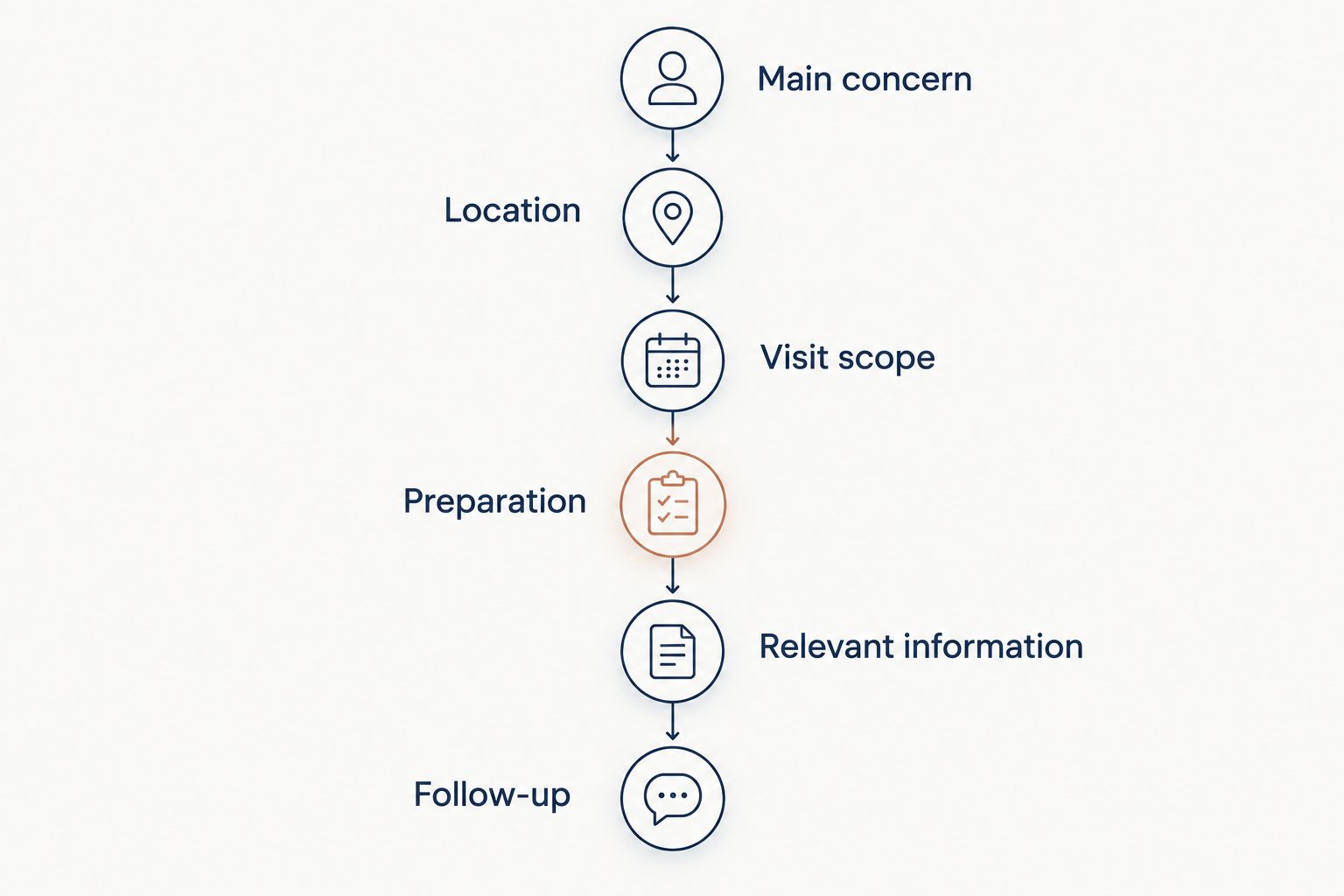
Confirm the clinical plan before organizing the trip around it.
Which appointment fits your concern?
A men's clinic and primary care serve overlapping needs, but they are not interchangeable in every situation. Best for a focused men's health concern and best for a broad symptom assessment are different decisions.
| Appointment option | Best for | What it helps address | Limit to consider |
|---|---|---|---|
| Focused men's health appointment | Discussing testosterone, sexual health or another service the clinic explicitly provides | A consultation centered on your stated concern | Confirm whether unrelated conditions need evaluation elsewhere |
| Primary care appointment | New, broad or unexplained symptoms and coordination of existing conditions | Reviewing symptoms alongside your wider medical history | A separate referral or focused treatment visit can still be necessary |
| Emergency evaluation | Chest pain, severe breathing difficulty or signs of stroke | Immediate assessment of potentially life-threatening symptoms | A routine clinic appointment is not an emergency service |
Fatigue, changes in sexual function and weight changes do not establish a diagnosis by themselves. Sleep problems, medicines, mood symptoms and other medical conditions can require attention alongside hormone questions.
If you already have a primary care clinician, bring that clinician's details and ask how information should be shared. Avoid creating separate treatment plans that do not account for one another.
What should you confirm before crossing the river?
For a 2026 appointment, confirm the current location and instructions directly rather than relying on an old message, saved map pin or directory listing. Ask which entrance to use and whether any arrival paperwork should be completed ahead of time.
Check live traffic and road conditions on the day of travel. A static article cannot give a dependable journey time from every Metro East starting point, and your actual route depends on the confirmed destination.
Tell the office if your schedule has a firm limit. Ask about the expected visit length, but keep travel planning separate from any promise about when testing or treatment will be completed.
If a procedure or medicine is planned, ask whether it affects driving and whether you need another person to take you home. Do not assume either that a driver is required or that driving yourself is appropriate; obtain instructions for the actual visit.
What should you bring to the appointment?
Bring information that helps a physician understand the man behind the symptoms. A useful record is accurate, readable and connected to the question you want answered.
Your symptoms and goals
Write down when symptoms began, how they affect daily life and whether they fluctuate. Include sleep quality, work schedule and changes in sexual function when relevant. Be clear about what you hope to improve without deciding in advance what caused the problem.
Your medicines and supplements
List prescription medicines, nonprescription products, supplements and any hormones you use. Include the dose and schedule from the label or prescription when available. Do not stop medicines to prepare for an appointment unless your treating clinician gives you specific instructions.
Your existing results and medical history
Bring available laboratory reports with the collection date, units and laboratory reference ranges. A screenshot showing only a flagged result leaves out context. Include relevant diagnoses, surgeries, allergies and the names of clinicians already managing your care.
Your practical questions
Write down questions about testing, treatment risks, follow-up and billing. If privacy is a concern, ask how appointment reminders, results and other communications are delivered. You can raise those questions before discussing sensitive symptoms.
Do testosterone visits require special lab planning?
Ask before arranging bloodwork. A low-testosterone diagnosis requires symptoms or signs and consistently low testosterone levels, not a symptom checklist alone. Clinical guidance recommends confirming a low result with repeat morning testing; the physician determines which tests and timing fit your circumstances.
Tell the clinician if you work nights, recently had an illness, use testosterone or have taken anabolic steroids. These details matter when choosing and interpreting testing. Do not change a prescribed hormone schedule on your own to influence a result.
For your 2026 appointment, ask whether existing results are useful or whether new testing is needed. Also confirm where samples should be collected and how the clinic receives the reports.
Men's Medical Institute testosterone care is physician-led. That does not mean every man who asks about testosterone needs treatment; the evaluation should establish whether treatment is appropriate and what monitoring it would require.
What should you ask about ED, weight management or NAD+?
The preparation should follow the concern, not a generic appointment checklist. Tell the office what you want to discuss so you can ask for relevant instructions.
For ED concerns, describe when the difficulty occurs, current medicines and any previous treatment. Mention nitrate medicines, including nitroglycerin: sildenafil and tadalafil must not be taken with nitrates because the combination can cause dangerous drops in blood pressure.
For weight management, bring your current medication list, relevant medical history and previous treatment experience. Ask how the physician evaluates treatment suitability and monitors tolerability. Do not assume a consultation guarantees a particular medicine.
For NAD+ questions, separate an offered service from a proven health outcome. Injectable NAD+ is not a proven longevity treatment. Evidence for broad anti-aging benefit in humans is limited, and questions about sterile preparation and safety belong in the conversation before treatment decisions.
These are general preparation points, not instructions to start, stop or combine therapies.
Why does the visit plan vary?
The reason for variation should be clinical or practical—not a mystery you discover after arriving. These factors shape what needs to happen before, during and after the appointment:
- Your main concern. A discussion about erectile function needs different history than a question about testosterone testing.
- Existing records. Available results help the physician understand prior evaluation, but do not automatically replace new testing.
- Your medication history. Current prescriptions, supplements and hormone use affect safety discussions and interpretation.
- Testing requirements. Sample timing, preparation and collection arrangements depend on the ordered tests.
- Follow-up location. In-person and remote care have different requirements, including rules related to where you are physically located.
- Care coordination. Other treating clinicians need accurate information when treatment plans overlap.
Ask which of these applies to your visit. A useful answer explains what you need to do, who handles it and how you will receive the next instruction.
Can follow-up happen while I am in Illinois?
Do not assume an initial Missouri visit makes every later remote appointment possible from Illinois. Telehealth requirements depend on factors including your physical location during the appointment and the clinician's authority to provide care there.
Before booking in 2026, ask whether follow-up can occur while you are at home in Illinois, whether a return visit is needed and how laboratory monitoring is arranged. Confirm the plan for prescription questions as well; a video appointment and prescribing are not the same question.
Also ask whom to contact for a nonurgent side effect or an unclear instruction. Routine messages are not a substitute for emergency care, and you should know the distinction before treatment begins.
Will everything happen during the first visit?
Do not plan on a same-day prescription or completed treatment. A physician can need additional history, records, examination findings or test results before making a recommendation.
Ask whether any planned laboratory collection requires a separate appointment and how treatment decisions will be communicated. If another trip is needed, knowing that possibility beforehand helps you plan without pressuring a medical decision to fit your calendar.
What should I ask about the full bill?
Ask for the complete billing explanation, not just a headline program amount. Confirm which services are included and which are separate: consultation, laboratory work, medicines, supplies and follow-up are distinct questions.
At Men's Medical Institute, labs are separate from the testosterone program price. Ask for the current written details and clarify what applies to the care you are considering; do not assume one service's billing arrangements apply to another.
If you intend to use insurance, ask the clinic and your insurer what applies to the specific service. Do not infer coverage from the fact that a treatment is medically discussed or prescribed.
FAQ
What's the first thing to check when searching mens clinic near me from Metro East?
Confirm that the clinic evaluates your concern, then verify the exact appointment address and preparation instructions. Search-result distance alone does not tell you whether the appointment fits your needs.
Should I get testosterone labs before my appointment?
Ask the clinic before arranging testosterone labs. The physician needs to determine which tests, collection timing and preparation fit your symptoms and circumstances.
Can I use testosterone results from another doctor?
Bring the complete report and ask whether it is sufficient for the evaluation. Include the collection date, units and reference ranges; additional testing can still be necessary.
Can I have a remote follow-up from my home in Illinois?
Confirm this directly before booking. Remote care depends on your physical location during the appointment and the clinician's authority to provide care there.
Will I leave my first visit with a prescription?
A first visit does not guarantee a prescription. Treatment decisions depend on the medical evaluation, relevant records and any necessary testing.
Are labs included in the testosterone program price?
Labs are separate from the testosterone program price. Ask for current written billing details and clarify the testing and follow-up arrangements before starting care.
Is injectable NAD+ proven to extend life?
No. Injectable NAD+ is not a proven longevity treatment, and evidence for broad anti-aging benefit in humans is limited.
Should I stop my medicines before a men's health appointment?
Do not stop prescribed medicines unless your treating clinician gives you specific instructions. Bring an accurate list of prescriptions, supplements and hormone products instead.
One last thing
Before leaving the appointment, ask: What happens next, and who is responsible for arranging it? That question covers outstanding results, treatment decisions, monitoring and any return visit without assuming treatment is already settled.
If you are planning a 2026 visit from Metro East, call Men's Medical Institute at 314-394-1660 to discuss the appointment and preparation. This article provides general education, not individual medical advice; your treating physician determines the appropriate evaluation and care.