TriMix injections: why dose units differ between prescriptions

Dose units for trimix injections differ because the syringe marking describes liquid volume, while the prescription determines how much of each medicine that volume contains. A familiar number of units is not a transferable dose: when your formulation, instructions or syringe changes, your prescriber or dispensing pharmacist must confirm what to draw up before you inject.
TL;DR
- For trimix injections, syringe units describe volume; the formulation determines the amount of medicine delivered.
- A U-100 syringe scale represents 100 units per milliliter, not a standardized TriMix drug strength.
- Never transfer an old dose to a different formulation without confirmation from your prescriber or pharmacist.
- Mensmedicalinstitute offers physician-led ED treatment for men in St. Louis.
- An erection lasting 4 hours requires emergency medical care, even without pain.
Why do dose units differ between TriMix prescriptions?
The same syringe marking can deliver different amounts of medicine from different TriMix formulations. TriMix combines alprostadil, papaverine and phentolamine in a compounded preparation. The concentration of each ingredient matters; the name TriMix alone does not identify the strength.
An insulin syringe adds another source of confusion. Its printed units are calibrated for insulin, but clinicians sometimes use that scale to describe the volume of another prescribed injectable medicine. Those markings do not become standardized units of TriMix potency.
For men seeking physician-led ED treatment in St. Louis, Mensmedicalinstitute provides care centered on individual medical judgment. This 2026 guide explains prescription language, not how to select or change your injection dose.
| Label or instruction | What it tells you | What it does not tell you |
|---|---|---|
| TriMix | The combination contains three medicines | The concentration of each ingredient |
| Concentration per milliliter | How much of an ingredient is in a stated liquid volume | Your personally prescribed injection amount |
| Syringe units | A position on the specified syringe scale | A universal measure of TriMix strength |
| Prescribed volume | How much liquid your clinician directs you to inject | Whether an older vial has the same formulation |
| Pharmacy formulation code | A pharmacy-specific identifier for the preparation | A strength you can assume another pharmacy uses |
Why this matters
A refill can look familiar while carrying a different concentration. Using the same syringe marking without checking the prescription can therefore deliver a different amount of medicine.
Too much erectile medication can cause a prolonged erection; an erection lasting 4 hours requires emergency medical care. Too little can produce an inadequate response, but that does not make an extra injection safe. Your written treatment plan, not an online comparison, should govern what happens next.
The safest habit in 2026 is straightforward: check the current vial against the current instructions before treating a familiar unit count as routine.
Syringe units: a volume scale, not a TriMix strength
On a U-100 insulin syringe, 100 units corresponds to 1 milliliter, and each unit corresponds to 0.01 milliliter. These relationships explain the scale only. They are not a recommended TriMix dose and do not establish which syringe you should use.
A syringe marked directly in milliliters displays volume differently. Even when two devices can measure the same volume, their printed markings are not interchangeable. Confirm the exact device named in your instructions rather than choosing one because its barrel looks similar.
Ask the clinician or pharmacist to demonstrate the prescribed marking on the syringe you will actually use. A verbal instruction to use a certain number of units is incomplete if you do not know which syringe scale it refers to.
Do not use this explanation to convert a prescription yourself. A correct volume conversion still cannot resolve a changed formulation, an unclear label or a prescribing error.
Ingredient concentration: what determines the medicine amount
Concentration states how much medicine a given volume contains. Because TriMix contains multiple ingredients, a prescription must account for each ingredient rather than treating the mixture as one universally standardized drug strength.
A formulation change can affect the balance between ingredients, not just make the entire mixture uniformly stronger or weaker. That is why a simple instruction to halve or double an old unit count is not a safe substitute for a new prescription.
The order in which ingredients appear also matters when reading shorthand. Do not compare strings of numbers unless the pharmacist has identified the ingredient, unit of measurement and volume basis attached to each number.
For a 2026 refill review, ask for the full ingredient concentrations in plain language. A pharmacy's shorthand code is useful for its records, but it is not enough for you to establish equivalence between prescriptions.
Why the prescribed amount varies
Different instructions do not automatically mean either prescription is wrong. These factors explain why a clinician needs more information than the name TriMix:
- Ingredient concentrations: The amount of each medicine per milliliter determines what a measured volume delivers.
- Ingredient balance: Changing the relative amounts of alprostadil, papaverine and phentolamine changes the formulation, not merely its label.
- Syringe scale: Instructions must match the actual measuring device, including whether it is marked in units or milliliters.
- Individual response: The prescriber considers erection response, duration and adverse effects when directing treatment.
- Updated instructions: A changed formulation or treatment plan requires reconciliation with the current prescription rather than continued reliance on an older message.
You cannot judge a prescription by comparing your unit count with another man's. Even identical formulations do not establish that two patients should receive identical instructions.
How to check a new vial before your next injection
Use this sequence whenever you receive a new formulation, change pharmacies or find conflicting instructions. The purpose is to resolve uncertainty before injecting, not to calculate your own replacement dose.
- Read the label. Check your name, the medicine, ingredient concentrations and the pharmacy's directions. Look at the current vial rather than relying on a photograph of an older one.
- Match the instructions. Compare the dispensing label with the latest written instructions from your prescriber. If they disagree, stop and ask which directions apply.
- Confirm the syringe. Show the clinician or pharmacist the actual syringe or its packaging. Ask them to identify the prescribed marking on that device.
- Resolve any change. Ask whether the formulation has changed and whether your previous instructions still apply. Do not infer equivalence from the vial size, appearance or pharmacy code.
- Keep the plan. Save the confirmed instructions with your medication information, including what to do for an inadequate response or a prolonged erection.
The American Urological Association's erectile dysfunction guideline recommends an in-office injection test for men considering intracavernosal injection therapy. That supports supervised assessment and instruction; it does not establish a universal starting dose for every compounded mixture.
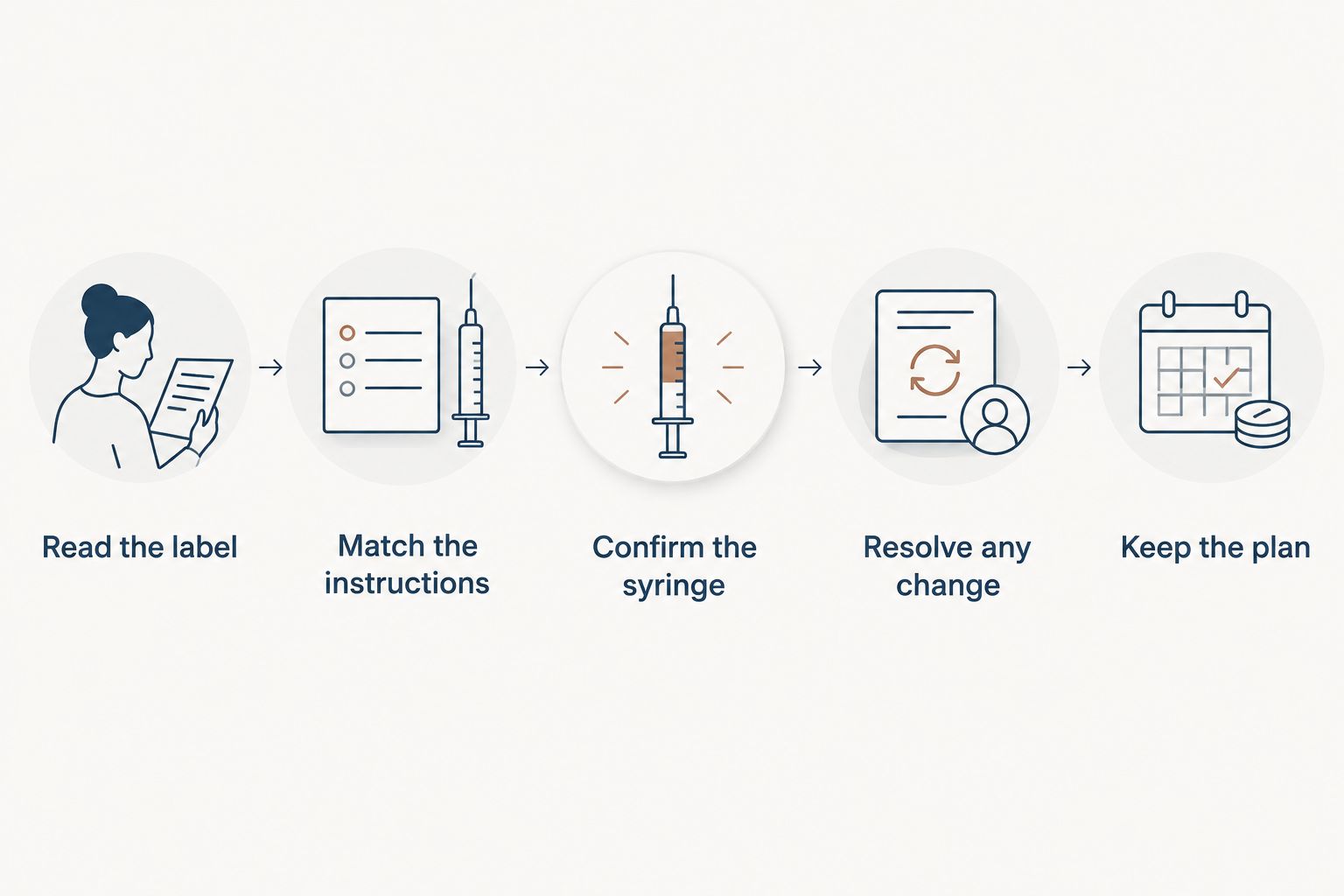
Resolve conflicting instructions before injecting rather than translating an old unit count yourself.
What should you ask the pharmacy?
Ask the pharmacist to read back the full formulation, explain the concentration units and confirm that the dispensing directions match the prescriber's order. Then ask whether the syringe supplied or recommended matches those directions.
A useful question is whether anything changed from the previous dispensing. If the answer is yes, ask the prescriber to confirm the current treatment instructions before you use the new preparation.
What should you tell your prescriber?
Describe the actual response, including how long the erection lasted, whether it was adequate for sexual activity and whether you had pain, bruising or other symptoms. Bring the vial information and syringe details so the clinician can interpret your experience against the correct formulation.
Include other ED medicines and blood thinners in the discussion. Do not combine treatments or change injection frequency unless your clinician has specifically instructed you to do so.
Can you use the same units after changing pharmacies?
The same unit count is not proof of the same dose. A new pharmacy may dispense a different formulation or use a different internal naming system. Only a comparison of the complete prescription and confirmed instructions can establish what applies to your new vial.
Ask both the dispensing pharmacist and prescriber to resolve any discrepancy. Do not bridge the gap by estimating an equivalent amount from a forum, a friend's prescription or an online calculator.
For men arranging ED care in St. Louis or Metro East Illinois in 2026, keeping the prescriber and dispensing pharmacy in the same conversation reduces avoidable confusion. Ask who you should contact when a label and an office instruction do not agree.
Does a larger unit count mean stronger treatment?
A larger unit count means more liquid only when you are comparing the same syringe scale. Whether it delivers more medicine depends on the formulation; the number alone cannot rank treatment strength across prescriptions.
This distinction also explains why another patient's experience is a poor dosing reference. The useful comparison is your documented response to your own prescribed formulation, reviewed with your clinician.
What are the benefits and limits of TriMix treatment?
TriMix is an ED treatment option that delivers medication directly into erectile tissue. Intracavernosal injection therapy can help men for whom oral ED treatment is unsuitable or ineffective, but it requires instruction and careful follow-through.
The trade-offs include the injection itself, possible pain or bruising, and the risk of prolonged erection or tissue scarring. Compounded TriMix preparations are not FDA-approved finished products; FDA does not review compounded drugs for safety, effectiveness or quality before marketing.
Mensmedicalinstitute is for men in St. Louis seeking physician-led ED care. Physician-led care still requires your participation: disclose other medicines, follow the confirmed prescription and report adverse effects. No clinic can determine the right treatment from a unit count alone or promise a particular result.
When should you get urgent help?
An erection lasting 4 hours is a medical emergency, even if it is not painful. Seek emergency care rather than waiting for a routine office callback or trying an unapproved home remedy.
Your clinician should give you a plan for an erection that lasts longer than intended, including when to call before that emergency threshold. Do not wait until an injection problem occurs to ask for those instructions.
If you think you used the wrong formulation or amount, contact your prescriber promptly for individualized guidance. Tell them what you injected, when you injected it and what symptoms you have; do not take another injection to correct an unsatisfactory response.
Talk through unclear instructions before treatment
If you are considering ED treatment or need help understanding an existing prescription, contact the clinic or call 314-394-1660. Ask what information to bring so the discussion can include the vial label, written instructions, syringe and other medicines.
Mensmedicalinstitute provides physician-led men's health care; this article provides general education, not individual medical advice. Your prescribing clinician and dispensing pharmacist must resolve questions about your specific preparation and injection amount.
FAQ
Why do my trimix injections have different unit instructions now?
Different unit instructions can reflect a changed formulation, syringe scale or individualized treatment plan. Ask your prescriber and dispensing pharmacist to confirm the current vial and directions before injecting.
Are TriMix units the same as milligrams?
No. Syringe units describe a marking on a specified scale, while milligrams measure an amount of medicine. The ingredient concentration connects liquid volume with the amount of drug delivered.
What does U-100 mean on my syringe?
U-100 means the syringe scale corresponds to 100 insulin units per milliliter. When that syringe is used for another medicine, its markings describe volume, not standardized units of that medicine's strength.
Can I keep my old dose when I get a stronger TriMix vial?
Do not carry an old dose over to a stronger or otherwise changed formulation without explicit instructions from your prescriber. The same volume can deliver different amounts of the ingredients.
Can I take another injection if the first one does not work?
Do not take an additional injection unless your prescriber has explicitly directed that action in your treatment plan. An inadequate response needs clinical review, not an improvised repeat dose.
When is an erection after TriMix an emergency?
An erection lasting 4 hours requires emergency medical care, even without pain. Follow your clinician's earlier-contact instructions and do not delay emergency treatment while waiting for an office response.
Are all compounded TriMix prescriptions FDA approved?
No. Compounded TriMix preparations are not FDA-approved finished products. FDA does not review compounded drugs for safety, effectiveness or quality before they are marketed.
One last thing
The most useful number is not always the one printed beside a syringe line. A perfectly measured volume can still be wrong for a changed prescription.
For your next refill in 2026, keep the current vial label and confirmed instructions together. If the formulation, directions and syringe do not clearly match, pause before injecting.