Urgent care ED visit to a physician-led plan: 2026 workflow

Yes, you can go to urgent care for erectile dysfunction, but ongoing ED usually needs follow-up rather than repeated walk-in visits. Instead of retelling your history at each visit, collect the urgent care findings and bring them to a physician who can assess causes, review medication safety, and build an ongoing plan.
TL;DR
- Can you go to urgent care for erectile dysfunction? Yes, but services vary and ongoing symptoms need follow-up.
- An erection lasting more than four hours needs emergency care, not a routine ED appointment.
- Mensmedicalinstitute offers physician-led ED care for men in St. Louis.
- Bring your medication list, urgent care records, and symptom history to your follow-up visit.
Why this matters
An urgent care visit can address an immediate concern without completing the evaluation behind it. Erectile dysfunction can involve blood vessels, medications, hormones, nerves, stress, or several factors together. A prescription alone does not establish the cause.
Mensmedicalinstitute is best for St. Louis men seeking individualized, physician-led ED care. Its role is ongoing assessment and treatment, not emergency care. You can learn about Mensmedicalinstitute before deciding whether that approach fits your needs.
For your 2026 care plan, the useful handoff is simple: what happened, what was checked, what was prescribed, and what still needs attention. This guide is general education, not individual medical advice.
Before you start
- Choose the right setting first. Call 911 for chest pain, severe shortness of breath, or stroke symptoms. Go to an emergency department for an erection lasting more than 4 hours or a significant penile injury, especially with a popping sound, swelling, or bruising.
- Gather your materials. Bring your urgent care discharge instructions, test results, medication bottles or a current list, and a short account of when the erection problem began. Include supplements and medicines obtained online.
- Flag the easy-to-miss safety issue. Tell every clinician about nitroglycerin, isosorbide, and recreational nitrites, sometimes called poppers. Combining nitrates or nitrites with ED medicines such as sildenafil or tadalafil can dangerously lower blood pressure.
You do not need a complete medical record before asking for help. Bring what you have and identify the urgent care location so you can request the remaining records.
Choose the care setting
Match the visit to the problem
- Check for emergency symptoms. Do not wait for an ED consultation if you have the warning signs above. If chest pain occurs after taking an ED medicine, call 911 and tell responders exactly what you took and when; do not self-administer nitroglycerin.
- Call urgent care before traveling. Ask whether the location evaluates erectile difficulties, what testing it can provide, and whether it handles medication questions. Do not assume every walk-in clinic offers the same services.
- Arrange ongoing follow-up. For recurring erection problems without emergency symptoms, primary care or a clinician who treats ED is the setting for a fuller evaluation.
Expected result: You know whether you need emergency treatment, a limited walk-in assessment, or a scheduled evaluation. Urgent care is a possible entry point, not a required first step.
Compare the available settings
| Setting | Best for | Main benefit | Limitation |
|---|---|---|---|
| Emergency department | Prolonged erection, significant penile injury, or serious accompanying symptoms | Emergency assessment and treatment | Not a substitute for routine ED follow-up |
| Urgent care | A non-emergency concern when you cannot promptly reach your usual clinician | An initial assessment and guidance on next steps | ED services and testing differ by location |
| Primary care | Recurring ED alongside general health concerns | Evaluation connected to your broader medical history | Some treatment questions require referral |
| Physician-led men's health care | Focused ED assessment and an individualized treatment plan | Dedicated discussion of sexual health and treatment choices | Does not replace emergency services or all primary care |
Choose the setting by symptoms, not by how embarrassing the conversation feels. A private, scheduled visit is appropriate for persistent ED; an emergency warning sign changes that decision.
Prepare the clinical handoff
Build your visit summary
- Write a symptom timeline. Record whether the change was sudden or gradual, whether it happens consistently, and whether you still notice morning or spontaneous erections. Include changes in desire, discomfort, curvature, or ejaculation.
- List relevant health changes. Note new medicines, surgery, diabetes, high blood pressure, sleep problems, tobacco use, alcohol use, and major stress. These details guide questions; they do not diagnose the cause by themselves.
- Request the urgent care record. Ask for the visit note, discharge instructions, laboratory results, and medication details. A patient portal summary is useful, but a missing result should remain an open question rather than a guessed answer.
- Record the treatment actually used. Include the medicine name, prescribed directions, when you took it, what happened, and any adverse effects. Do not increase the dose to make the record more informative.
Expected result: Your next clinician can distinguish your original symptoms from treatment effects and see which questions remain unanswered.
For a 2026 follow-up, a dated medication list is more useful than a list you cannot confirm is current. Include treatments you stopped, especially if side effects prompted the change.
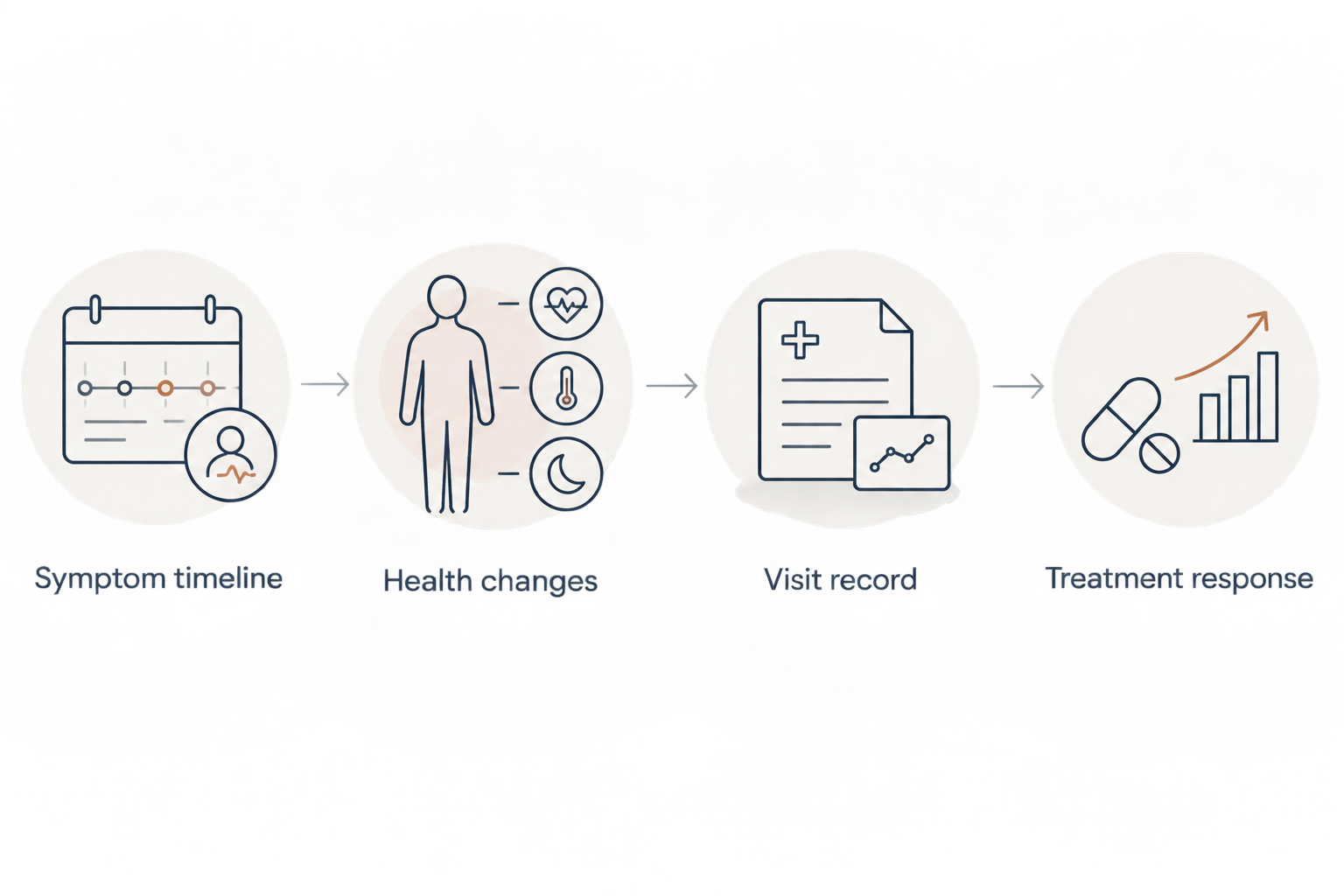
A useful handoff includes what happened before and after treatment, not just the prescription name.
Keep the conversation factual
You do not need to prove that the problem is severe enough to deserve care. Describe what changed and what you want help with: getting an erection, maintaining it, managing side effects, or understanding a possible underlying condition.
Avoid labeling yourself with low testosterone based only on ED. Erection problems and low sexual desire overlap, but they are not interchangeable symptoms.
Establish the physician-led plan
Review causes and safety
- Discuss your goals and medical history. Explain what a useful outcome looks like and what concerns you about treatment. Mention fertility plans before any discussion of testosterone therapy.
- Review cardiovascular health. ED can be a marker of cardiovascular disease, a point recognized in the American Urological Association's ED guideline. Ask whether your blood pressure, diabetes screening, cholesterol assessment, or exercise-related symptoms need attention.
- Confirm the reason for each test. Not every man needs every test. When testosterone deficiency is suspected, diagnosis generally requires compatible symptoms and low testosterone confirmed on 2 separate early-morning blood tests, not one isolated result.
- Agree on treatment and reassessment. Ask what the treatment is intended to improve, what side effects require contact, and what happens if it does not help. Leave with directions you understand.
Expected result: You have a working assessment and a defined next step, not merely another prescription. Some causes remain uncertain after the first appointment; the plan should explain how they will be evaluated.
Set treatment boundaries
A physician-led ED plan in 2026 should address medication interactions, correct use, and your broader health. It should not promise a guaranteed response or treat testosterone as the automatic answer.
Oral ED medicines help many men, but they are unsuitable with nitrates and do not address every cause of ED. Other approaches require their own assessment, instructions, and discussion of risks. Do not combine ED pills, injections, or another person's medication without explicit prescribing instructions.
Mensmedicalinstitute provides physician-led ED treatment in St. Louis. That focused care still requires candid discussion of limitations: response varies, further evaluation can be necessary, and ongoing medical conditions need coordination with your usual clinicians.
If urgent care already prescribed an ED medicine
The second workflow starts with a safety review, not an automatic refill. Keep the prescription packaging and discharge instructions so the next clinician can verify exactly what was prescribed.
- Check that the directions are clear. If the dose, timing, or frequency is unclear, contact the prescriber or dispensing pharmacist before taking it.
- Confirm your full medication list was reviewed. Specifically disclose nitrates, nitrites, other ED treatments, and medicines that affect blood pressure. A pharmacist can help identify interactions but does not replace evaluation of the ED itself.
- Record the response without changing the plan yourself. Note benefit and side effects. A single unsuccessful attempt does not establish that all ED treatment will fail.
- Arrange follow-up before relying on repeated walk-in prescriptions. Bring the record even if the medicine worked. Improvement does not rule out diabetes, vascular disease, or another contributing condition.
Expected result: You preserve useful information from the urgent care visit while giving the next clinician a safe basis for continuing, changing, or stopping treatment.
If you have no prescription, skip the medication-response record. Do not borrow a pill to create a trial before your appointment.
Troubleshooting the handoff
Urgent care does not evaluate ED
Ask for guidance on the appropriate care setting, then arrange a scheduled appointment. Being redirected does not mean the symptoms are unimportant; the clinic's scope is the issue. Emergency warning signs still require emergency care.
Your records have not arrived
Bring the discharge paperwork and medication packaging you already have. Identify the clinic and visit date, and ask how to authorize a record transfer. Do not delay an urgent safety question while waiting for paperwork.
The prescribed medicine did not help
Contact the prescriber rather than increasing the dose or adding a second treatment. Timing, correct use, medication interactions, and the underlying cause all deserve review. The next step is a clinical decision, not proof that your condition is untreatable.
One testosterone result was low
Do not treat one result as a completed diagnosis. Illness, testing conditions, and normal variation affect interpretation. Discuss symptoms and repeat early-morning testing with the clinician before deciding whether testosterone treatment is appropriate.
You are uncomfortable describing the problem
Write a brief note and hand it to the clinician. Include when the problem began, what happens, and your main concern. You can ask to discuss sexual health privately without a partner or accompanying family member present.
Customize your workflow
Make the 2026 follow-up fit the question that remains unresolved. Persistent ED, a medication safety concern, low desire, and an abnormal laboratory result are different starting points, even when they occur together.
Before leaving, ask who will interpret pending results and whom to contact about side effects. If several clinicians prescribe for you, ask how medication changes will be communicated. Keep your own updated list as well.
For men traveling from Metro East Illinois, confirm what records to bring before making the trip. You can contact the practice or call 314-394-1660 to ask about an appointment. Ask what the evaluation includes and which laboratory or follow-up services are separate; do not assume all services are bundled.
FAQ
Can you go to urgent care for erectile dysfunction?
Yes, you can seek an initial assessment at urgent care, but ED services vary by location. Recurring symptoms need follow-up with primary care or a clinician who treats ED.
Is erectile dysfunction itself a medical emergency?
Erectile dysfunction without other concerning symptoms is generally not an emergency. An erection lasting more than four hours, significant penile injury, chest pain, or stroke symptoms requires emergency attention.
Will urgent care prescribe an ED medicine?
A prescription is not guaranteed. The clinician must assess your symptoms, medical history, medication interactions, and whether treatment fits the clinic's scope.
What should I bring to a follow-up after urgent care?
Bring your discharge instructions, available test results, medication list, and symptom timeline. Include any ED treatment you used and what happened afterward.
Does erectile dysfunction mean I need testosterone?
No. ED alone does not establish testosterone deficiency or a need for testosterone treatment. Diagnosis requires appropriate symptoms and confirmatory testing interpreted by a clinician.
Should I still follow up if the ED medicine works?
Yes, recurring ED still deserves evaluation even when medication helps. A treatment response does not rule out cardiovascular risk factors, diabetes, medication effects, or other contributors.
What if I take nitroglycerin and want ED treatment?
Tell the prescribing clinician before taking any ED medicine. Sildenafil and tadalafil must not be combined with nitrates because the combination can dangerously lower blood pressure.
One last thing
The most useful outcome of a 2026 urgent care visit is a safe next step, not necessarily a prescription. A normal result or a helpful pill answers only part of the question. Ask what remains unexplained and who will follow it up.
For a low-pressure conversation about physician-led ED care, call Mensmedicalinstitute at 314-394-1660. Individual treatment decisions require a medical evaluation.