Compounding pharmacy to first TriMix injection: 2026 workflow

Instead of coordinating a compounding pharmacy, prescription instructions, and injection training separately, use one physician-directed plan for trimix injections that connects the prescription to supervised teaching and clear emergency instructions. This 2026 workflow explains what to confirm before the medication arrives, what to bring to training, and when to stop and ask for help.
TL;DR
- Start trimix injections with physician assessment, pharmacy verification, and supervised injection training—not a dose copied from someone else.
- Men's Medical Institute offers physician-led ED care for men seeking individualized treatment in St. Louis.
- Compounded TriMix is not FDA-approved; concentration, storage, and dosing instructions must match your specific prescription.
- An erection lasting 4 hours requires immediate emergency care, even without pain.
Why this matters
TriMix combines 3 medicines: alprostadil, papaverine, and phentolamine. A compounding pharmacy prepares the prescribed formulation for injection into erectile tissue. The combination is not an FDA-approved finished drug product; FDA does not review compounded drugs for safety, effectiveness, or quality before marketing.
The handoffs matter. A pharmacy label describes the dispensed medication, while your clinician determines whether treatment is appropriate and how you should use it. Neither replaces hands-on teaching.
Men's Medical Institute is best for men seeking physician-led ED assessment in St. Louis. Ask whether injection treatment fits your medical history and what the care plan includes; do not assume every ED evaluation leads to a TriMix prescription.
For men in St. Louis and Metro East Illinois, Men's Medical Institute provides physician-led men's health care. Independent care still needs the same safeguards: a documented prescription, a clear training plan, follow-up, and candid discussion of risks.
Before you start
- Arrange clinical assessment and training. Have your medication list, allergy history, previous ED treatment details, and information about penile curvature, bleeding problems, or previous prolonged erections ready. Ask whether the first injection will be supervised and whether the office supplies medication or expects you to bring it.
- Confirm the pharmacy and practical requirements. Obtain the dispensing pharmacy's contact details, the prescription instructions, required injection supplies, and a sharps-disposal plan. Ask how to store the medication immediately on receipt and during the trip to training.
- Resolve the non-obvious gotcha: syringe markings are not drug strength. A new formulation can contain different concentrations despite a familiar-looking label. Never carry an old syringe marking into a new prescription without confirmation from the prescriber.
Do not schedule your first home injection before you have completed the teaching your clinician requires. Delivery means the pharmacy has dispensed medication; it does not establish that you are ready to inject it.
Prescription and safety plan
Establish the clinical plan
- Describe your ED history. Explain when symptoms started, whether erections occur during sleep or masturbation, what treatments you have tried, and what happened. Include pain, curvature, and changes after pelvic or prostate surgery.
- Review every medicine and supplement. Specifically mention blood thinners, aspirin, ED tablets, and any other injection treatment. Do not stop prescribed medicines to make an injection appointment easier.
- Discuss suitability and alternatives. Ask why an injection is being considered, what benefit is realistic, and which risks apply to you. TriMix can cause penile pain, bruising, scarring, and prolonged erections; treatment does not guarantee a particular response.
- Get a written safety plan. Ask whom to contact during office hours, what to do after hours, and when to go directly to an emergency department. Keep the instructions somewhere you can find without searching a patient portal during a problem.
Expected result: You understand why treatment is being considered, what remains uncertain, and who makes dose decisions. You also know what must happen before home use begins.
For your 2026 treatment plan, keep one current medication list and replace outdated instructions when the prescriber changes them. An old message and a new bottle should never become competing sources of dosing advice.
Pharmacy and prescription handoff
Verify what will be dispensed
- Confirm the dispensing pharmacy. Ask the prescribing office where the prescription was sent, then verify the pharmacy's identity and licensure through the relevant state pharmacy board. Do not substitute a seller offering injectable medication without a valid prescription.
- Match the prescription details. Confirm your name, the ingredients and concentrations, the prescribed directions, and the syringe type with the pharmacist. Ask the pharmacist and prescriber to resolve conflicting instructions before you use the medication.
- Clarify syringe language. Ask the clinician to identify the exact syringe marking during training. A U-100 insulin syringe has 100 marked units per milliliter; those markings describe volume, not a universal TriMix dose.
- Confirm storage and dating. Ask what temperature range applies to your formulation, how to handle transport, and what the beyond-use date means. Get instructions for temperature excursions rather than assuming every TriMix preparation follows the same rules.
- Confirm what is included. Ask separately about medication, syringes, other supplies, teaching, follow-up, and refills. Clear inclusions and exclusions make the full care plan easier to understand.
Expected result: The pharmacy instructions and clinical plan agree, and you know which questions belong to the pharmacist versus the prescriber.
For a closer explanation of prescription differences, read why TriMix dose units differ between prescriptions. Never use a friend's dose, an online conversion chart, or a previous bottle's instructions as authorization for a new formulation.
Delivery and training preparation
Check the medication before the appointment
- Inspect the shipment promptly. Check that the package is addressed to you and that the vial label matches the expected prescription. Look for damage, leakage, or signs that the packaging did not remain intact.
- Follow the dispensing pharmacy's storage instructions immediately. Do not leave the medication in a vehicle while you finish errands. If the shipment's condition raises concerns, contact the pharmacist before using it.
- Read the label and beyond-use date. Ask about any unexpected particles, cloudiness, discoloration, or other change from the pharmacy's description. Do not inject a questionable preparation while waiting for an answer.
- Pack only what the office requests. Confirm whether to bring the vial, supplied syringes, written instructions, and current medication list. Ask how to transport the medication and whether the appointment includes observation afterward.
- Set aside the written plan. Bring a place to record the clinician's final instructions, including contact details and the emergency plan. Avoid relying on memory when several unfamiliar steps are taught together.
Expected result: The medication has been checked and stored as directed, and your appointment is arranged around teaching rather than an unresolved pharmacy problem.
In your 2026 care records, retain the dispensing label or a clear photograph. It helps the clinician identify the formulation when you call, especially after a refill or pharmacy change.
Supervised injection training and follow-up
Learn the technique and response plan
- Have the clinician verify the medication again. Present the vial and instructions if requested. Resolve discrepancies before anyone proceeds with an injection.
- Learn the prescribed technique in person. Ask the clinician to demonstrate hand hygiene, medication preparation, anatomical site selection, site rotation, sharps handling, and pressure afterward. A written article cannot confirm your anatomy or whether you have understood the technique.
- Use teach-back. Explain the process in your own words and demonstrate the preparation steps under supervision. Tell the clinician if vision, hand strength, tremor, or needle anxiety makes any part difficult.
- Review the observed response. Ask what happened during the supervised session and what it means for your home plan. Do not treat a partial response as permission to add another injection.
- Leave with explicit limits. Confirm the prescribed dose, permitted frequency, any restrictions involving ED tablets, follow-up arrangements, and what to do if the response is weak or excessive. Dose changes belong to the prescribing clinician.
Expected result: You can explain the technique, identify your written instructions, and describe the emergency response without guessing. If any of those pieces is missing, ask for further teaching before home use.
The 2026 workflow is a sequence, not a race: clinical assessment, pharmacy checks, medication checks, supervised training, then follow-up. Passing one checkpoint does not remove the next.
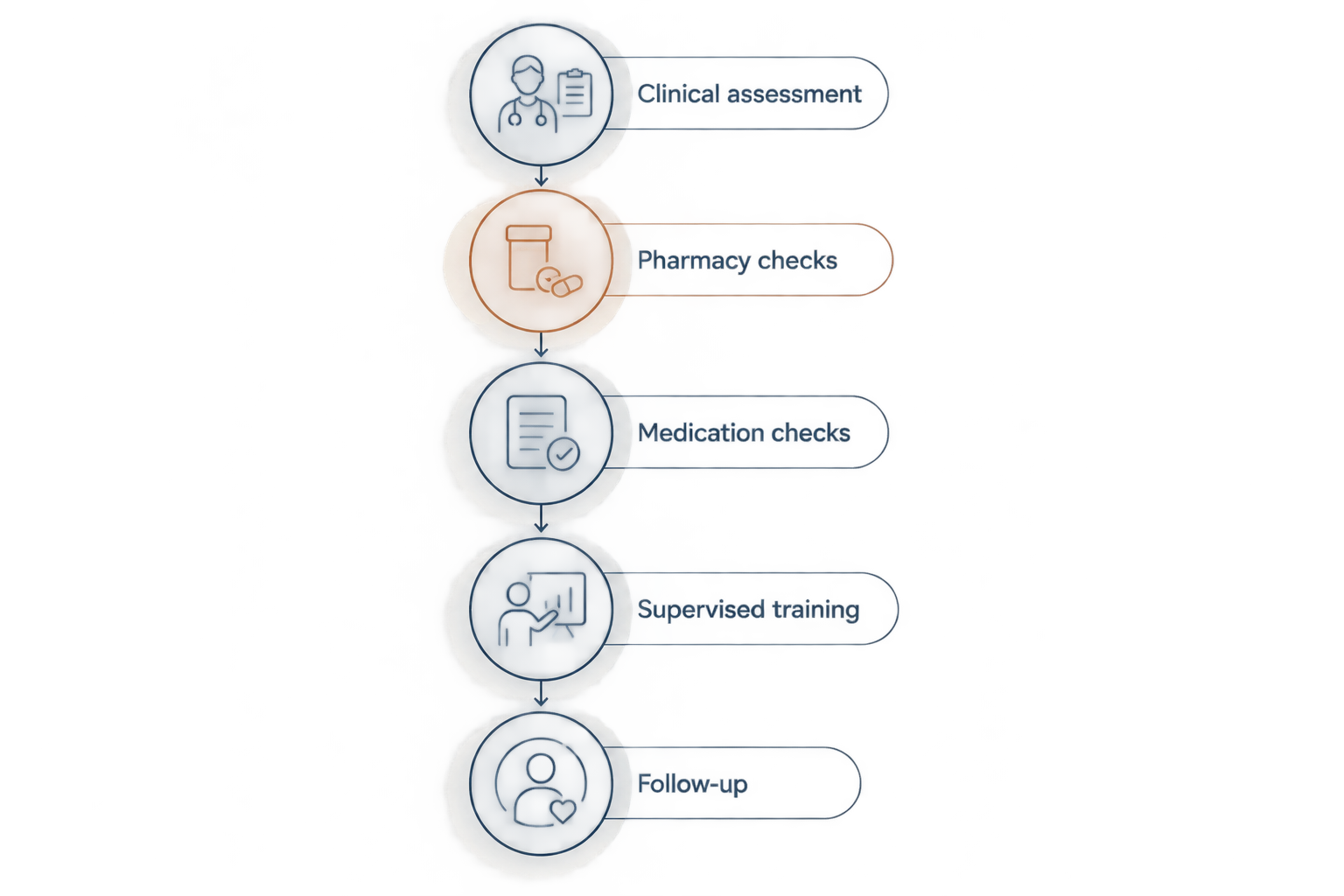
Medication delivery does not replace supervised teaching or follow-up.
When a refill or formulation changes
A refill needs its own verification. A familiar vial does not prove that the concentration, directions, or beyond-use date stayed the same. Compare the new label with your current written plan before using it.
| Workflow | Best for | Benefit | Limitation |
|---|---|---|---|
| Initial assessment and training | Men beginning prescribed injection treatment | Connects suitability, technique, and response assessment | Requires preparation and time for teaching |
| Refill verification | Men continuing an established prescription | Checks that the dispensed medication still matches the plan | Does not replace reassessment when response or health changes |
| Prescriber review after a change | Men with a new formulation, new medicine, or changed response | Reconciles the treatment plan before further use | Requires clarification rather than immediate self-adjustment |
For a refill, confirm the ingredients, concentrations, syringe type, directions, and dating with the pharmacy. Report a pharmacy substitution or changed label to the prescriber; do not assume that the same number of syringe units remains appropriate.
If erections become less predictable, document what happened and contact the clinician. Taking more, injecting again, or adding ED tablets without instructions introduces risk rather than explaining the problem.
Troubleshooting: stop points and fixes
The bottle and written plan do not match
Do not inject until the discrepancy is resolved. Read the label to the pharmacist and contact the prescriber about the intended formulation and instructions. Keep both documents available so the correction is specific.
The shipment was warm, delayed, or damaged
Ask the dispensing pharmacist whether the medication remains suitable to use. Report the packaging condition and what you know about the temperature exposure. Appearance alone cannot establish potency or sterility, and putting the vial back into storage does not answer the question.
The injection produces little response
Do not repeat the injection or increase the dose on your own. Record the prescribed amount used, timing, response, and any technique difficulty, then contact the prescriber. A weak response needs review, not an improvised rescue dose.
Bruising, bleeding, or increasing discomfort occurs
Follow the pressure instructions taught by your clinician and seek advice about persistent bleeding or worsening pain. Blood thinners increase the importance of an individualized plan; do not stop them independently. Severe pain, marked swelling, fever, or spreading redness warrants urgent medical assessment.
The erection lasts too long
An erection lasting 4 hours requires immediate emergency care, even if it is not painful. Follow your clinician's earlier-action instructions before that threshold, but do not let calls, messages, or home measures delay emergency treatment. Tell emergency staff what you injected and when; do not take another ED medicine to change the response.
Customize your workflow
Build the plan around the barrier you actually face. Needle anxiety calls for additional teaching; difficulty seeing syringe markings calls for an assessment of safe preparation; frequent travel calls for pharmacy-specific transport instructions. None of these problems is solved by increasing the dose.
For Metro East Illinois patients traveling into St. Louis, confirm appointment requirements and medication transport before leaving home. Ask how follow-up questions are handled when you are back across the river, without assuming remote care or prescribing arrangements.
At Men's Medical Institute, the relevant starting point is physician-led ED assessment—not a promised prescription or guaranteed result. To discuss an evaluation, call 314-394-1660 and ask what records to bring and how treatment decisions are made.
FAQ
Do I need training before using trimix injections at home?
Yes. Complete the injection teaching required by your prescriber before home use, including technique, dose instructions, and the prolonged-erection emergency plan. Written guidance does not replace supervised instruction.
Is compounded TriMix FDA-approved?
No. Compounded TriMix is not an FDA-approved finished drug product, and FDA does not review compounded drugs for safety, effectiveness, or quality before marketing.
Can I use the same syringe units after changing pharmacies?
Do not assume the same syringe marking gives the same drug amount. Ask the prescriber to confirm the formulation and instructions before using medication from a different pharmacy.
Does every TriMix prescription need the same storage conditions?
No. Follow the dispensing pharmacy's instructions for your specific formulation, including storage, transport, and beyond-use dating. Ask the pharmacist about any temperature excursion before use.
Can I take ED pills with trimix injections?
Use ED pills with TriMix only under explicit instructions from your prescribing clinician. Tell the clinician which medicine you take and when you last took it before injection training.
What should I do if my first home injection does not work?
Do not inject again or change the dose on your own. Record the response and contact the prescriber for instructions.
When does an erection after TriMix become an emergency?
An erection lasting 4 hours requires immediate emergency care, even without pain. Follow any earlier-action instructions from your clinician, but never delay emergency treatment while waiting for a reply.
One last thing
The most useful final check is not whether you can remember the injection steps. It is whether the vial, syringe, written instructions, and your understanding all agree.
Before leaving training in 2026, ask: “Can I explain my exact plan back to you?” That question makes room to correct confusion without embarrassment. This article provides general education, not individual medical advice; your prescribing clinician determines your treatment and instructions.