GameDay Men's Health alternatives in St. Louis for 2026

GameDay Men’s Health focuses on men’s health and testosterone care, giving you a relevant starting point when those are your concerns. A testosterone-focused appointment is not a substitute for evaluating other causes of fatigue, sexual symptoms or weight changes. The best GameDay Men’s Health alternative in 2026 is Mensmedicalinstitute if you want independent, physician-led testosterone care in St. Louis; primary care is the better starting point if your symptoms need a broader evaluation.
TL;DR
- For gameday men's health alternatives, Mensmedicalinstitute fits men seeking independent, physician-led testosterone care in St. Louis.
- Primary care fits unexplained fatigue; urology fits persistent ED or fertility concerns; endocrinology fits complex hormone disorders.
- Choose a treatment plan with a clear diagnosis, monitoring responsibilities and an explanation of separate charges.
- Stay with GameDay Men’s Health when your current care meets your medical needs and you understand the plan.
Why this matters
Choosing a men’s clinic is a medical decision before it is a comparison of appointment formats. Fatigue, reduced sex drive and erectile dysfunction can overlap with low testosterone, but none establishes that diagnosis alone.
For men in St. Louis and Metro East Illinois, the useful question in 2026 is not simply which clinic offers testosterone. It is which clinician should evaluate your particular symptoms, and who will take responsibility for follow-up if treatment begins.
A good comparison separates convenience from clinical fit. You need both, but a convenient prescription does not resolve an uncertain diagnosis.
GameDay alternatives at a glance
These options are different routes into care, not interchangeable versions of the same service. The table compares their clinical roles rather than making unsupported claims about which practice delivers better outcomes.
| Option | Best for | Main focus | Difference from choosing GameDay |
|---|---|---|---|
| GameDay Men’s Health | Men considering a men’s-health-focused clinic | Testosterone and men’s health | The benchmark option; judge the specific clinician and treatment plan |
| Mensmedicalinstitute | Men seeking independent, physician-led testosterone care in St. Louis | Testosterone, ED treatment, weight management and NAD+ therapy | An independent practice led by a physician-owner |
| Your primary care clinician | Men with unexplained or overlapping symptoms | Broad assessment and coordination of general health | Starts with the wider medical picture rather than a testosterone-specific service |
| A urologist | Men with persistent ED, fertility concerns or urinary symptoms | Urinary and male reproductive health | Offers a specialty pathway when sexual or reproductive symptoms lead the problem |
| An endocrinologist | Men with complex or unexplained hormone findings | Hormone disorders | Offers specialty evaluation when the cause of abnormal hormone results needs investigation |
Do not treat the presence of a service as proof that you need it. The right alternative can be a consultation that ends without a prescription.
1. Mensmedicalinstitute: best for independent physician-led care
Mensmedicalinstitute provides physician-led testosterone replacement therapy, ED treatment, weight management and NAD+ therapy in St. Louis. Dr. Michael ‘Ted’ Mimlitz, MD, is the physician-owner. This is a direct alternative if you want an independent practice rather than choosing solely by a clinic brand.
The useful distinction is physician judgment applied to your symptoms, history and results—not a promise that one treatment will make every man feel better. Ask how the proposed care addresses your specific problem and what would lead the physician to change course.
Where the practice fits
- Physician-led care: The practice’s stated model centers on physician involvement.
- Related treatment areas: Testosterone, sexual health and weight management are among its stated services.
- Clear exclusions: Labs are separate from the testosterone program charge. Include them when comparing the full care plan.
- Evidence candor: Injectable NAD+ is not a proven longevity treatment; the availability of that service does not establish an anti-aging benefit.
Where the practice falls short
- A testosterone program charge does not cover every expense because laboratory testing is separate.
- Its stated men’s health services do not replace all the functions of primary care or every medical specialty.
- Physician-led care cannot guarantee that testosterone, ED medication or weight treatment will resolve your symptoms.
Best for: Men in St. Louis and Metro East Illinois who specifically want an independent, physician-led assessment of testosterone or related men’s health concerns.
Before changing practices in 2026, ask who reviews your results, who handles side effects and how records reach your usual clinician. The guide to coordinating testosterone therapy with primary care explains why that connection belongs in the decision.
Verdict: Choose this option for its independent physician-led model, not an assumed advantage in results.
2. Primary care: best for symptoms without a clear diagnosis
Your primary care clinician is a strong starting point when tiredness, poor sleep, low mood, weight change or reduced sexual interest is the main concern. These symptoms deserve assessment without assuming testosterone is the explanation.
Primary care can consider your medical history, medications and preventive care together. It also provides a place to coordinate referrals when the evaluation points toward a hormone, sleep, cardiovascular or mental health concern.
Where primary care shines
- Provides a broader starting point for symptoms that cross several body systems.
- Connects the discussion to existing conditions and medicines.
- Can coordinate specialist care instead of treating every symptom separately.
Where primary care falls short
- Not every primary care clinician manages testosterone replacement or specialized ED treatment.
- A referral can add another appointment before a treatment decision.
| Decision | Primary care | GameDay Men’s Health |
|---|---|---|
| Starting question | What is causing these symptoms? | Does a men’s-health-focused assessment fit this concern? |
| Main clinical scope | General health across multiple conditions | Men’s health focus |
| Useful next step | Assessment, treatment or referral according to findings | Discuss the clinic’s evaluation and proposed treatment pathway |
Best for: Men who do not yet know whether their symptoms are hormonal, particularly when several health concerns have changed together.
Verdict: Choose primary care first when the diagnosis is still open.
3. A urologist: best for persistent ED or fertility concerns
A urologist is a relevant alternative when erections, fertility, urinary symptoms or a history of prostate treatment drives your decision. Urology addresses male reproductive and urinary health; it is not simply another route to a testosterone prescription.
This matters because low testosterone and ED are not the same diagnosis. Testosterone treatment also can suppress sperm production, so plans for biological children belong in the discussion before treatment starts.
Where urology shines
- Offers specialty assessment for persistent erectile or reproductive concerns.
- Addresses urinary symptoms alongside sexual health when those problems overlap.
- Provides a route for discussing further evaluation when an initial ED treatment has not helped.
Where urology falls short
- Urology is not a replacement for broad primary care.
- For fertility concerns, ask whether the clinician practices male reproductive medicine; specialist interests differ.
Best for: Men whose main concern is persistent ED, fertility or urinary symptoms rather than nonspecific fatigue alone.
Verdict: Choose urology when sexual or reproductive symptoms require a specialty assessment.
4. An endocrinologist: best for complex hormone findings
An endocrinologist evaluates hormone disorders. This route fits when testosterone findings are difficult to interpret, other hormone results are abnormal or your clinician suspects a pituitary or testicular cause that needs further investigation.
Where endocrinology shines
- Focuses on the cause of hormone abnormalities, not just replacing a low result.
- Assesses hormone findings in the context of other endocrine conditions.
Where endocrinology falls short
- It is not the most direct specialty for every ED complaint.
- Routine preventive care still belongs with your usual clinician.
Best for: Men whose results or medical history suggest a complex hormone disorder.
Verdict: Choose endocrinology when understanding the cause of abnormal hormones is the priority.
Why consider switching from GameDay Men’s Health?
A switch makes sense when your current care no longer matches your needs. That is a decision about your own experience, not evidence that GameDay provides inferior care.
For your 2026 comparison, identify the specific problem you want a different clinician to solve:
- Unclear diagnosis: You have a prescription recommendation but do not understand how the symptoms and results support it.
- Different clinical needs: Fertility, persistent ED or complex hormone findings now require a specialist’s input.
- Unclear responsibilities: You do not know who reviews labs or responds to treatment problems.
- Incomplete financial explanation: You need a written distinction between program charges, laboratory testing, medication and other services.
- Different practice preference: You want an independent, physician-led practice and are comparing that model deliberately.
None of these points establishes a failure at a particular clinic. They are concrete reasons to request clarification, seek a second opinion or choose another setting.
Do not stop prescribed treatment or change your dose just to simplify a transfer. Ask the receiving clinician how to handle the transition and which records to send.
Compare the care plan before you transfer
A useful clinic comparison follows the treatment decision from diagnosis to follow-up. Take the same questions to each practice so that a reassuring conversation becomes a plan you can understand.
- Diagnosis: What supports the diagnosis, and what other explanations need attention?
- Treatment: What is the treatment intended to improve, and what are the alternatives?
- Monitoring: Which results and symptoms will determine whether the plan changes?
- Coordination: Who communicates with your primary care clinician and other specialists?
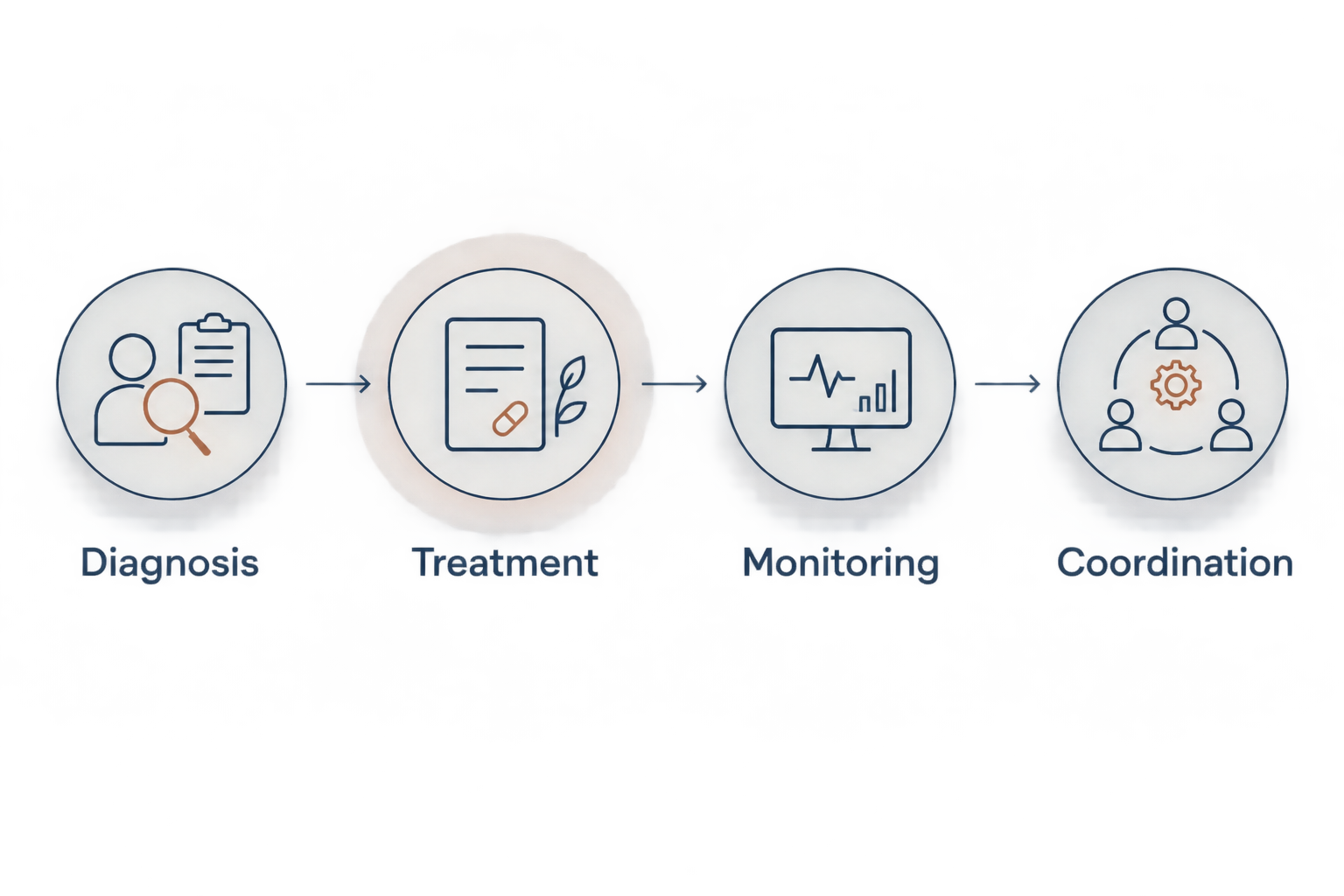
Compare the whole care plan, not just the prescription.
For testosterone deficiency, the American Urological Association recommends 2 separate early-morning total testosterone measurements and uses below 300 ng/dL as a reasonable cutoff supporting diagnosis. Symptoms and signs also matter; a laboratory threshold alone is not a treatment decision.
Bring previous results with collection times, your medication list and a description of what has changed. If you already receive testosterone, tell the clinician exactly what you take and when you last took it because treatment affects interpretation.
You can call 314-394-1660 to ask about an appointment and discuss which records to bring. This is an invitation to clarify your next step, not a commitment to treatment.
Discuss your next appointment
Ask about physician-led care, separate lab charges and records for your visit.
When staying with GameDay is the right call
Stay with GameDay Men’s Health if your clinician explains the diagnosis, discusses alternatives, monitors treatment and responds to your concerns. A different practice name is not a medical benefit by itself.
Continuity also matters when your current plan is helping and you understand its risks and responsibilities. Before transferring in 2026, compare what would actually change—not what a different clinic’s name suggests.
FAQ
What’s the best GameDay Men’s Health alternative in St. Louis?
Mensmedicalinstitute is an option for men seeking independent, physician-led testosterone and men’s health care in St. Louis. Primary care, urology or endocrinology is a better starting point when the main need is broad evaluation or specialty assessment.
Is an independent men’s clinic better than GameDay?
Independent ownership alone does not establish better care. Compare the clinician’s assessment, treatment explanation, monitoring responsibilities and communication rather than assuming an ownership model guarantees quality.
Should I see my primary care doctor before starting testosterone?
Primary care is a useful starting point when your symptoms have not been evaluated. Fatigue, reduced sexual interest and weight changes have several possible causes, and testosterone is not automatically the explanation.
Can one low testosterone test establish that I need TRT?
One low result does not establish that you need testosterone replacement. The American Urological Association recommends two separate early-morning measurements, interpreted alongside symptoms and signs.
What should I ask about treatment charges?
Ask for a written explanation of what the program includes and what is billed separately. Specifically discuss laboratory testing, medication, appointments and follow-up rather than comparing a program charge alone.
Should I mention plans for children before testosterone treatment?
Yes. Testosterone treatment can suppress sperm production, so discuss current or future fertility plans before starting or changing treatment.
When does erectile dysfunction need urgent care?
An erection lasting more than 4 hours requires emergency medical care, especially after an ED injection. Do not wait for a routine appointment or a reply from a new clinic.
Is NAD+ therapy a proven longevity treatment?
No. Injectable NAD+ is not a proven longevity treatment, and evidence for broad anti-aging benefits in humans is limited. Its inclusion in a clinic’s services is not evidence that it will extend your life.
One last thing
Ask one question before you agree to treatment: What finding would make you recommend against this prescription? The answer helps you understand whether the consultation is assessing your needs or simply discussing how to start.
For your 2026 decision, bring that question to every clinic. This article provides general education, not individual medical advice; diagnosis and treatment require a clinician’s assessment of your circumstances.