How much does testosterone replacement therapy cost per month?

TRT does not have one monthly cost that applies to every patient: your total depends on the prescribed treatment, the care included in the program, and separately billed services. The monthly program fee is not the full bill when laboratory testing costs extra. Compare the ongoing treatment charge and its exclusions before deciding whether a program fits your budget.
TL;DR
- How much does TRT cost per month? Compare the full care bill, not just the advertised testosterone program fee.
- Men’s Medical Institute provides physician-led testosterone care in St. Louis; laboratory testing is billed separately from its testosterone program.
- A first-month offer does not tell you the ongoing monthly charge or the cost of follow-up testing.
- Choose testosterone replacement therapy after a medical evaluation, not because a monthly offer looks affordable.
Why this matters
A monthly quote is useful only when you know what it covers. Medication, laboratory testing, appointments, and supplies are different parts of care; a clinic’s billing arrangement determines which appear together and which arrive separately.
At Men’s Medical Institute, labs are separate from the testosterone program price. That distinction belongs in your budget before treatment starts, not after you receive a laboratory bill.
For your 2026 comparison, start with a written list of inclusions and exclusions. The guide to comparing the full cost of TRT care explains why the advertised payment is only part of the decision.
How much does testosterone replacement therapy cost per month?
Your monthly TRT expense consists of the program charge plus any services, medication, testing, or supplies that the program does not include. Ask for the ongoing charge separately from any introductory offer, then identify expenses that occur outside the monthly billing cycle.
Use this breakdown when reviewing a quote. The table describes questions to ask, not services that every clinic charges for separately.
| Part of the bill | What to establish | Why it matters |
|---|---|---|
| Initial evaluation | Whether the assessment has a separate charge | Starting care and continuing care are different expenses |
| First-month program | When introductory terms end | The first payment does not establish the continuing payment |
| Ongoing program | What the recurring charge includes | You need a clear baseline for budgeting |
| Testosterone prescription | Whether medication is included or billed separately | A care fee and a medication charge are not automatically the same thing |
| Laboratory testing | Who bills for tests and whether collection is separate | Testing can sit outside the program fee |
| Follow-up care | Which scheduled visits and additional concerns are included | The scope of care matters alongside the charge |
| Supplies | Whether prescribed administration supplies are included | Treatment instructions and purchasing responsibilities should match |
Compare equivalent care before comparing monthly payments. A quote that includes one set of services cannot be compared directly with a quote that excludes those services.
You also need to distinguish a charge from an insurance benefit. A clinic’s willingness to provide an invoice does not establish that your insurer will reimburse it.
The first month: separate starting costs from continuing care
The first month is a starting point, not a reliable picture of the full treatment budget. An initial evaluation, baseline testing, or an introductory program arrangement can make it different from later months.
Ask when the ongoing billing terms begin and which starting expenses are separate. Request the answer in writing so you can compare the initial payment with the continuing obligation.
For a 2026 treatment decision, use these questions:
- Does the first payment cover an evaluation, treatment, or both?
- Are baseline laboratory tests included or billed separately?
- What happens financially if the physician determines that TRT is inappropriate?
- Does starting care create a continuing payment obligation?
- Which cancellation or renewal terms apply?
These are questions to verify, not assumptions about a particular clinic’s policies. A clear answer should tell you what you are paying for before you authorize payment.
Ongoing treatment: separate the program fee from the total
An ongoing program charge gives you a predictable billing item, but it does not establish that every aspect of treatment is included. Laboratory testing is a confirmed exclusion from the testosterone program at Men’s Medical Institute.
Ask how the practice handles follow-up visits, prescription changes, and questions between appointments. Do not assume that a recurring payment means unlimited appointments or that every prescription-related expense is included.
For a practical budget, distinguish monthly payments from periodic expenses. A laboratory bill paid during a testing month still belongs in your treatment budget, even though it does not recur every month.
You can also request a 12-month planning outline based on the proposed care schedule. Treat it as a planning document, not a guarantee: your physician can change testing or treatment when your clinical circumstances require it.
Why TRT costs vary
The useful question is not simply why one advertised payment differs from another. It is whether the difference reflects treatment, included services, billing arrangements, or an introductory offer.
- Prescribed formulation. Injectable, topical, and other testosterone formulations have different administration requirements. Ask for the cost of the formulation actually being considered for you.
- Included medical care. Establish whether the quote includes the initial assessment, scheduled follow-up, and review of treatment-related concerns.
- Laboratory billing. Identify the laboratory, the ordered tests, and who bills you. Do not assume a program payment covers testing.
- Starting versus continuing terms. An introductory arrangement and an ongoing program charge describe different stages of treatment.
- Insurance benefits. Coverage depends on your plan and its requirements. Confirm benefits for appointments, medication, and laboratory services separately.
- Administration supplies. Ask whether you must obtain supplies separately for the prescribed treatment and whether those expenses appear in the quote.
None of these factors establishes that a higher charge produces better care. They explain why you need an itemized comparison before drawing a conclusion.
How do I compare TRT quotes without missing something?
Use the same questions for each practice. That keeps the comparison focused on your proposed care rather than on whichever headline payment attracts your attention first.
Start with the evaluation
Ask who evaluates you, who makes prescribing decisions, and what information the clinician needs before recommending treatment. A financial discussion should not substitute for establishing whether testosterone therapy is medically appropriate.
Symptoms such as low energy or reduced sexual interest have several possible causes. A treatment recommendation needs more than a symptom checklist or a single result interpreted without context.
Request an itemized quote
Ask for a written explanation of the starting charge, ongoing charge, included services, and exclusions. Have the practice distinguish confirmed charges from expenses that depend on the eventual prescription or testing plan.
If something is described as included, ask what that means in practice. For example, prescription management and the medication itself are separate concepts; the quote should make clear which it covers.
Confirm laboratory billing
Ask where testing takes place, who sends the bill, and how you can request an estimate. Confirm whether specimen collection has a separate charge rather than assuming the test estimate covers everything.
If you plan to use insurance, check the laboratory’s network status with your insurer. A clinic’s participation and a laboratory’s participation are separate questions.
Review ongoing terms
Ask how billing changes after an introductory period and what happens when the treatment plan changes. Read renewal and cancellation terms before agreeing to a continuing arrangement.
For your 2026 budget, keep the written quote and your insurer’s benefit information together. They answer different questions: what the provider charges and what your plan covers.
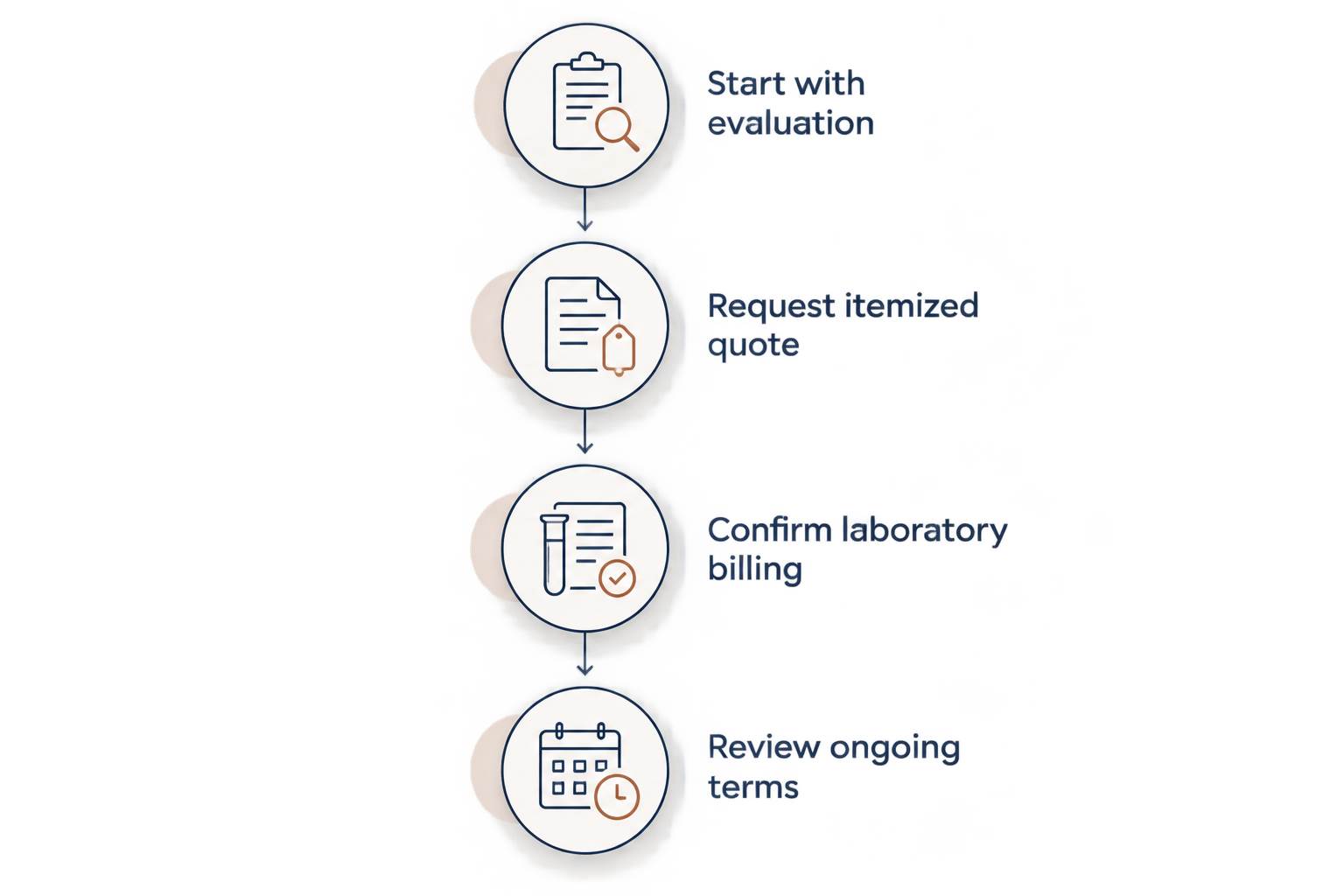
Compare the proposed care and its exclusions before comparing recurring payments.
Which TRT program is best for me?
Men’s Medical Institute is best suited to St. Louis men seeking physician-led testosterone care who understand that laboratory testing is billed separately. Its stated approach centers on individualized physician judgment rather than a guaranteed result.
The practical benefit is knowing that physician-led care is part of the offering. The budget limitation is equally important: the program payment alone does not tell you the total cost of treatment.
For men in St. Louis and Metro East Illinois, appointment logistics also belong in the decision. Ask what your proposed care requires before arranging travel or time away from work; do not assume every visit or test can happen in the same setting.
If you want to discuss whether an evaluation makes sense, call 314-394-1660 or contact the practice. You can ask about the program, laboratory exclusions, and the steps involved without assuming that TRT is the right treatment for you.
Does a lower monthly TRT payment mean worse care?
A lower monthly payment does not establish worse care, just as a higher payment does not establish better care. You need to know what is included, who makes treatment decisions, and how follow-up is handled.
Look for clear prescribing responsibility and a monitoring plan that responds to your health history and treatment. Avoid using a payment amount as a substitute for those details.
An unclear quote is a reason to ask more questions, not proof of poor medical care. Give the practice an opportunity to explain the scope and exclusions before deciding.
Will insurance cover my testosterone treatment?
Insurance coverage is plan-specific, so confirm your own benefits before counting on reimbursement. Ask separately about the medical evaluation, testosterone prescription, and laboratory testing.
For a 2026 coverage check, ask your insurer whether prior authorization, a particular pharmacy, or a preferred laboratory applies. Record the explanation and any reference information provided during the conversation.
Do not treat a submitted claim as a promise of payment. Your deductible, copayment, coinsurance, and exclusions determine your share under the plan.
Should I choose TRT based on the monthly payment?
No. Choose TRT only after a clinician establishes that treatment is appropriate; then compare the financial terms. Testosterone therapy treats a clinical condition, not a budget category or a promise to feel younger.
Endocrine Society clinical guidance calls for symptoms or signs consistent with testosterone deficiency and consistently low testosterone concentrations. Confirming the diagnosis generally involves 2 separate morning testosterone measurements, with further assessment guided by the results and clinical history.
Tell the clinician if you want children, because testosterone therapy can suppress sperm production. Your health history, fertility plans, and monitoring needs matter more than whether an introductory offer looks appealing.
FAQ
How much does TRT cost per month in St. Louis?
Your monthly TRT expense is the program charge plus any separately billed care, medication, tests, or supplies. Compare the ongoing charge and exclusions rather than relying on an introductory payment.
Are labs included in the testosterone program at Men’s Medical Institute?
No. Laboratory testing is billed separately from the testosterone program price at Men’s Medical Institute, so the program fee is not your full treatment budget.
Is testosterone medication always included in a monthly TRT program?
No universal inclusion applies across TRT programs. Ask whether the quoted charge includes the prescribed medication or only the medical services associated with managing it.
Will my health insurance pay for TRT?
Coverage depends on your insurance plan and its requirements. Confirm benefits for appointments, the prescribed medication, and laboratory services separately before relying on reimbursement.
Is a cheaper TRT program automatically a worse choice?
No. A lower payment does not establish worse care; compare the included services, prescribing responsibility, laboratory arrangements, and follow-up plan.
Do I need blood tests before starting testosterone therapy?
Yes. Diagnosing testosterone deficiency requires appropriate blood testing alongside symptoms and clinical assessment; confirmation generally involves separate morning measurements.
Can I start TRT just because I feel tired?
Fatigue alone does not establish testosterone deficiency. A clinician should assess your symptoms, health history, and appropriate testing before recommending treatment.
Can testosterone treatment affect my fertility?
Yes. Testosterone therapy can suppress sperm production, so discuss current or future plans for children before starting treatment.
One last thing
Ask the practice to explain a month when testing is due, not just a month when nothing changes. That question brings separately billed laboratory work into the conversation and makes the budget more useful.
Before committing to care in 2026, keep the treatment decision and the payment decision distinct. First establish whether TRT fits your medical needs; then confirm that you understand the program’s recurring charges, exclusions, and terms.
This article provides general education, not individual medical advice. Your diagnosis, prescription, and monitoring schedule require a clinician’s assessment.