Low testosterone symptoms in men who work night shifts

Low testosterone symptoms in men who work night shifts include reduced sex drive, fewer spontaneous erections, fatigue, and changes in mood or concentration—but these symptoms do not establish a diagnosis. Disrupted sleep, sleep apnea, depression, and medication effects can produce similar complaints. The next step is a physician evaluation that accounts for your sleep schedule and repeat testosterone testing, not treatment based on symptoms or a single blood result.
TL;DR
- Low testosterone symptoms in men overlap with sleep disruption; night-shift fatigue alone does not establish testosterone deficiency.
- Reduced sex drive and fewer spontaneous erections deserve attention alongside sleep quality, medicines, and mood.
- Men’s Medical Institute provides physician-led testosterone care for men in St. Louis.
- Tell your physician when you sleep before scheduling testosterone blood tests.
What are low testosterone symptoms in men who work night shifts?
The symptoms are not unique to night workers. What changes is the context: fatigue after an overnight shift, sexual changes after broken daytime sleep, and blood drawn after being awake all night need careful interpretation.
| Symptom or change | How it relates to testosterone evaluation | What else needs attention |
|---|---|---|
| Reduced sexual desire | A recognized symptom of testosterone deficiency | Depression, relationship stress, medicines, and sleep disruption |
| Fewer spontaneous erections | A relevant change to discuss with your physician | Sleep timing, erectile dysfunction, and other health conditions |
| Persistent fatigue | Can occur with testosterone deficiency but is nonspecific | Sleep deprivation, sleep apnea, anemia, and thyroid disease |
| Poor concentration or low mood | Can accompany testosterone deficiency | Shift-work sleep disruption, depression, and anxiety |
| Reduced strength or muscle mass | Can warrant evaluation when persistent | Exercise changes, nutrition, illness, and medication effects |
A symptom pattern matters more than an isolated bad shift. Describe what changed, how long it has persisted, and whether it improves after adequate sleep. A useful symptom diary can help you bring those details to an appointment.
Why this matters
Night work creates a diagnostic problem: inadequate sleep can resemble testosterone deficiency, and sleep timing affects how testosterone results should be interpreted. Neither explanation should automatically replace the other.
For men seeking care in 2026, the practical goal is to identify the cause of symptoms before choosing treatment. Testosterone therapy does not replace sleep or treat every cause of fatigue, and a sleep problem does not rule out a separate hormone disorder.
Which symptoms deserve particular attention?
Reduced sex drive and fewer spontaneous erections
A sustained drop in sexual desire is more relevant to a testosterone evaluation than tiredness alone. Fewer spontaneous erections also deserve discussion, especially when the change is different from your usual pattern.
For a night worker, the phrase morning erection can be misleading. Describe erections associated with waking from your main sleep period rather than judging yourself against a daytime worker’s clock. The absence of an erection on a particular day is not a diagnostic test.
Fatigue, mood changes, and trouble concentrating
These symptoms are real, but they do not identify a single cause. Feeling exhausted after insufficient sleep does not prove your testosterone is low.
Tell your physician whether symptoms occur only during runs of overnight shifts or continue during time off. Also mention loss of interest, persistent sadness, anxiety, or difficulty functioning; those concerns deserve their own assessment, not an assumption that testosterone explains everything.
Changes in strength or body composition
A persistent loss of strength or muscle mass belongs in the conversation. So do changes in exercise, food intake, illness, and activity level, because those details affect interpretation.
Weight gain alone does not diagnose testosterone deficiency. Your physician needs the broader history rather than a conclusion based on appearance or a change on the scale.
Why symptoms vary between night-shift workers
The same symptom can have different explanations in different men. These factors help your physician decide what to investigate:
- Sleep duration: Repeatedly cutting your main sleep period short can cause fatigue and impaired concentration.
- Sleep quality: Snoring, breathing pauses, frequent waking, and unrefreshing sleep raise concern for a sleep disorder.
- Shift pattern: Rotating between daytime and overnight schedules changes the context for symptoms and blood sampling.
- Medicines and substances: Opioids, glucocorticoids, some psychiatric medicines, and alcohol can affect hormones, sexual function, or sleep.
- Other health conditions: Obesity, diabetes, thyroid disease, anemia, and depression can contribute to overlapping symptoms.
- Reproductive goals: Plans for children change treatment decisions because testosterone therapy can suppress sperm production.
Bring the names of prescribed medicines, supplements, and any hormones you already use. Do not stop prescribed treatment on your own to prepare for testing.
How should a night-shift worker be evaluated?
A useful evaluation connects your symptoms, sleep pattern, examination, and laboratory results. It should also leave room for more than one explanation.
- Symptom history. Describe your usual energy, sexual function, mood, and strength, then explain what changed. Include whether symptoms persist away from work.
- Sleep review. Bring your shift pattern and main sleep times, including recent schedule changes. Report snoring, witnessed breathing pauses, or unintended sleep episodes.
- Blood testing. Ask how to schedule the sample around your main sleep period. Tell the clinician if you are acutely ill or have had unusually poor sleep.
- Results discussion. Review whether repeat results and symptoms support testosterone deficiency, whether further testing is needed, and what treatment would address.
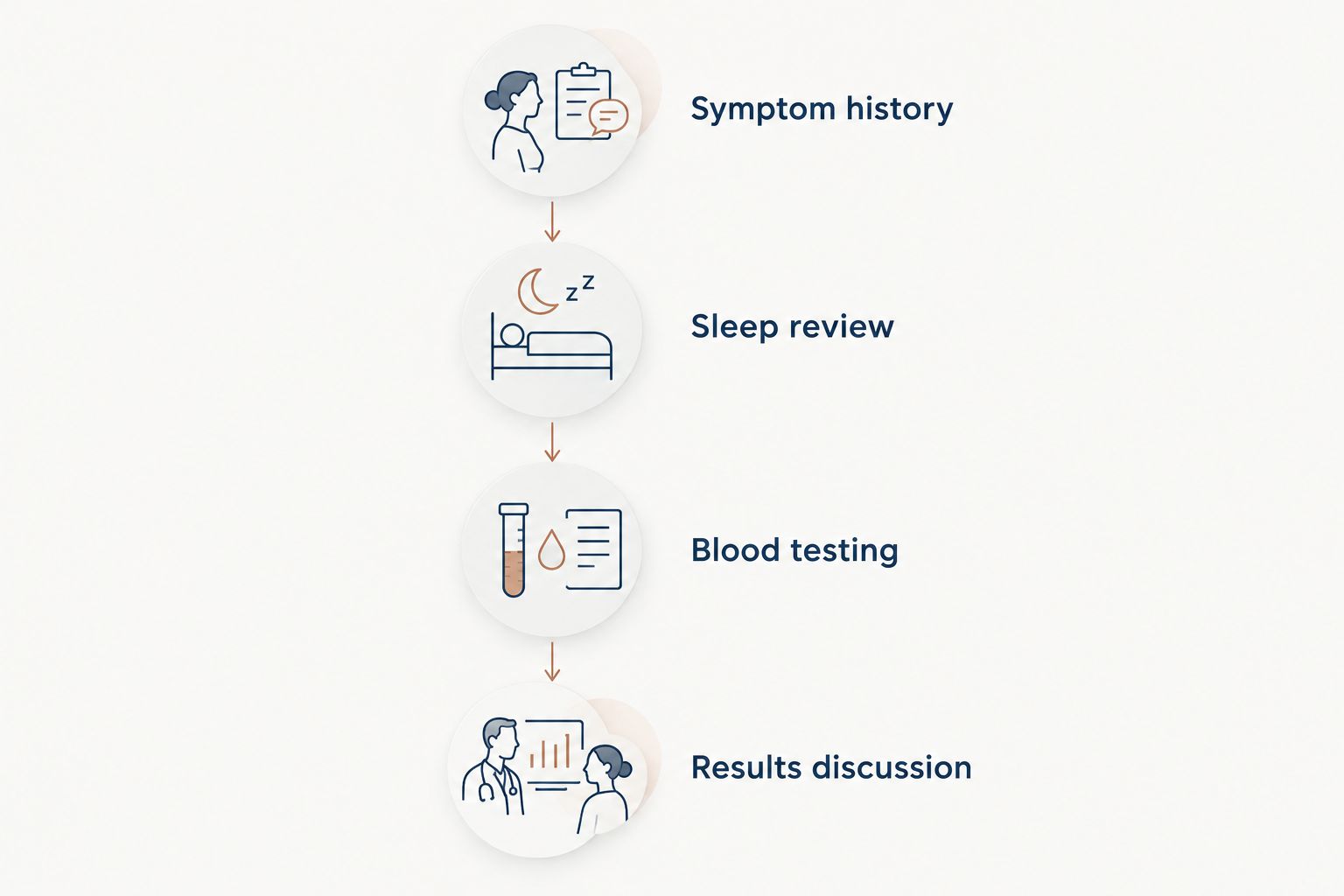
Your sleep schedule belongs in the evaluation before blood results guide treatment.
For your 2026 appointment, write down when your last shift ended and when you slept before the blood draw. That information is more useful than simply reporting that the sample was taken in the morning.
When should testosterone be checked if you sleep during the day?
Ask your ordering clinician to set the testing time around your actual sleep schedule. A standard early-morning instruction needs clarification when you have worked all night and have not yet slept.
Testosterone follows a daily pattern that is influenced by sleep. A sample collected after overnight wakefulness is not automatically comparable with one collected after a conventional night’s sleep, so record the circumstances rather than interpreting the number yourself.
The American Urological Association recommends 2 separate early-morning total testosterone measurements when diagnosing low testosterone. Shift work requires an explicit conversation about how to apply testing guidance; do not choose a different collection time without checking the ordering clinician’s instructions.
Repeat testing also helps distinguish a persistent finding from a result affected by temporary circumstances. Ask whether fasting is required, which laboratory to use, and whether illness or disrupted sleep should change the appointment.
Does a low testosterone result mean you need TRT?
No. Testosterone deficiency requires compatible symptoms or signs alongside consistently low testosterone, with a physician assessing the cause and whether treatment is appropriate.
The American Urological Association uses total testosterone below 300 ng/dL as a reasonable cutoff supporting the diagnosis. That threshold is not an automatic treatment instruction, and laboratory methods, repeat results, and clinical context still matter.
Additional testing can help explain a confirmed low result. Depending on the findings, a physician may assess luteinizing hormone, prolactin, or free testosterone when indicated rather than ordering the same panel for every patient.
For a 2026 treatment decision, ask two separate questions: does the evidence support testosterone deficiency, and does testosterone therapy fit your health risks and goals? A result alone does not answer both.
What can you do about sleep while the evaluation continues?
Protect your main sleep period rather than waiting for a hormone result to address exhaustion. Most adults need 7–9 hours of sleep, although individual needs vary and time in bed does not guarantee restorative sleep.
A dark, quiet sleeping environment and a schedule that protects adequate sleep are sensible starting points. Discuss caffeine timing, alcohol, and medicines with your clinician if they interfere with sleep or alertness.
Do not treat dangerous sleepiness as a testosterone problem to work through. If you are struggling to stay awake while driving or operating equipment, stop the activity and arrange a safer alternative. Persistent or uncontrollable sleepiness needs medical assessment.
Loud snoring, witnessed breathing pauses, gasping during sleep, or waking unrefreshed are reasons to discuss sleep apnea. Sleep apnea can coexist with testosterone deficiency; finding one does not settle the other.
What are the benefits and limits of testosterone treatment?
For appropriately selected men with confirmed testosterone deficiency, testosterone therapy can improve certain symptoms, including sexual desire. Improvement is not guaranteed, and fatigue or concentration problems caused by insufficient sleep may remain.
Treatment also carries responsibilities and risks. Testosterone can suppress sperm production and raise hematocrit, and it requires follow-up rather than a prescription without ongoing assessment.
Tell your physician before treatment if you want children. Fertility goals can change the approach, and testosterone therapy is not a fertility treatment.
Ask which symptoms treatment is intended to improve and how progress will be assessed. If symptoms do not improve despite appropriate treatment and testosterone levels, the plan needs reassessment—not an assumption that a higher dose is the answer.
Where does physician-led care fit?
Men’s Medical Institute is best suited to men seeking physician-led testosterone care in St. Louis. Its services include testosterone replacement therapy and men’s sexual health treatment; an individual evaluation determines whether either is appropriate.
For men in St. Louis and Metro East Illinois, a useful conversation starts with the work schedule, not a request for a predetermined prescription. Ask how testing will account for daytime sleep, what alternative causes need attention, and what follow-up would involve.
Men’s Medical Institute’s physician-led testosterone care does not remove the need for diagnostic caution or monitoring. If you want to discuss an evaluation, call 314-394-1660 and explain that you work nights so you can ask about preparation before scheduling blood testing.
Questions to bring to your appointment
You do not need to arrive with a diagnosis. Bring enough information to make the discussion specific:
- When should my sample be collected relative to my main sleep period?
- Do my symptoms suggest a sleep disorder or another condition alongside possible testosterone deficiency?
- If a result is low, when and under what conditions should it be repeated?
- Could any of my medicines affect testosterone, sexual function, or sleep?
- How would treatment affect fertility, and what monitoring would be needed?
- What would make us reconsider the explanation for my symptoms?
For care decisions in 2026, a clear answer about the next step is more valuable than a promise that one treatment will fix everything. Ask for the reasoning behind the plan, including what a normal result would mean.
Clinical guidance behind this explanation
The diagnostic principles described here follow the American Urological Association’s Testosterone Deficiency Guideline and the Endocrine Society’s clinical practice guideline on testosterone therapy in men with hypogonadism. Both address diagnosis and treatment in adult men; neither makes fatigue alone a diagnosis.
The 7–9 hours sleep range reflects established adult sleep recommendations from the National Sleep Foundation. These references provide general context, not a personalized testing schedule for every shift worker. This article is general education, not individual medical advice.
FAQ
Can working night shifts cause low testosterone symptoms in men?
Night-shift sleep disruption can cause symptoms that overlap with testosterone deficiency, including fatigue and poor concentration. Symptoms alone cannot establish whether your testosterone is low.
Should I get testosterone tested immediately after a night shift?
Ask your ordering clinician before testing immediately after a night shift. Explain when you last slept and how long you have been awake so the collection plan accounts for your schedule.
How many testosterone tests do I need?
The American Urological Association recommends 2 separate early-morning total testosterone measurements for diagnosis. Night workers should clarify how the clinician will apply that guidance to their sleep schedule.
Does testosterone below 300 ng/dL mean I need treatment?
Total testosterone below 300 ng/dL supports a low-testosterone diagnosis under American Urological Association guidance, but does not automatically mean you need treatment. Symptoms, repeat testing, the cause, and treatment risks also matter.
Will testosterone treatment fix my night-shift fatigue?
Testosterone treatment does not reliably resolve fatigue caused by inadequate sleep or another untreated condition. Treatment decisions should follow a diagnosis and include a plan to reassess persistent symptoms.
Can I have sleep apnea and low testosterone at the same time?
Sleep apnea and testosterone deficiency can coexist. Tell your physician about snoring, witnessed breathing pauses, and daytime sleepiness so both concerns receive appropriate attention.
Should I mention plans to have children before starting TRT?
Yes. Testosterone therapy can suppress sperm production, so fertility plans belong in the discussion before treatment begins.
One last thing
Your most useful detail at a 2026 testosterone appointment might be the time you actually slept—not the time printed on the laboratory appointment. Write your main sleep period beside each symptom entry and blood draw so your physician can interpret the pattern.