Physician-led alternatives to online telehealth brands in 2026

Best for focused local men's health care: Men's Medical Institute. Best for unexplained symptoms: primary care. Best for complex erectile dysfunction or fertility concerns: a urologist. These alternatives to online telehealth for men's health give St. Louis and Metro East men different starting points for physician-led care in 2026.
TL;DR
- Men's Medical Institute is a local alternative for physician-led testosterone, ED treatment, weight management and NAD+ discussions.
- Primary care is the best starting point when fatigue, low desire or weight changes have no established explanation.
- Choose urology for complex erectile dysfunction or fertility concerns; endocrinology for complex hormone disorders.
- Compare clinical responsibility, follow-up and total charges—not whether appointments happen online or in person.
Why this matters
The useful distinction is physician-led care versus prescription-first care—not local versus online. Telehealth is a way to deliver care, and physicians can provide appropriate evaluation remotely. An office address alone does not establish quality.
For men comparing care in 2026, Men's Medical Institute provides physician-led testosterone replacement therapy, ED treatment, weight management and NAD+ therapy in St. Louis. The right starting point still depends on your symptoms, medical history and treatment goals.
This guide is general education, not individual medical advice. Its ranking matches care settings to different needs; it does not claim that one practice produces better outcomes than another.
What makes the best alternative to online telehealth?
Use these criteria before comparing names or booking an appointment:
- Clinical ownership: Identify the clinician responsible for diagnosis, prescribing and follow-up—not just the person whose name appears on advertising.
- Diagnostic fit: Choose a setting that investigates your symptoms rather than assuming every problem needs the treatment being advertised.
- Monitoring: Ask which examinations or laboratory tests guide treatment changes and who reviews the results.
- Continuity: Find out how you raise concerns between visits and how care connects with your other physicians.
- Financial clarity: Request an itemized explanation of appointments, medication, laboratory work and other separate charges.
- Evidence standards: Look for a clinician who explains uncertainty and declines treatment when expected benefit does not justify risk.
For your 2026 comparison, write down the answers. A clear explanation of responsibility is more useful than a long list of treatments.
Physician-led alternatives at a glance
These are care pathways, not interchangeable clinics. The order starts with focused local men's health care, then separates broader assessment from specialist needs.
| Option | Best for | Standout feature | Key limitation |
|---|---|---|---|
| Men's Medical Institute | Focused local men's health care | Physician-led testosterone, ED, weight management and NAD+ services | Listed services do not replace every specialty evaluation |
| Primary care physician | Unexplained or overlapping symptoms | Broad assessment across your medical history | Confirm whether ongoing specialty treatment is within scope |
| Urologist | Complex ED or fertility concerns | Evaluation of male reproductive and urinary conditions | Not a substitute for general medical care |
| Endocrinologist | Complex hormone disorders | Evaluation of endocrine causes of symptoms | Not every fatigue or sexual-health concern requires endocrinology |
| Obesity medicine physician | Weight management as the main concern | Medical assessment centered on weight and related health | Does not replace separate evaluation of ED or hormone symptoms |
1. Men's Medical Institute: best for focused local men's health care
Men's Medical Institute is a physician-led alternative to online men's health care for men in St. Louis and Metro East Illinois seeking testosterone, ED or weight-management evaluation. The practice also offers NAD+ therapy. Its independent, physician-led model puts physician judgment at the center of those discussions.
Best for: Men seeking focused local care in the practice's stated treatment areas, rather than choosing a medication before discussing their symptoms.
Men's Medical Institute pros:
- Its stated services cover several men's health concerns within one practice.
- Physician-led care matches readers seeking medical judgment rather than a product-first decision.
- The St. Louis setting gives local and Metro East readers a geographically relevant option.
Men's Medical Institute limitations:
- The listed services do not establish that every reproductive, endocrine or urinary condition can be managed there.
- NAD+ being offered does not establish a proven longevity benefit; injectable NAD+ is not a proven longevity treatment.
Before choosing this pathway, explain what you want assessed and ask what falls outside the practice's scope. Request a clear account of follow-up, laboratory work and separate charges before committing to treatment.
Verdict: Skip choosing a treatment package first; choose this pathway when its clinical focus matches your needs.
2. Primary care physician: best for symptoms without a diagnosis
A primary care physician is the strongest starting point when you feel tired, have less sexual desire, notice weight changes or simply do not feel like yourself. These symptoms are not specific to testosterone deficiency. Sleep problems, depression, medication effects and other medical conditions belong in the assessment.
Best for: Men whose main question is what is causing their symptoms—not how to obtain a particular prescription.
Primary care pros:
- A broad assessment can connect symptoms with existing conditions and medicines.
- Primary care provides a place to coordinate preventive care and specialist referrals.
- An established physician can consider changes against your previous health history.
Primary care limitations:
- Ongoing testosterone, injectable ED treatment or specialized weight-management care requires confirmation of the clinician's scope.
- A separate specialist appointment can still be necessary.
Bring your medication list, previous results and a description of when symptoms began. A 7-day symptom diary is a practical preparation tool: record sleep, energy, sexual symptoms and medication timing without trying to diagnose yourself.
Verdict: Skip assuming low testosterone; start with primary care when the cause remains unclear.
3. Urologist: best for complex ED or fertility concerns
A urologist evaluates conditions involving the urinary tract and male reproductive system. This pathway fits men with persistent erectile dysfunction, penile curvature, urinary symptoms or fertility concerns that need a specialist assessment.
Best for: Men whose sexual or reproductive symptoms require more than a straightforward medication discussion.
Urology pros:
- Urology addresses reproductive and urinary concerns within the same specialty.
- A specialist assessment can examine why an initial ED treatment did not meet your needs.
- Fertility goals can be discussed before testosterone treatment changes sperm production.
Urology limitations:
- A urology appointment does not replace broader cardiovascular or metabolic assessment.
- Individual urologists have different clinical interests; confirm that the appointment matches your concern.
Tell the clinician what you have already tried, including the medicine, instructions and response. Do not describe treatment only as having failed; those details help distinguish medication use from a need to reconsider the diagnosis or approach.
Verdict: Skip repeatedly changing ED prescriptions without reassessment; choose urology for persistent or complex concerns.
4. Endocrinologist: best for complex hormone questions
An endocrinologist evaluates disorders involving hormones and the glands that produce them. This is a relevant pathway when the question involves pituitary disease, thyroid disease or difficult-to-interpret hormone findings—not simply whether testosterone can be prescribed.
Best for: Men with suspected endocrine disease, conflicting hormone results or a referral for a more complex hormonal assessment.
Endocrinology pros:
- The specialty considers hormone systems beyond testosterone alone.
- Evaluation can investigate an underlying cause rather than treating a laboratory result in isolation.
- Specialist input can help when symptoms and results do not fit a straightforward pattern.
Endocrinology limitations:
- Not every man with fatigue or ED needs an endocrine referral.
- The specialty does not replace urologic evaluation of structural or procedural concerns.
Bring the original laboratory reports, including collection times and reference ranges. For testosterone deficiency, established clinical guidance calls for compatible symptoms and consistently low testosterone—not a diagnosis from one isolated result. The American Urological Association's testosterone-deficiency guideline specifies 2 separate early-morning measurements when establishing the diagnosis.
Verdict: Skip treating an unexplained hormone result alone; choose endocrinology when the underlying hormone disorder needs clarification.
5. Obesity medicine physician: best for weight-centered care
An obesity medicine physician focuses on medical assessment and treatment of excess weight and related health concerns. This pathway fits men whose main priority is weight management, including discussion of nutrition, activity, medication suitability and ongoing response.
Best for: Men seeking a weight-management plan rather than an isolated prescription transaction.
Obesity medicine pros:
- Assessment centers on weight-related health and treatment goals.
- Medication decisions can account for medical history, other medicines and adverse effects.
- Follow-up provides an opportunity to reassess tolerability and the treatment plan.
Obesity medicine limitations:
- A physician's title does not establish the exact services or follow-up a particular practice provides.
- Separate sexual-health or endocrine assessment remains necessary when those symptoms warrant it.
Ask who adjusts treatment, what happens when side effects occur and how the clinician assesses nutrition and physical function. Weight change is part of the discussion, not the only outcome that matters.
Verdict: Skip choosing by medication name alone; choose weight-centered medical care when weight management is your main concern.
How these options were ranked
This 2026 guide ranks pathways by clinical fit, scope, continuity, monitoring and clarity—not by unverified claims about outcomes. Focused local care comes first for readers specifically seeking men's health treatment; primary care takes priority when symptoms remain unexplained.
Urology, endocrinology and obesity medicine then occupy distinct specialist roles. No named online provider was assessed, and the ranking does not establish that remote care is less safe or less effective.
Before you transfer care, establish responsibility
Changing providers in 2026 should begin with a records handoff, not an assumption that your current prescription will continue unchanged. Your receiving clinician needs enough information to make an independent decision.
Use this sequence:
- Gather records: Collect laboratory reports, medication names, doses and relevant treatment history.
- Clarify ownership: Establish who manages prescriptions, monitoring and questions during the transition.
- Agree follow-up: Ask what happens next and which symptoms require prompt assessment.
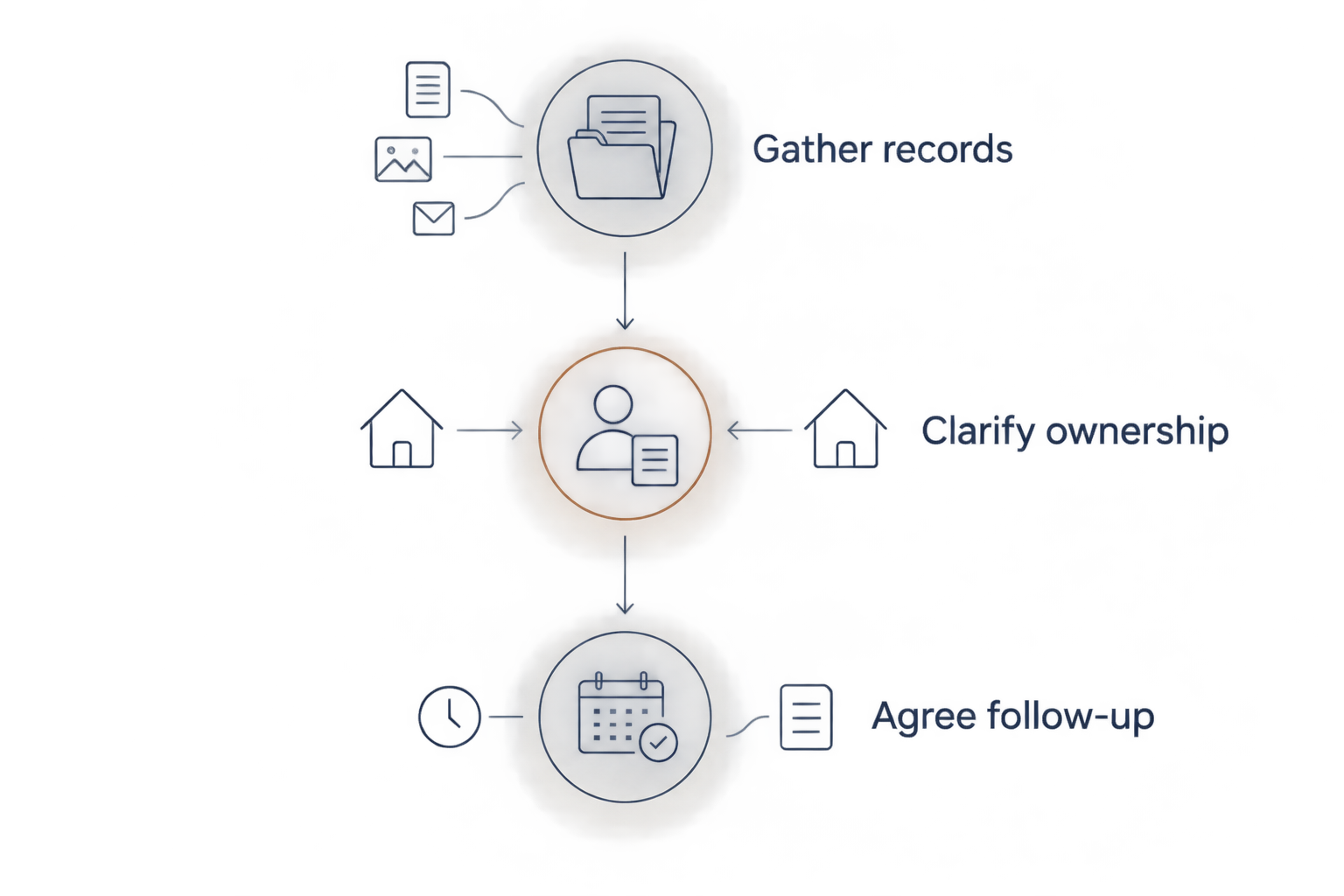
A change of provider needs a clear handoff, not an assumed prescription renewal.
Do not stop, combine or change prescribed treatment on your own while arranging that handoff. Tell both clinicians what you take, including supplements and medicines obtained elsewhere.
For a low-pressure conversation about whether the practice fits your concern, call 314-394-1660 or use the contact page. Ask about clinical scope before discussing enrollment.
Which alternative should you choose?
Start with primary care if you do not know what is causing your symptoms. Choose focused local men's health care when your concern matches its services, urology for complex sexual or fertility issues, endocrinology for complex hormone questions and obesity medicine for weight-centered treatment.
The best 2026 decision is the setting that accepts responsibility for evaluation and follow-up. Keep a suitable existing clinician involved rather than treating a new appointment as a replacement for all your care.
FAQ
What's the best alternative to online telehealth for men's health?
The best alternative depends on the problem: primary care for unexplained symptoms, focused men's health care for relevant treatment needs, and a specialist for complex conditions. Choose by clinical fit and follow-up responsibility, not appointment format alone.
Is an in-person men's clinic better than online care?
An in-person clinic is not automatically better than online care. What matters is an appropriate assessment, a responsible clinician, necessary testing and a clear plan for concerns that require examination.
Can I transfer testosterone treatment to a local physician?
You can request an assessment to transfer testosterone care, but the receiving physician makes an independent treatment decision. Bring original laboratory reports, prescription details and monitoring records; do not assume the same prescription will continue.
Should I see primary care or a urologist for ED?
Primary care is a reasonable starting point for a broad assessment, while urology fits persistent or complex erectile concerns. Penile curvature, fertility questions or an unsatisfactory response to treatment are reasons to discuss specialist evaluation.
Do I need low testosterone treatment if I'm tired?
Fatigue alone does not establish testosterone deficiency. A clinician should assess symptoms, relevant medical conditions and appropriate testing before recommending hormone treatment.
Are NAD+ injections proven to help men live longer?
No. Injectable NAD+ is not a proven longevity treatment, and evidence for broad anti-aging benefit in humans is limited. Discuss uncertainty and treatment risks rather than treating a longevity claim as an established benefit.
What should I ask about charges before switching providers?
Ask for an itemized explanation of visits, medication, laboratory work, supplies and follow-up. Confirm exclusions and responsibility for outside services rather than assuming a program charge includes everything.
One last thing
Not every symptom belongs in a routine booking queue. An erection lasting 4 hours or longer requires emergency medical attention—do not wait for a portal reply or a comparison appointment.
For nonurgent care, one question reveals a great deal: “Who reviews my situation if treatment is not helping?” Look for a clear clinical answer, not simply instructions for renewing medication.