Testosterone therapy for military veterans: complete 2026 guide

Veterans’ testosterone therapy is medical treatment for confirmed testosterone deficiency with the aim of improving symptoms attributable to low testosterone. This 2026 guide explains how military veterans can separate hormone problems from overlapping concerns such as disrupted sleep, medication effects, depression, and prior head injury without assuming that every symptom needs testosterone.
TL;DR
- Testosterone therapy for veterans requires symptoms and consistently low testosterone, not fatigue or military service alone.
- Men’s Medical Institute offers physician-led testosterone care for men in the St. Louis area.
- Coordinate VA and civilian prescriptions, laboratory results, and follow-up rather than maintaining separate treatment plans.
- Discuss fertility, sleep apnea, blood counts, and treatment goals before starting testosterone replacement therapy.
Why testosterone care matters for veterans
A veteran’s symptoms deserve a full evaluation, not an automatic testosterone prescription. Low libido, fewer spontaneous erections, and reduced energy warrant discussion, but those symptoms do not establish a hormone deficiency. Sleep disorders, depression, chronic pain, and medication effects also belong in the assessment.
Military history matters when it identifies something clinically relevant. Tell your clinician about a traumatic brain injury, testicular injury, opioid treatment, or a major change in sleep. A history of head injury deserves attention because pituitary problems can affect hormone production; it does not prove that testosterone is low.
Men’s Medical Institute is best suited to St. Louis-area men seeking physician-led testosterone evaluation. Its testosterone care is one option alongside evaluation through your existing clinicians. Choosing a civilian practice does not replace coordination with your VA or primary care team.
For your 2026 care plan, define the problem before choosing the treatment. Wanting to feel like yourself again is a reasonable starting point; a useful plan turns that concern into specific symptoms, diagnostic questions, and follow-up goals.
How to approach testosterone therapy for veterans
Document your symptoms
Start with a written symptom history before buying supplements or arranging treatment. Record what changed, when it began, and how it affects daily life. Separate reduced sexual desire from difficulty getting an erection: they overlap, but they are not the same problem.
Include the context that a hormone result cannot show. Night shifts, broken sleep, pain flares, alcohol use, relationship strain, and changes in mental health all help a clinician interpret symptoms. You do not need a polished medical narrative; plain descriptions are more useful than a checklist copied from an advertisement.
- Sexual symptoms: Note changes in desire, spontaneous erections, and erectile function.
- Daily function: Describe fatigue, strength changes, and difficulty completing usual activities.
- Sleep pattern: Record snoring, witnessed breathing pauses, shift work, and daytime sleepiness.
- Medical history: Include head injuries, testicular injuries, and previous hormone treatment.
- Medication history: List prescriptions, supplements, anabolic steroids, and nonprescribed hormones.
Confirm low testosterone
Ask your existing clinician to review symptoms and arrange appropriate testing first. The American Urological Association uses total testosterone below 300 ng/dL as a reasonable diagnostic cutoff, but diagnosis also requires compatible symptoms and clinical assessment. A single low result is not enough.
The American Urological Association and Endocrine Society recommend confirmation with 2 separate early-morning blood tests. Acute illness, disrupted sleep, and testing circumstances affect interpretation; tell the clinician if you work overnight rather than choosing a testing time yourself. Additional testing, such as luteinizing hormone or selected free testosterone measurement, depends on the findings.
For a 2026 evaluation, bring the actual laboratory reports, including collection times and reference ranges. A physician-led practice such as Men’s Medical Institute provides another route to evaluation, but a different setting does not remove the need to confirm the diagnosis.
- Obtain complete reports rather than a screenshot of a single flagged result.
- Tell the clinician whether you were ill or sleeping unusually before testing.
- Disclose current testosterone use before interpreting any hormone measurement.
- Ask whether further testing is needed to distinguish testicular from pituitary causes.
- Avoid starting testosterone before the diagnostic assessment is complete.
Review treatment risks
Discuss fertility before the first prescription. Testosterone replacement therapy can suppress sperm production, so it is not the right default treatment for a man trying to conceive. The guide to what TRT means for fertility explains why reproductive plans belong in the initial conversation.
A safety review also includes blood counts, sleep apnea, cardiovascular history, urinary symptoms, and prostate-related assessment when appropriate. The Endocrine Society recommends against starting testosterone in men with certain conditions, including untreated severe obstructive sleep apnea or elevated hematocrit. The physician must interpret individual findings rather than rely on a screening form alone.
Testosterone is not a treatment for PTSD, and it does not replace depression care or sleep-apnea treatment. Keep those care plans active while the hormone evaluation proceeds.
- State whether you want biological children now or in the future.
- Report diagnosed sleep apnea and whether you use the prescribed treatment.
- Bring any history of high hematocrit, blood clots, heart attack, or stroke.
- Discuss prostate history and urinary symptoms without assuming everyone needs identical testing.
- Review opioid or psychiatric medicines with the prescriber; do not stop them yourself.
Coordinate your care
Start by sharing your medication list and laboratory reports with each treating clinician. If you receive both VA and civilian care, ask who will manage testosterone prescriptions and who will respond to abnormal results. Do not assume that a civilian visit automatically updates your VA record.
Men’s Medical Institute provides physician-led testosterone care in St. Louis, but the reason to choose a practice should include how its care fits with your existing treatment. Ask how records are exchanged, who reviews results, and how you should report medication changes. Those questions matter more than whether a clinic promises a particular testosterone level.
VA coverage and authorization are separate from the clinical question of whether treatment is appropriate. Ask your VA team about the rules that apply to your situation before arranging outside treatment with an expectation of reimbursement.
- Identify the clinician responsible for the testosterone prescription.
- Share all hormone prescriptions, including medicines obtained elsewhere.
- Confirm who orders follow-up testing and receives the results.
- Ask how to send civilian records to your VA or primary care team.
- Verify coverage, referrals, and authorization directly with the responsible organization.
Choose your treatment
Choose treatment only after confirming the diagnosis and reviewing alternatives. Correcting a contributing problem, such as untreated sleep apnea or a medication effect, belongs in the discussion. When testosterone is appropriate, injections and topical gels have different practical demands; neither is best for every veteran.
Injections avoid daily skin application but require correct technique and a prescribed schedule. Gels avoid needles but require consistent application and precautions against transferring testosterone to another person. Your clinician should explain formulation-specific monitoring and what to do after a missed dose.
For veterans traveling between St. Louis and Metro East Illinois, consider the full care routine: appointments, blood draws, medication handling, and communication. Ask for written instructions instead of adjusting treatment around travel on your own.
- Match the delivery method to your routine and ability to use it correctly.
- Ask for injection teaching if an injectable formulation is prescribed.
- Review skin-contact precautions if a topical formulation is prescribed.
- Request a written plan for missed doses and treatment interruptions.
- Confirm which services, laboratory tests, and supplies are included or separate.
Monitor your response
Agree on what improvement would look like before treatment begins. Track the symptoms that led to evaluation, not just the testosterone result. A higher laboratory number without meaningful benefit is a reason to reassess the plan, not automatically increase the dose.
The Endocrine Society recommends checking testosterone and hematocrit at 3–6 months after starting therapy, with subsequent monitoring tailored to treatment and clinical findings. A hematocrit above 54% requires clinician-directed action, including holding treatment and evaluating contributing factors. Do not manage an abnormal result by changing your prescription yourself.
Your 2026 follow-up plan should name the next review, the tests required, and the symptoms that warrant earlier contact. The sequence is straightforward: document your symptoms, confirm low testosterone, review treatment risks, coordinate your care, choose your treatment, and monitor your response.
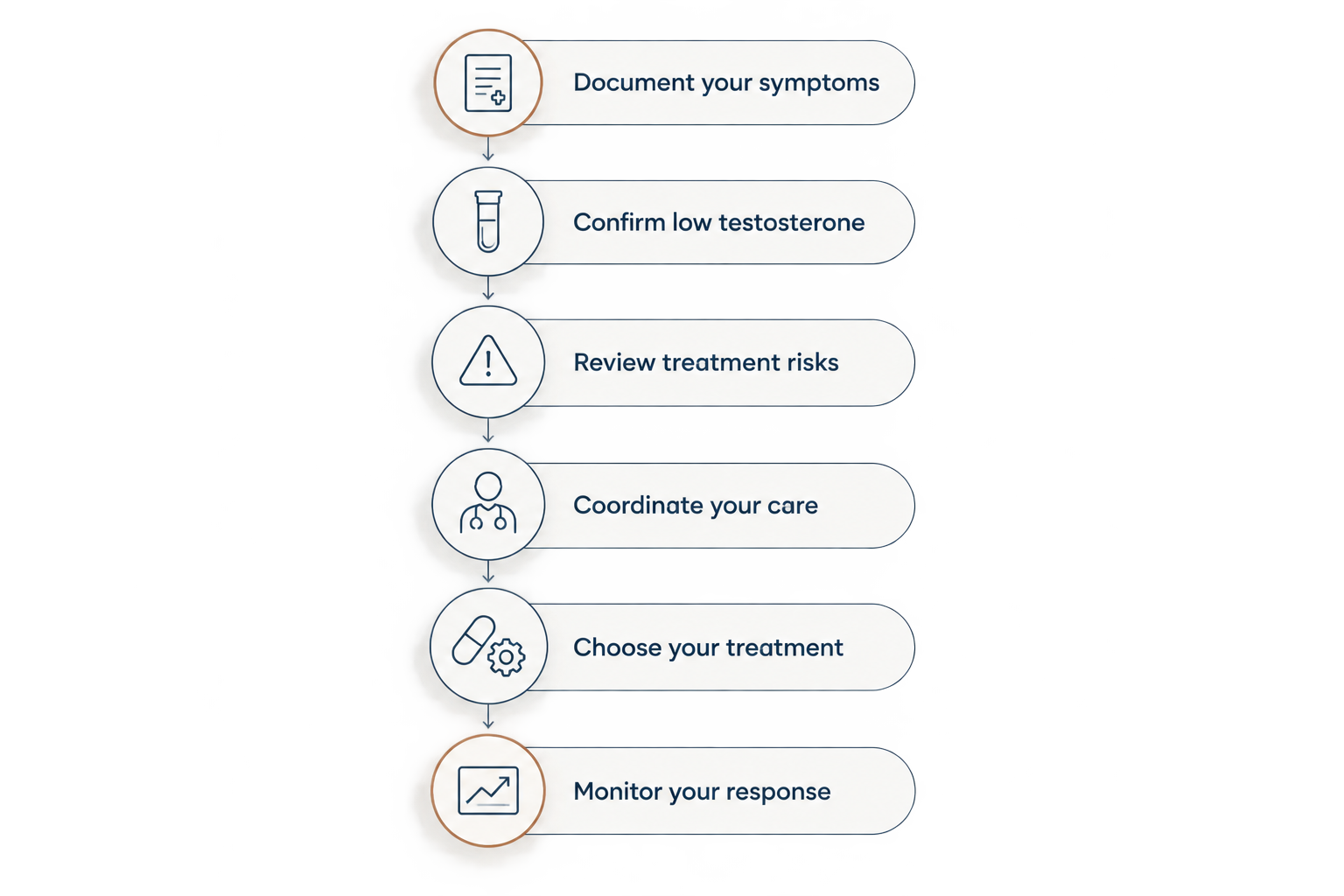
Confirm the diagnosis and review safety before choosing a treatment.
Use your follow-up visit to compare symptoms, laboratory findings, and side effects together. Reporting a problem early gives the prescriber the information needed to reassess treatment safely.
- Record changes in the original symptoms and daily function.
- Complete blood tests at the time specified for your formulation.
- Report acne, swelling, breast symptoms, or worsening sleep-related symptoms.
- Tell the prescriber about new medicines or changes in other treatment.
- Ask whether continuing therapy remains justified if symptoms do not improve.
Compare evaluation and treatment options
Choose the care setting for coordination and the treatment for clinical fit. These are separate decisions. The following 2026 comparison describes practical advantages and limitations; it does not establish coverage or recommend a prescription for an individual veteran.
| Option | Best for | Main advantage | Key limitation |
|---|---|---|---|
| Existing VA or primary care team | Veterans starting an evaluation within established care | Builds on an existing medical relationship | Confirm the evaluation pathway and any referral requirements directly |
| Men’s Medical Institute testosterone care | St. Louis-area men seeking a physician-led testosterone evaluation | Offers a local physician-led care option | Civilian care requires deliberate coordination with other treating clinicians; benefit is not guaranteed |
| Endocrinology evaluation | Men with suspected pituitary disease or a complex hormone disorder | Focuses on the underlying endocrine diagnosis | Does not replace care for unrelated causes of fatigue or sexual symptoms |
| Injectable testosterone | Men with confirmed deficiency who can follow an injection plan | Avoids daily skin application | Requires correct technique, scheduled dosing, and formulation-specific monitoring |
| Topical testosterone gel | Men with confirmed deficiency who prefer to avoid needles | Provides a needle-free treatment route | Requires consistent application and measures to prevent transfer to others |
Before selecting any option, ask what happens if the findings do not support testosterone treatment. A sound evaluation must leave room for a different diagnosis and a different next step.
Common mistakes veterans make
- Treating military service as the diagnosis. Service history can guide questions, but symptoms and confirmatory testing determine whether testosterone deficiency is present.
- Explaining every symptom with a head injury. Report a prior injury so the clinician can assess whether pituitary testing is appropriate; do not assume the cause before evaluation.
- Separating VA and civilian medication lists. Conflicting prescriptions and incomplete records make safe monitoring harder. Give each clinician the same current information.
- Stopping pain or mental-health medicines to improve testosterone. Discuss possible medication effects with the prescriber instead of stopping treatment independently.
- Expecting TRT to solve every sexual symptom. Erectile dysfunction can require its own evaluation even when testosterone deficiency is confirmed and treated.
FAQ
Can veterans get testosterone therapy through the VA?
Ask your VA care team whether testosterone evaluation and treatment are appropriate and available through your care pathway. Do not assume that a civilian prescription establishes VA coverage or authorizes outside care.
What testosterone level qualifies a veteran for TRT?
A testosterone level alone does not qualify a veteran for TRT. The American Urological Association uses total testosterone below 300 ng/dL as a reasonable cutoff, together with compatible symptoms and confirmation on separate early-morning tests.
Can a traumatic brain injury cause low testosterone?
A traumatic brain injury can affect pituitary function and contribute to low testosterone. Report the injury and your symptoms so a clinician can decide whether a pituitary evaluation is appropriate.
Will testosterone therapy treat PTSD or depression?
Testosterone therapy is not a treatment for PTSD and does not replace depression care. Men with confirmed testosterone deficiency still need assessment and treatment for mental-health symptoms on their own merits.
Can I use a civilian testosterone clinic while receiving VA care?
Discuss civilian testosterone care with both the civilian prescriber and your VA team before starting or changing treatment. Clarify prescribing responsibility, records sharing, laboratory monitoring, and any coverage or authorization requirements.
Does testosterone treatment affect fertility?
Testosterone treatment can suppress sperm production and impair fertility. Tell the clinician about current or future plans for biological children before starting therapy so the evaluation and treatment discussion reflect those goals.
What should I bring to a testosterone appointment in 2026?
Bring your medication list, complete laboratory reports, symptom history, and relevant VA or civilian records. Include prior hormone use, sleep-apnea history, head injuries, and fertility plans so the clinician can assess more than a testosterone number.
One last thing
A normal testosterone result is not a dismissal of your symptoms. It redirects the evaluation toward other explanations rather than justifying an unnecessary prescription. Ask what the next diagnostic step is before leaving the appointment.
If you live in St. Louis or Metro East Illinois and want to discuss physician-led testosterone evaluation, call 314-394-1660. You can ask what records to bring and how to coordinate with your existing clinicians. This article provides general education, not individual medical advice.