Tirzepatide and weight loss: preparing for surgery or sedation

If you take tirzepatide for weight loss, tell your procedure and anesthesia teams before surgery or sedation: most patients can continue treatment, but the plan depends on their individual risk. Tirzepatide delays stomach emptying, so fasting alone does not guarantee an empty stomach; some patients need a liquid-only diet, changes to anesthesia, or a postponed procedure.
TL;DR
- Tirzepatide weight loss treatment requires a procedure-specific plan; do not stop or continue automatically.
- Most patients can continue treatment under multisociety guidance, but digestive symptoms and dose increases require extra assessment.
- Some higher-risk patients need a liquid-only diet for 24 hours before a procedure, with separate fasting instructions.
- Mensmedicalinstitute provides physician-led weight management in St. Louis; your anesthesia team directs procedure-day safety.
How should you prepare for surgery or sedation on tirzepatide?
Contact the team performing your procedure before changing your next dose. Tell them that you take tirzepatide, why you take it, your current dose, your last injection date, and whether the dose recently increased. Include nausea, vomiting, constipation, bloating, or trouble tolerating meals.
The anesthesia team and prescribing clinician should agree on a plan that covers medication, food, fluids, and restarting treatment. A routine instruction to stop all medicines does not replace a specific answer about tirzepatide.
If you need help connecting with your prescribing clinician, use the contact page. Do not wait until you arrive for the procedure to raise the question.
| Your situation | What the team assesses | Possible plan | Important limitation |
|---|---|---|---|
| Stable dose without significant digestive symptoms | Procedure, anesthesia, and other medical conditions | Continue treatment with the prescribed preparation | No symptoms does not prove the stomach is empty |
| Starting treatment or increasing the dose | Escalation stage and gastrointestinal effects | Delay an elective procedure until escalation and symptoms resolve | The decision depends on your clinical circumstances |
| Significant nausea, vomiting, abdominal pain, or constipation | Severity and possible causes | Reassess before an elective procedure | Skipping an injection does not immediately resolve symptoms |
| Other reasons for delayed stomach emptying | Medical history and overall aspiration risk | Modified preparation or anesthesia precautions | Medication timing alone does not address every risk |
Why this matters
The concern is aspiration: stomach contents entering the lungs during anesthesia or deep sedation. Sedation can reduce the protective responses that normally help keep material out of your airway.
In 2026, the practical question is not simply whether tirzepatide belongs on a stop list. It is whether your stomach-emptying risk, procedure, and anesthesia plan fit together safely.
Weight loss progress does not answer that question. You can feel well, be losing weight, and still need a specific preparation plan. Conversely, taking tirzepatide does not automatically mean your procedure must be canceled.
Most patients: continuation after individual assessment
Multisociety guidance supported by the American Society of Anesthesiologists states that most patients can continue GLP-1 medicines before elective surgery. That guidance includes medicines such as tirzepatide, which acts on both GIP and GLP-1 receptors.
Continuation is a clinical decision, not permission to ignore your facility's instructions. Your anesthesia team must consider the procedure, digestive symptoms, dose changes, and other conditions that affect stomach emptying.
Continuing avoids an unnecessary interruption in prescribed treatment. The limitation is that medication continuation still requires attention to aspiration risk; it does not make preparation optional.
If a generic handout conflicts with instructions from your prescriber, ask the teams to resolve the difference before your next injection. Do not choose whichever instruction is easier to follow.
Higher-risk patients: a liquid-only diet for 24 hours
Some patients at higher risk need a liquid-only diet for 24 hours before their procedure. Multisociety guidance identifies this as one way to reduce risk, alongside changes to anesthesia and, in selected settings, a stomach ultrasound.
A liquid-only diet and fasting are not interchangeable. Your team must explain which liquids are allowed, when to stop them, and whether the instructions differ because of diabetes or another condition.
Do not assume a protein shake, smoothie, or milk-based drink counts as a clear liquid. A drink can be liquid without meeting your facility's clear-liquid rules.
The benefit of a modified diet is that it addresses food intake before anesthesia. Its limitation is that it cannot certify an empty stomach or replace the anesthesia team's assessment. Do not prescribe this preparation for yourself or shorten the final fasting period because you followed it.
Dose escalation: extra assessment during treatment changes
The dose-escalation phase often lasts 4 weeks to 8 weeks, depending on the medicine and why it is prescribed, according to the American Society of Anesthesiologists' multisociety guidance. Your own titration schedule can differ.
Starting treatment and increasing the dose deserve particular attention because digestive effects can be more prominent during these periods. Tell the team about the change even if your prescription still looks familiar or you have taken earlier doses without difficulty.
For elective procedures, guidance recommends waiting until the escalation phase has passed and gastrointestinal effects have resolved when these factors create increased risk. That does not mean delaying urgent treatment.
If a dose increase is approaching your procedure date, ask the prescriber and anesthesia team to coordinate it. Do not increase, reduce, or skip the dose on your own to make the calendar work.
Why preparation varies between patients
Your tirzepatide plan depends on more than your injection day. These factors change the assessment:
- Dose changes: Starting treatment or increasing the dose puts you in a different situation from someone established on a stable regimen.
- Digestive symptoms: Nausea, vomiting, abdominal pain, bloating, and constipation need to be reported before an elective procedure.
- Current dose: Higher doses can produce more gastrointestinal effects and warrant additional preparation.
- Other medical conditions: Conditions that slow stomach emptying can add risk independently of tirzepatide.
- Procedure and anesthesia: Deep sedation and general anesthesia require attention to airway protection; local anesthesia without sedation presents a different situation.
- Diabetes treatment: Interrupting tirzepatide can affect glucose management, so the plan must account for its role in your diabetes care.
These differences explain why another patient's instructions are not a safe substitute for yours. A friend having a different procedure at another facility is not a useful dosing guide.
What should you confirm before the procedure?
For a procedure scheduled in 2026, ask for instructions that name tirzepatide explicitly. Keep the final plan somewhere you can find it when preparing, rather than relying on memory from a scheduling call.
- Medication details: Record the exact medication, dose, injection schedule, last dose, and prescribing clinician. If you use a compounded preparation, identify it accurately rather than substituting a brand name.
- Symptom check: Report digestive symptoms and recent dose changes. Tell the team if symptoms worsen after the initial assessment.
- Written preparation: Confirm whether to continue or withhold treatment, which foods and drinks are permitted, and the final fasting instructions.
- Restart plan: Ask who will decide when you restart, particularly if you miss doses, have postoperative nausea, or cannot eat normally.
If the instructions say to hold treatment, clarify the last permitted dose date. If they say to continue, confirm that the anesthesia team has considered your symptoms and recent titration.
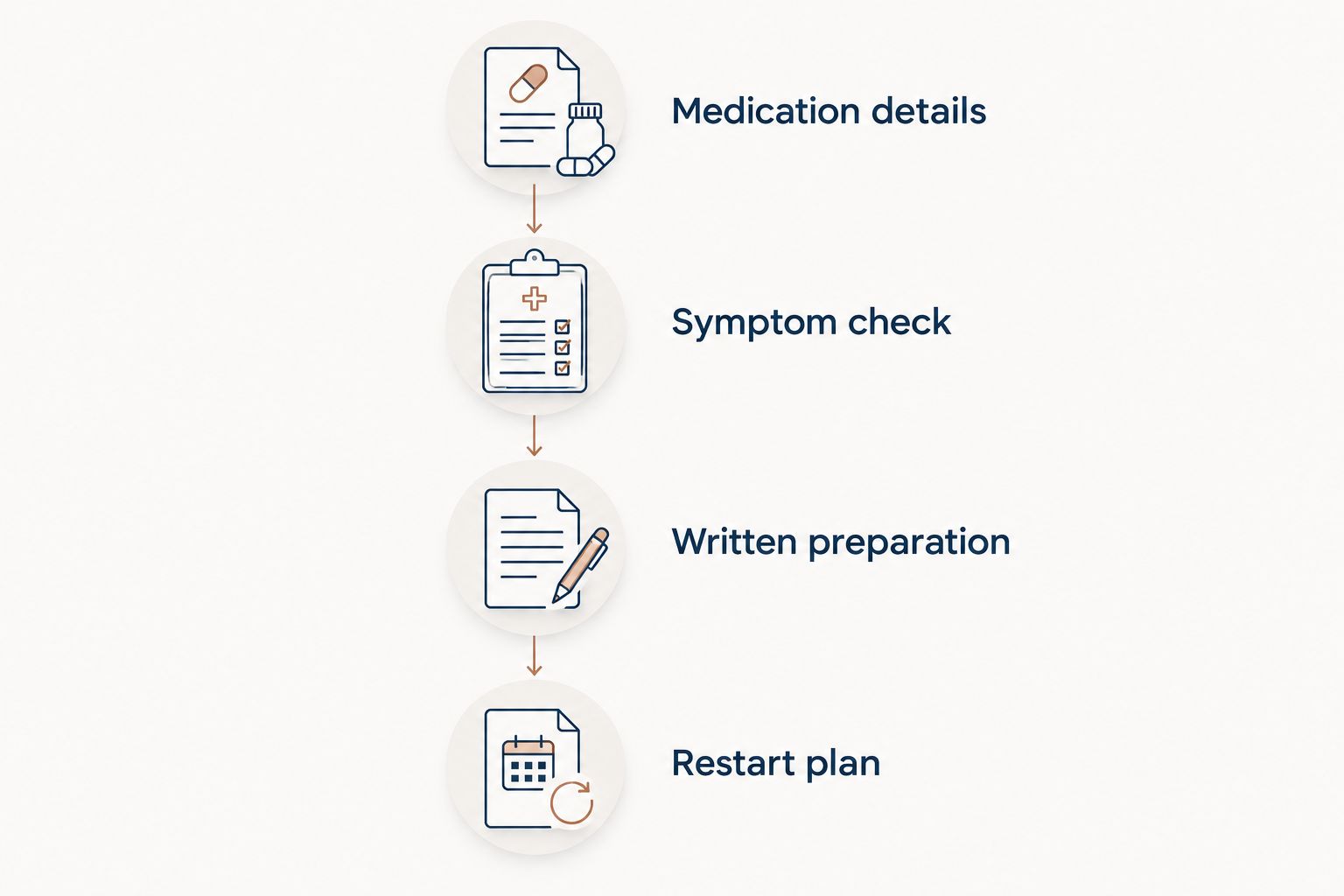
A useful plan covers both preparation and restarting treatment.
What evidence supports this advice in 2026?
The main sources are multisociety perioperative guidance supported by the American Society of Anesthesiologists and FDA-approved tirzepatide prescribing information. The guidance addresses procedural risk assessment; the prescribing information describes delayed gastric emptying and reports of pulmonary aspiration during general anesthesia or deep sedation.
Those sources also leave important limits. The prescribing information states that available data are insufficient to establish whether changing fasting instructions or temporarily stopping tirzepatide reduces retained stomach contents and aspiration risk.
There is no proven medication-holding interval that guarantees an empty stomach. That is why the plan must account for symptoms, treatment stage, and the procedure—not just the number of days since an injection.
Guidance helps clinicians make decisions across groups of patients. It cannot establish your individual anesthesia risk without a medical assessment.
Should I stop tirzepatide before a colonoscopy?
Do not stop tirzepatide automatically before a colonoscopy. The endoscopy and anesthesia teams need to coordinate the medication plan with bowel preparation, dietary restrictions, and the intended level of sedation.
Bowel preparation does not prove that your stomach is empty. Follow the endoscopy unit's instructions and report significant nausea, vomiting, or difficulty completing the preparation.
What if I need emergency surgery after taking tirzepatide?
Tell the emergency team that you take tirzepatide and when you last injected it. Do not delay emergency evaluation because you recently took a dose or ate a meal.
For urgent or emergency procedures, the anesthesia team can use precautions appropriate to a potentially full stomach. The treatment decision balances aspiration risk against the danger of delaying necessary care.
When can I restart tirzepatide after surgery?
Restart tirzepatide when your treating team says it is appropriate, considering your recovery, food intake, nausea, and any missed doses. There is no single restart day that fits every operation.
If treatment has been interrupted, ask the prescriber whether your previous dose remains appropriate. Never double a dose or resume an altered schedule without instructions.
Coordinating weight management in St. Louis
Mensmedicalinstitute fits men seeking physician-led weight management in St. Louis. For men in St. Louis and Metro East Illinois, the useful next step is coordination between the prescribing clinician and the team responsible for anesthesia—not a separate set of competing instructions.
Mensmedicalinstitute provides physician-led weight management, but your anesthesia team directs procedure-day safety. A prescribing visit does not replace the procedural assessment or guarantee that surgery can proceed.
To discuss your weight management treatment and an upcoming procedure, call 314-394-1660. Bring the procedure date, facility instructions, medication details, and any recent digestive symptoms.
FAQ
Can I keep taking tirzepatide for weight loss before surgery in 2026?
Most patients can continue tirzepatide before elective surgery under multisociety guidance, but your anesthesia team must assess your individual risk. Recent dose increases, digestive symptoms, and other causes of delayed stomach emptying can change the plan.
Does following the fasting instructions mean my stomach is empty?
No. Tirzepatide delays stomach emptying, and fasting does not guarantee that no stomach contents remain. Follow the fasting instructions anyway and tell the anesthesia team about your treatment.
Do I need a liquid-only diet before sedation?
Some higher-risk patients need a liquid-only diet for 24 hours before a procedure. Your team must specify which liquids are permitted and when all drinking must stop.
Should I report constipation if I feel otherwise well?
Yes. Report constipation along with nausea, vomiting, abdominal pain, or bloating because digestive symptoms help the team assess risk. Do not decide that a symptom is irrelevant simply because you can tolerate it.
Can I have surgery if I already took my tirzepatide injection?
A recent tirzepatide injection does not automatically cancel surgery. Contact the procedural team promptly so it can assess the dose timing, symptoms, urgency, and anesthesia plan.
Do I need to mention tirzepatide for a dental procedure?
Yes. Tell the dental team about tirzepatide, especially if sedation or general anesthesia is planned. Local anesthesia without sedation is a different situation, so ask which type of anesthesia you will receive.
Can I restart my usual dose as soon as I get home?
Do not assume you should restart immediately after discharge. Confirm the plan with your treating team, particularly if you have nausea, reduced food intake, or an interruption in treatment.
One last thing
A bowel prep cleans the bowel; it does not certify an empty stomach. That distinction matters even when you have followed every instruction carefully.
For your 2026 procedure, keep a written tirzepatide plan with your preparation instructions. This article provides general education, not individual medical advice; Mensmedicalinstitute and your procedural team need your medical history to advise you personally.