Tirzepatide weight loss: planning meals when appetite is low

For tirzepatide weight loss, plan small, regular meals around protein, fluids, and foods you can comfortably tolerate rather than waiting for strong hunger. Reduced appetite is an expected medication effect, but persistent vomiting, dehydration, or difficulty eating enough requires your prescriber’s attention—not a stricter diet.
TL;DR
- Tirzepatide weight loss meal planning should protect nutrition, not turn reduced appetite into a goal of eating nothing.
- Choose smaller meals with protein; adjust portions and textures when nausea or fullness interferes.
- Persistent vomiting, severe abdominal pain, or inability to keep fluids down needs medical attention.
- Mensmedicalinstitute is for St. Louis men seeking independent, physician-led weight management.
Why this matters
A quieter appetite can make weight management feel less demanding. It also removes a familiar reminder to eat, making it easier to miss meals without noticing how little you have consumed.
The goal is a tolerable eating pattern that supports your health—not the smallest possible food intake. Protein, hydration, and treatment follow-up still matter when hunger fades. For men in St. Louis and Metro East Illinois, choosing a weight loss clinic with ongoing support means considering who will address eating difficulties after treatment begins.
This 2026 guide provides general education, not an individual meal prescription or medical advice. Your clinician should account for your health conditions, medications, activity, and response to treatment.
How do you plan meals for tirzepatide weight loss when appetite is low?
Build a simple meal structure before deciding how much to eat. You do not need an elaborate menu, but you do need a way to notice when low appetite becomes inadequate intake.
- Set meal reminders. Choose eating opportunities that fit your workday instead of relying entirely on hunger. A reminder prompts a check-in; it does not mean forcing a large meal.
- Choose protein. Include a tolerable protein source, such as eggs, yogurt, fish, tofu, or beans. If a full mixed meal feels overwhelming, start with the component you most need help fitting into your day.
- Add tolerated foods. Include carbohydrates, produce, and fats in amounts you tolerate. Avoid creating a protein-only diet that crowds out other nutrients.
- Check fluids. Keep drinks accessible and notice whether nausea or fullness is limiting drinking as well as eating. Follow any fluid restriction your clinician has prescribed.
- Record symptoms. Briefly note missed meals, vomiting, bowel changes, and whether symptoms follow a dose change. Bring that pattern to your prescriber.
Use this sequence to simplify decisions, not to grade yourself. If eating remains difficult despite smaller portions and practical adjustments, the next step is treatment review.
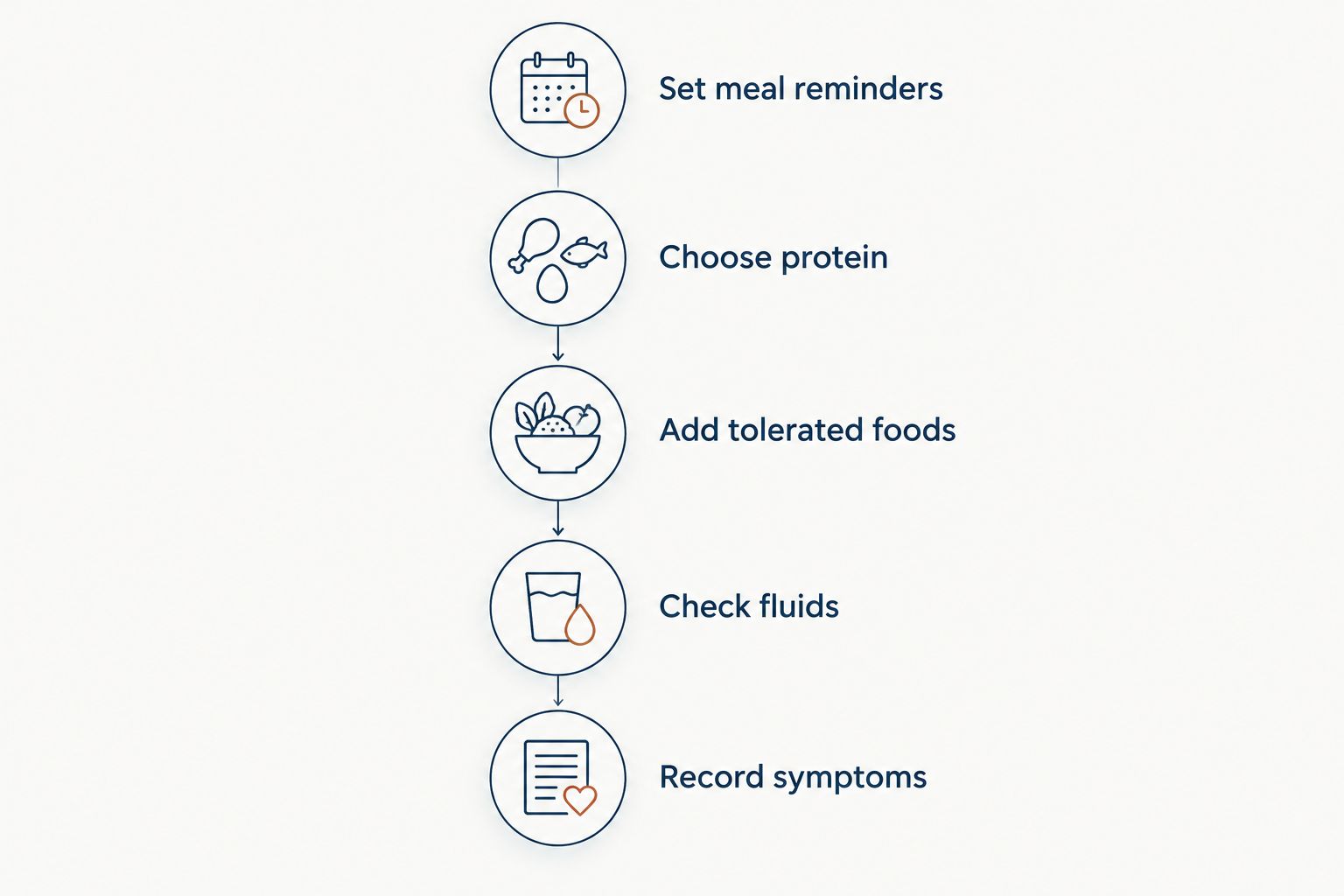
A repeatable routine helps you notice when reduced appetite is interfering with basic nutrition.
Which meal formats work when a full plate feels overwhelming?
Choose the format you can tolerate, not the one that looks most like a conventional dinner. These are meal-planning options, not a ranking of foods or a prescribed daily menu.
| Meal format | Best for | Main advantage | Main limitation |
|---|---|---|---|
| Small mixed meal | Men who tolerate solids but fill up quickly | Combines protein with other food groups | A large serving can still feel uncomfortable |
| Soft meal | Men who find softer textures easier to eat | Allows choices such as eggs, yogurt, or soft tofu | A narrow selection can become nutritionally repetitive |
| Divided meal | Men who cannot comfortably finish a usual portion | Separates the meal into manageable eating opportunities | Requires planning and safe food storage |
| Nutrition drink | Men whose clinician recommends help meeting intake | Offers an alternative when solid meals are difficult | Formulas differ; some do not provide balanced meal nutrition |
A small mixed meal might combine fish or tofu with rice and cooked vegetables. A soft meal might use yogurt with fruit or eggs with toast, depending on tolerance.
Keep portions modest to start, eat slowly, and stop when comfortably full. If you repeatedly leave most meals unfinished, do not assume the answer is simply to serve less; discuss whether your overall intake is adequate.
How much protein should you plan for?
Protein needs are individual; a general reference intake is not automatically your weight-loss target. The National Academies’ Dietary Reference Intakes give a protein recommended dietary allowance of 0.8 grams per kilogram of body weight per day for generally healthy adults.
For an 80-kilogram adult, that calculation equals 64 grams of protein per day. These figures describe a general adult reference, not a tirzepatide-specific prescription. Age, kidney disease, body composition, activity, and the extent of dietary restriction affect how a clinician or registered dietitian sets an appropriate goal.
For meal planning in 2026, use an individualized protein target rather than treating an online calculator as a medical assessment. Ask how to distribute protein across the foods you actually eat, especially if your usual portions have become much smaller.
Protein alone is not a complete muscle-preservation plan. Discuss resistance exercise appropriate to your health, and report declining strength or difficulty carrying out normal activities rather than judging progress only by the scale.
Why appetite and meal tolerance vary
Tirzepatide affects appetite and delays gastric emptying. The following factors help explain why the same meal can feel manageable on one occasion and uncomfortable on another:
- Treatment stage: Nausea, vomiting, and diarrhea can occur during treatment, including during dose escalation.
- Meal size: A large serving can be difficult to tolerate when you already feel full quickly.
- Food composition: Rich, high-fat meals can be harder to tolerate when nausea is present.
- Bowel symptoms: Constipation or diarrhea can complicate eating and drinking.
- Other medicines and conditions: Medicines that lower blood sugar and conditions that affect digestion can change the safety plan.
These factors are reasons to individualize care, not reasons to diagnose yourself. A symptom that repeatedly prevents eating deserves a conversation about treatment, not an assumption that discomfort proves the medication is working.
Should you eat if you are not hungry?
Yes—low hunger does not establish that your nutritional needs have been met. Try a small, tolerable meal or snack at your planned eating opportunity rather than waiting indefinitely for appetite to return.
There is a difference between eating without strong hunger and forcing food through significant nausea or pain. If you cannot eat comfortably, describe that problem to your prescriber; do not turn the meal plan into a contest of willpower.
For your 2026 treatment plan, agree on what should trigger a call. The useful question is not just whether you feel hungry, but whether you can consistently eat, drink, and function.
Can you skip meals to make tirzepatide work better?
Do not use skipped meals as a way to intensify tirzepatide treatment. Deliberately restricting intake further can make it harder to meet protein, fluid, and other nutrient needs when appetite is already reduced.
Skipping meals is especially important to discuss if you take insulin or a sulfonylurea, because tirzepatide used with those medicines increases the risk of low blood sugar. Follow your prescribed glucose-monitoring and hypoglycemia plan; do not independently change medication doses.
What if meat feels too heavy?
You do not need meat at every meal to include protein. Depending on your preferences and medical needs, alternatives include eggs, dairy foods, tofu, soy foods, beans, and lentils.
Texture, portion size, and preparation matter. Soft tofu or yogurt can feel different from a large piece of meat, while beans and lentils also contribute fiber that some people need to introduce gradually.
When comparing the protein content of common foods, match the listed amount to the portion you actually eat and check whether the food is measured cooked or uncooked. A food can contain protein without supplying enough in the small serving you currently tolerate.
Do not turn this comparison into another rigid food rule. The practical aim is a selection of foods you can eat consistently, with professional help if the selection keeps narrowing.
How should you handle fluids and constipation?
Drink regularly through the day rather than leaving all fluids until a large meal. If drinking with food makes fullness uncomfortable, try smaller amounts between eating opportunities while following your clinician’s instructions.
There is no single fluid target appropriate for every reader. Heart failure, kidney disease, and other conditions can require individualized guidance, so avoid adopting a high-volume drinking challenge from social media.
Constipation is a recognized adverse effect of tirzepatide. Discuss persistent symptoms with your clinician, and increase fiber gradually if advised rather than suddenly adding a large amount when you already feel bloated.
Persistent constipation with significant abdominal pain, vomiting, or marked swelling needs medical assessment. Do not keep adding supplements or laxatives without advice when those symptoms are present.
When does low appetite need medical attention?
Reduced appetite alone is different from being unable to maintain intake. Contact your prescriber when eating difficulties continue, vomiting recurs, or symptoms are interfering with your normal activities.
Seek prompt medical attention for:
- Severe, persistent abdominal pain, particularly pain that extends to the back, with or without vomiting.
- Inability to keep fluids down, especially with dizziness, faintness, or very little urine.
- Upper abdominal pain with fever or yellowing skin or eyes, which requires assessment for gallbladder problems.
- Possible low blood sugar, such as sweating, shaking, or confusion, particularly when using insulin or a sulfonylurea.
Severe confusion, fainting, or other emergency symptoms require emergency care. Follow the medication’s patient instructions and your clinician’s sick-day plan rather than waiting for a routine appointment.
FDA-approved tirzepatide prescribing information describes gastrointestinal adverse effects and warnings involving pancreatitis, gallbladder disease, and kidney injury from volume depletion. Those safety considerations remain part of meal-planning discussions in 2026; food adjustments are not a substitute for assessing a possible adverse reaction.
What should you bring to a treatment follow-up?
Bring a brief account of what happens during an ordinary day, not an idealized menu. Your prescriber needs to understand whether the plan works outside the appointment.
Useful details include your medication name and dose, recent dose changes, foods and drinks you tolerate, missed meals, vomiting or bowel symptoms, and any change in strength or daily functioning. Include all other medicines and supplements.
Ask whether your intake needs a registered dietitian’s assessment and whether persistent symptoms warrant changing the treatment plan. Do not increase, reduce, or space doses on your own to manage appetite.
Mensmedicalinstitute provides physician-led weight management for men in St. Louis. Its independent care model is relevant if you want medical judgment involved in weight management; this article does not establish whether a particular medicine is suitable for you.
For a low-pressure conversation about care, call 314-394-1660 or contact the practice. Ask what assessment and follow-up involve before deciding whether to proceed.
FAQ
What's the best meal plan for tirzepatide weight loss when I'm not hungry?
The best starting structure is small, regular meals that include protein, other tolerated foods, and fluids. Your clinician or registered dietitian should tailor amounts to your health and treatment response.
Should I force myself to finish meals on tirzepatide?
Do not force a large meal when you feel uncomfortably full or nauseated. Start with smaller portions, and contact your prescriber if you repeatedly cannot eat enough.
How much protein do I need while taking tirzepatide?
Your protein target needs individual assessment; 0.8 grams per kilogram of body weight per day is the general adult recommended dietary allowance, not a tirzepatide-specific target. Kidney disease, age, activity, and dietary restriction affect planning.
Can I use a protein shake instead of a meal?
A protein shake is not automatically a nutritionally complete meal replacement. Check its contents and discuss its role if you are regularly unable to tolerate solid meals.
Is vomiting a sign that tirzepatide is working?
Vomiting is an adverse effect, not a measure of successful treatment. Repeated vomiting or inability to keep fluids down requires medical attention.
Do I need to avoid all carbohydrates while taking tirzepatide?
Tirzepatide treatment does not automatically require avoiding all carbohydrates. Choose foods and portions that fit your individualized nutrition and blood-sugar plan.
Should I change my dose if I can't eat enough?
Do not change your tirzepatide dose on your own. Contact your prescriber to review symptoms, nutrition, hydration, and the treatment plan.
One last thing
A nearly empty plate is not a treatment outcome. Bring a description of an ordinary eating day to your next visit, including the food you could not finish and the drinks you struggled to tolerate.
For 2026, make that conversation part of treatment rather than waiting until eating becomes a crisis. Mensmedicalinstitute’s physician-led weight management offers a setting for individualized care; general nutrition advice cannot replace assessment of persistent symptoms.