Tirzepatide weight loss: preserving strength during treatment

Preserving strength during tirzepatide weight loss means pairing treatment with resistance exercise, adequate nutrition, and follow-up that tracks function—not just pounds. Weight loss can include lean tissue as well as fat, and eating less can make it harder to meet your nutritional needs. Your 2026 treatment plan should address those risks without promising that any routine will prevent all muscle loss.
TL;DR
- Tirzepatide weight loss requires attention to strength, food intake, and symptoms—not just the scale.
- Resistance training helps preserve muscle; walking supports health but does not replace strength work.
- Persistent weakness, vomiting, or difficulty eating warrants contact with your prescribing clinician.
- Mensmedicalinstitute offers physician-led weight management for men in St. Louis; treatment decisions require individual assessment.
Why this matters
A lower weight does not automatically mean better physical function. You want everyday tasks, stairs, and the activities you enjoy to remain manageable while your health improves. Losing weight while becoming progressively weaker deserves a closer look.
Tirzepatide reduces appetite, which can help with weight management but also makes it easier to eat too little. Nausea, vomiting, or diarrhea can further interfere with food and fluid intake. The answer is not to push through every symptom or chase the fastest possible change on the scale.
For men in St. Louis and Metro East Illinois, choosing a weight loss clinic with ongoing support means asking how the clinician handles nutrition, side effects, and declining strength—not just prescription renewals.
How can you preserve strength during tirzepatide weight loss?
Use resistance exercise, protect your food intake, and report declining function early. These steps support muscle health during weight loss, but they do not guarantee that every pound lost will come from fat.
- Establish your baseline. Tell your clinician about your usual activity, recent weight changes, appetite, injuries, and difficulty with everyday tasks. Describe what you can currently do comfortably rather than testing your maximum strength.
- Build a repeatable strength routine. Choose movements appropriate for your joints, balance, experience, and medical history. A physical therapist or qualified exercise professional can help when pain or mobility limits your options.
- Plan meals before appetite drops. Include protein-containing foods and enough overall nutrition to support daily life and exercise. A dietitian can help when reduced appetite makes this difficult.
- Track function alongside weight. Notice whether familiar exercises, stairs, or carrying groceries are becoming easier or harder. Use similar conditions when comparing your performance.
- Review problems before escalating treatment. Tell your prescriber about persistent gastrointestinal symptoms, dizziness, inadequate intake, or unusual weakness. Do not change your medication schedule on your own.
You do not need an elaborate dashboard. A short record of meals, symptoms, and familiar activities gives your clinician more useful context than a scale reading alone. Include changes in sleep and recovery when they affect your usual routine.
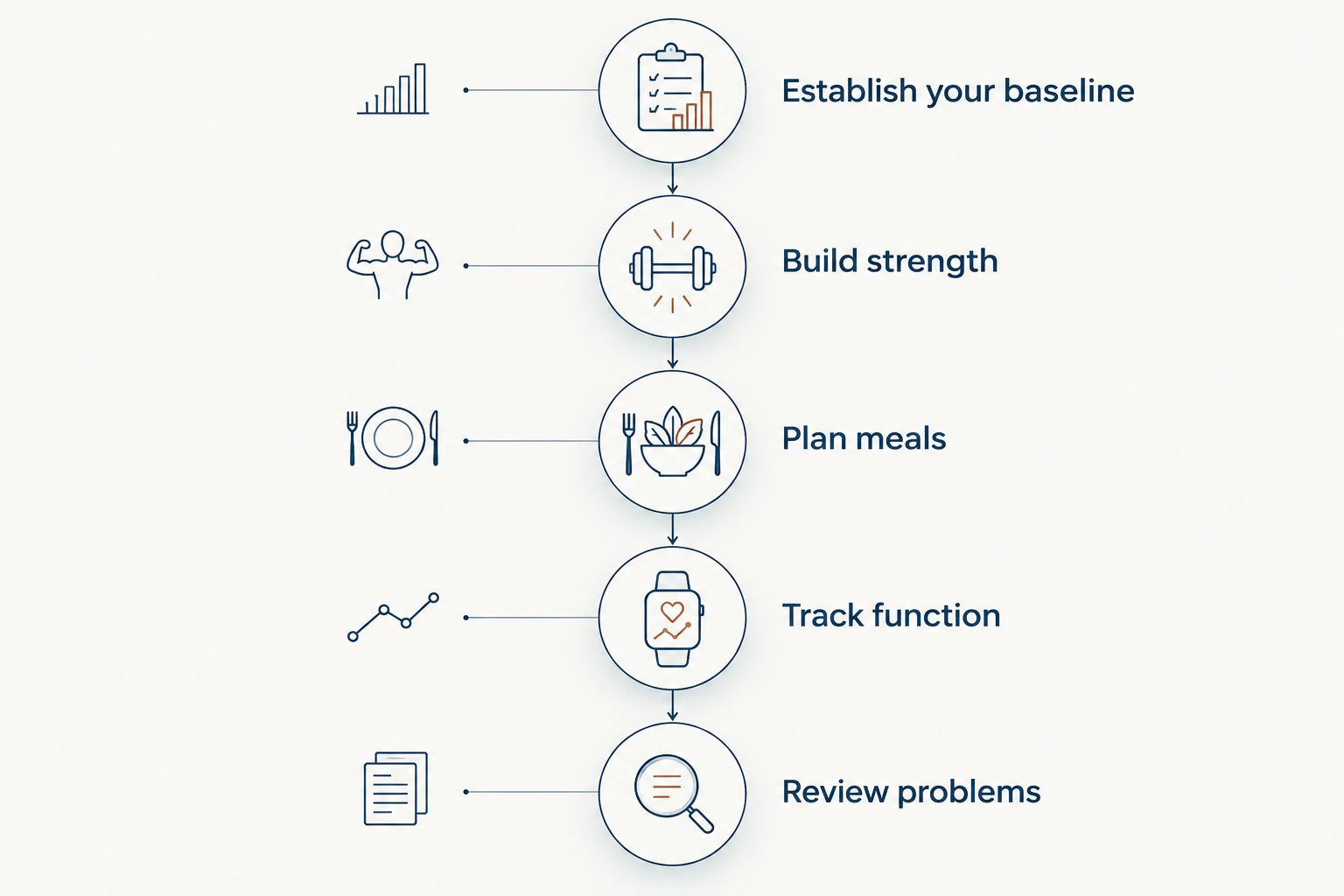
Track what your body can do alongside changes in weight.
Which approach supports strength rather than scale weight alone?
Different habits serve different purposes. Walking benefits health and activity tolerance; resistance exercise directly challenges your muscles; food provides the materials and energy needed for recovery. Treating one as a substitute for all the others leaves gaps.
| Approach | Best for | Main benefit | Limitation |
|---|---|---|---|
| Scale tracking alone | Watching weight trends | Simple way to follow overall weight change | Cannot distinguish fat, lean tissue, and fluid changes |
| Walking and aerobic activity | Cardiovascular health and activity tolerance | Supports regular movement | Does not replace resistance exercise |
| Resistance exercise | Maintaining muscle strength | Gives muscles a repeated training stimulus | Requires appropriate technique, progression, and recovery |
| Nutrition planning | Meeting needs with a smaller appetite | Helps maintain protein and overall food intake | Does not replace a muscle-strengthening stimulus |
| Combined care plan | Addressing weight and physical function together | Connects treatment, nutrition, activity, and follow-up | Needs adjustment when symptoms or circumstances change |
The strongest practical plan combines these tools instead of choosing only one. Your starting point still matters: someone returning after an injury needs a different exercise plan from someone already lifting regularly.
Build strength without turning treatment into a fitness test
The federal Physical Activity Guidelines for Americans, second edition, published in 2018, recommend muscle-strengthening activity on at least 2 days per week for adults. They also recommend 150 minutes per week of moderate-intensity aerobic activity, with additional benefits from more activity. These are general public-health targets, not a personalized prescription or a requirement to start at the full amount.
For your 2026 plan, begin with activity you can perform safely and repeat consistently. Exercises can include supported sit-to-stands, resistance-band rows, or appropriately selected machine exercises. The right choice depends on your balance, joints, cardiovascular health, and experience.
Keep the emphasis on controlled movement and manageable effort. If your usual exercise becomes much harder, check whether you have eaten, hydrated, and recovered adequately. Repeated deterioration deserves a clinical conversation rather than a harder workout.
A useful strength record includes:
- The movement: Use an exercise or everyday task you already know.
- The effort: Note whether the same task feels unusually difficult.
- The recovery: Record persistent soreness, fatigue, or dizziness.
- The context: Include illness, poor sleep, or reduced food intake.
Do not perform maximum-effort tests at home to prove that treatment is working. Stop exercise and seek appropriate assessment for chest pain, fainting, or other concerning symptoms.
Make smaller meals nutritionally useful
When appetite falls, meal planning becomes more deliberate. You do not have to force large meals, but repeatedly skipping food without a replacement plan can leave you short of protein, energy, and other nutrients.
Include a protein-containing food in your meals, using foods you tolerate and enjoy. Eggs, fish, poultry, dairy foods, beans, lentils, and tofu are examples—not a required shopping list. Build the rest of your intake around a varied eating pattern rather than trying to live on protein alone.
There is no universal protein target appropriate for every man receiving tirzepatide. Body size, age, activity, kidney health, and other medical conditions affect the recommendation. Ask your clinician or dietitian for an individualized target rather than copying a bodybuilding plan.
For a 2026 nutrition review, describe what you actually eat on a typical treatment day. Include days when nausea is worse. That makes the conversation more useful than simply saying your diet is healthy.
A protein shake can help fill a practical gap, but it is not required and does not guarantee muscle preservation. If you cannot tolerate meals or fluids, the next step is clinical advice—not adding more supplements or accepting poor intake as proof that the medication is working.
Track muscle-related function, not just body composition
Lean mass is not the same as muscle strength. Lean-mass measurements include more than skeletal muscle, and strength depends on factors beyond tissue size, including training, pain, and nervous-system function.
A body-composition result therefore needs context. A change in estimated lean mass does not, by itself, tell you how much strength you have lost or whether treatment should stop. Home body-composition scales also estimate rather than directly measure muscle, and hydration affects their readings.
Choose a few familiar activities and watch for a sustained pattern. Can you rise from your usual chair comfortably? Are stairs becoming harder despite a lower body weight? Is your normal training load repeatedly slipping?
Bring those observations to your 2026 follow-up rather than diagnosing muscle loss yourself. A clinician can review food intake, hydration, medications, sleep, medical conditions, and the need for examination or testing.
Mensmedicalinstitute is a fit for men in St. Louis seeking physician-led weight management. That care model does not guarantee preserved strength; you still need an individualized plan and an honest review when your function changes.
Why strength changes during treatment
Strength during weight loss reflects more than the medication dose. Several factors deserve attention when you and your clinician review a change:
- Reduced intake: A smaller appetite can make adequate nutrition harder to maintain.
- Training changes: Less resistance exercise removes a regular stimulus for muscle strength.
- Gastrointestinal symptoms: Nausea, vomiting, and diarrhea can interfere with nutrition and hydration.
- Starting health: Existing frailty, injury, or chronic illness changes what exercise is appropriate.
- Sleep and recovery: Poor sleep and inadequate recovery can affect exercise performance.
- Other medicines: Your overall medication plan matters, including medicines that affect blood sugar or blood pressure.
The American Academy of Sleep Medicine and Sleep Research Society's 2015 adult consensus recommends 7 or more hours of sleep per night on a regular basis. This is general sleep guidance, not a treatment for medication-related weakness. Persistent fatigue still needs assessment even when your sleep schedule appears adequate.
Does losing lean mass mean tirzepatide is unsafe for me?
A change in lean mass alone does not determine whether tirzepatide is appropriate for you. Your clinician should consider treatment benefits, physical function, nutrition, symptoms, and your medical history together.
Avoid making a stop-or-continue decision from a single home scale reading. Bring the pattern and your symptoms to the prescribing clinician.
Can I just walk instead of lifting weights?
Walking supports health, but it does not replace muscle-strengthening exercise. The general adult recommendation includes strength work on at least 2 days per week, adapted to your abilities.
If lifting is not currently practical, ask about supported exercises, resistance bands, or physical therapy. Pain or disability calls for adaptation, not an assumption that strength work is impossible.
Should I increase my dose if my weight loss slows?
A slower weight trend is not a reason to increase tirzepatide on your own. Your prescriber needs to review your response, tolerance, and treatment plan before making a dosing decision.
If you are also eating poorly or getting weaker, say so before a planned change. Appetite suppression is not the only measure of successful care.
Know when symptoms need medical attention
Do not label every symptom as normal adjustment. Persistent vomiting, inability to keep fluids down, marked dizziness, or new weakness warrants prompt contact with your clinician. These symptoms can interfere with hydration and safe daily activity.
FDA prescribing information for tirzepatide also warns about serious adverse effects, including pancreatitis and gallbladder problems. Severe or persistent abdominal pain needs urgent assessment, especially when accompanied by vomiting. Seek emergency help for severe allergic symptoms such as trouble breathing or swelling of the face or throat.
Low blood sugar is another consideration, particularly when tirzepatide is used with insulin or a sulfonylurea. Ask the prescribing clinician whether your other medicines need adjustment and what symptoms should trigger action. Do not independently change those medicines.
Exercise and nutrition advice cannot replace medication-safety counseling. Your 2026 review should include your complete medication list, relevant health history, and clear instructions for whom to contact when problems arise.
FAQ
How do I preserve muscle during tirzepatide weight loss?
Combine appropriate resistance exercise, adequate nutrition, and clinical follow-up during tirzepatide weight loss. Track everyday function as well as weight, and report persistent weakness or difficulty eating.
How many days a week should I do strength training?
General adult guidance recommends muscle-strengthening activity on at least 2 days per week. Your starting routine should reflect your health, injuries, balance, and exercise experience.
How much protein should I eat while taking tirzepatide?
Your protein target should be individualized rather than copied from a universal plan. Ask your clinician or dietitian to account for body size, activity, kidney health, and what you can tolerate.
Is a body-composition scale enough to tell whether I am losing muscle?
No. Home body-composition scales estimate lean tissue and are affected by hydration. Changes need to be considered alongside strength, symptoms, food intake, and clinical assessment.
Should I take testosterone to prevent muscle loss during weight loss?
Testosterone is not a routine treatment for preventing muscle loss during weight management. Evaluation for testosterone deficiency requires relevant symptoms and appropriate testing; weakness alone does not establish the diagnosis.
Are compounded tirzepatide products FDA-approved?
No. Compounded tirzepatide products are not FDA-approved, and FDA does not review them for safety, effectiveness, or quality before they are marketed. Ask exactly what product is being prescribed and dispensed.
Can I discuss weight management with Mensmedicalinstitute in St. Louis?
Yes. Mensmedicalinstitute offers physician-led weight management for men in St. Louis. Call 314-394-1660 to ask about an evaluation and what care involves.
One last thing
A useful goal is to lose weight without losing the ability to live your usual life. Before your next appointment, write down an everyday task you want to maintain—carrying groceries, using stairs, or completing a familiar workout—and tell your clinician why it matters.
For men considering Mensmedicalinstitute, call 314-394-1660 to discuss an evaluation and ask how weight management fits your health history. You can also contact the practice with questions about care. This article provides general education, not individual medical advice or a personalized treatment plan.