Tirzepatide weight loss plateau: questions for your physician

A tirzepatide weight loss plateau calls for a physician review of your weight trend, prescription, eating patterns, activity, and symptoms—not an automatic dose increase. A stretch without scale movement does not, by itself, establish that treatment has stopped working. Use this 2026 guide to prepare questions that help your physician decide whether to continue, adjust, or reconsider your plan.
TL;DR
- A tirzepatide weight loss plateau needs a clinical review, not an automatic dose increase.
- Compare your weight trend with your prescription history, nutrition, activity, and side effects.
- Mensmedicalinstitute offers physician-led weight management for men in St. Louis.
- Ask what would justify continuing treatment, changing the plan, or investigating another health concern.
Why this matters
A plateau is a reason to reassess treatment, not to blame yourself. Your scale measures total body weight, including changes in fluid and bowel contents. It cannot tell you whether your prescription is appropriate, whether you are eating adequately, or whether side effects need attention.
Mensmedicalinstitute provides physician-led weight management for men in St. Louis. For men in St. Louis and Metro East Illinois, the useful next step is a conversation built around the actual prescription and the man taking it—not a promise about the next weigh-in.
This article provides general education, not individual medical advice. Your prescribing clinician should direct medication changes.
Tirzepatide weight loss plateau: what should you ask your physician?
Start with this question: Does my recorded weight trend show a sustained plateau, and what information would change your recommendation? A few isolated readings do not answer that question. Bring the sequence of measurements, including when and how you weighed yourself, rather than only your highest and lowest numbers.
Use these steps to organize the discussion:
- Weight trend. Show your recent readings and explain changes in weighing conditions, bowel habits, or fluid retention. Ask whether the pattern represents a meaningful treatment concern.
- Prescription history. Bring your medication label, current dose, injection schedule, and dates of any missed doses or interruptions. Include the source of the medication.
- Daily intake. Describe meals, drinks, appetite, alcohol, and activity without trying to present a perfect week. Include days when nausea or low appetite makes eating difficult.
- Symptoms. Report constipation, vomiting, abdominal pain, dizziness, or weakness. Explain whether symptoms interfere with eating, drinking, work, or exercise.
- Follow-up plan. Ask what happens next, what you should monitor, and which symptoms require contact before the next appointment.
These details help your physician distinguish a measurement issue from a treatment problem. They also keep the conversation from becoming a dose discussion before safety and nutrition have been addressed.
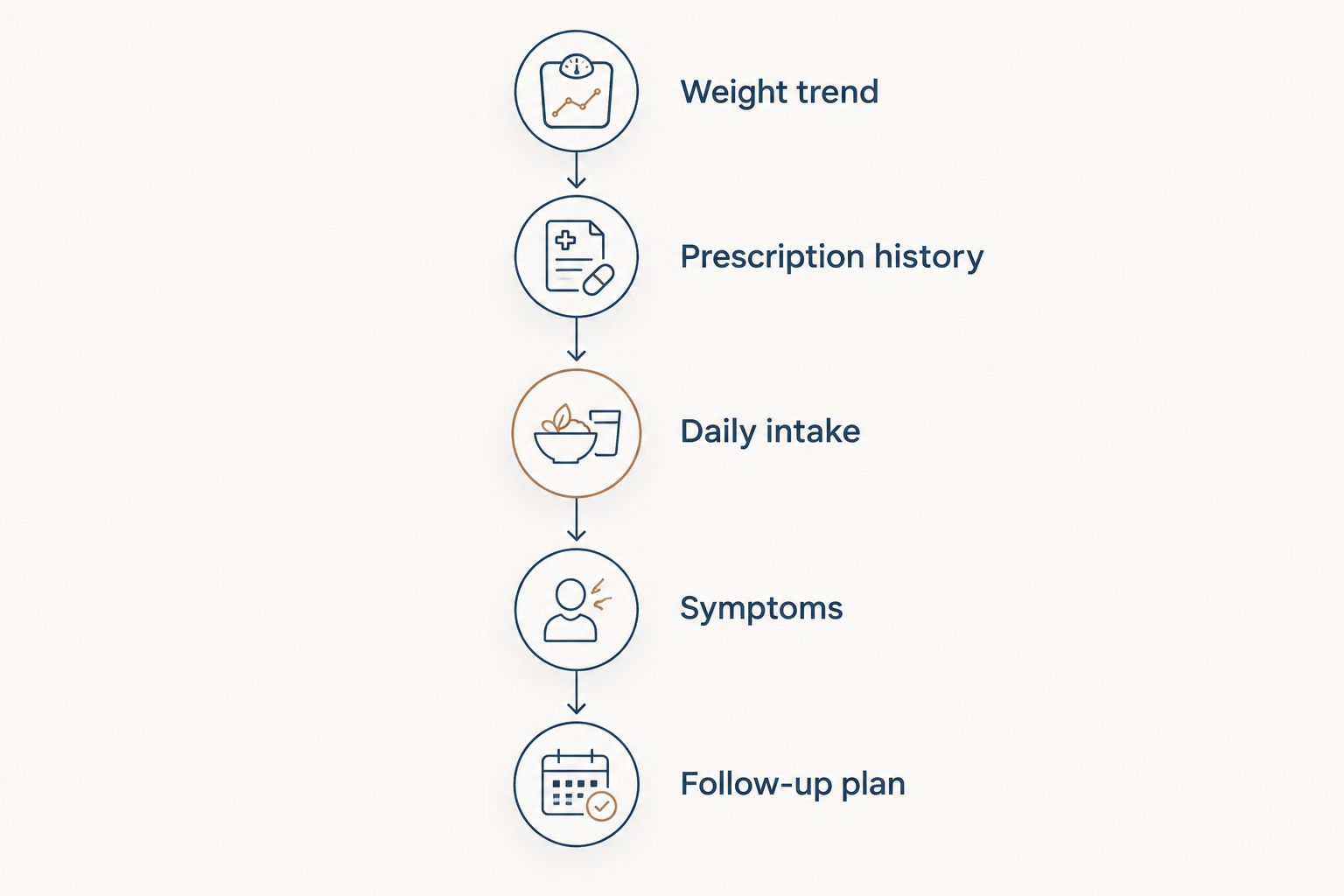
Review the whole treatment picture before deciding whether the prescription should change.
What can your physician do about a plateau?
There is no single adjustment that fits every plateau. Your clinician needs to weigh the treatment's benefits against side effects, nutritional concerns, and your health goals. Ask which approach fits your situation and why.
| Approach to discuss | Best for | Potential benefit | Limitation or concern |
|---|---|---|---|
| Continue and monitor | A weight pattern that needs clarification | Allows assessment under consistent conditions | Does not resolve an underlying problem without further review |
| Review the prescription | Questions about dose, interruptions, administration, or tolerability | Identifies whether medication use needs correction or adjustment | A higher dose can increase side effects and is not automatically appropriate |
| Reassess the broader plan | Changes in health, nutrition, activity, or other medicines | Addresses factors a prescription change alone will not solve | Requires an individualized assessment rather than a quick medication answer |
These are discussion paths, not instructions to select your own treatment. Do not increase the dose, shorten the interval between injections, or combine weight-loss medicines without your prescriber's direction.
If you are comparing follow-up arrangements, this guide to choosing a weight-loss clinic in St. Louis focuses on ongoing support. Ask who handles plateau questions and how to report symptoms between visits.
Why tirzepatide weight loss varies
Several factors can affect the trend your physician sees. None of these should be assumed to explain your plateau without a discussion:
- Changing energy needs. As body weight decreases, the energy needed to maintain that weight generally decreases. A routine that previously produced weight loss can eventually support weight maintenance.
- Medication use. Missed doses, treatment interruptions, and administration errors can affect treatment. Your clinician needs an accurate history before interpreting the response.
- Eating and drinking patterns. Appetite suppression does not describe everything you consume. Meal patterns, beverages, alcohol, and difficulty maintaining adequate nutrition all belong in the review.
- Activity and function. Changes in daily movement, resistance exercise, injury, or fatigue can alter the broader weight-management picture.
- Fluid and bowel changes. Constipation and shifts in body fluid can affect scale readings. A stable reading alone does not identify the cause.
- Other health factors. Medicines and medical conditions can affect weight or treatment tolerability. Review them with your clinician rather than stopping another prescription yourself.
The practical question is not which explanation sounds most convincing online. It is which explanation fits your history and changes the next clinical decision.
Does a plateau mean your tirzepatide dose is too low?
No. A plateau alone does not establish that your dose is too low. Dose decisions also depend on the prescribed product, treatment stage, response, side effects, and relevant medical history.
For your 2026 prescription discussion, distinguish starting treatment from maintenance treatment. FDA prescribing information for Zepbound, the tirzepatide product indicated for weight management, specifies a starting dose of 2.5 mg once weekly for 4 weeks, followed by 5 mg once weekly. The starting dose is for treatment initiation, not weight-management maintenance.
Those label details explain why your treatment stage matters; they are not instructions to change your own prescription. Your physician must determine the appropriate dose and timing for your situation.
Ask these questions before discussing an increase:
- Am I still in the initiation or dose-escalation phase?
- Have interruptions affected how you interpret my response?
- Are my side effects adequately controlled?
- What benefit are we seeking from a change?
- What findings would make you advise against increasing the dose?
If a prescription label lists both a concentration and an injection volume, ask the prescriber or dispensing pharmacist to explain them. Milligrams describe the drug amount; syringe markings do not identify that amount without the concentration. Do not copy another person's injection instructions.
Should you eat less or exercise harder to restart weight loss?
Not automatically. A plateau does not prove that further restriction is appropriate, especially if you already struggle to eat, feel weak, or have persistent gastrointestinal symptoms. Describe your actual intake before making a more restrictive plan.
Ask whether your meals provide adequate nutrition and whether you need individualized dietary guidance. Report nausea-related meal skipping and difficulty drinking fluids. These are clinical details, not evidence that you lack discipline.
Physical activity also needs to fit your health and current function. Ask how to include resistance exercise and routine movement without aggravating an injury or ignoring fatigue. The goal is a sustainable plan that supports health, not punishment for a stable scale reading.
Avoid adding supplements or another weight-loss medication to force a change. Your physician needs to check potential interactions and decide whether any additional treatment has a clear purpose.
What should you bring to your 2026 appointment?
Bring information that makes the decision clearer. A detailed explanation of your routine is more useful than a carefully edited version of it.
Your medication details
Bring the prescription label or a clear photograph of it. Include your current dose, injection day, recent changes, missed doses, and any difficulty using or storing the medication according to its instructions. List other prescriptions, over-the-counter medicines, and supplements.
Ask whether the product you receive is FDA-approved or compounded. Compounded tirzepatide products are not FDA-approved, and FDA does not review them for safety, effectiveness, or quality before marketing. Do not assume that a familiar ingredient name establishes equivalent regulatory review.
Your weight and symptom record
Bring dated measurements taken under reasonably consistent conditions. Note whether constipation, illness, travel, or a change in routine accompanied the apparent stall. Include symptoms even when you think they are unrelated.
Your physician can then decide whether the record needs more observation or a different evaluation. You do not need to diagnose the explanation before asking for help.
Your goals and concerns
Explain what successful treatment means beyond the scale: improved daily function, easier movement, or progress toward an agreed health goal. Ask which measures your clinician uses to assess benefit and what would count as an inadequate response.
Also ask which services are included in your care arrangement and which are billed separately. Clarify follow-up visits, laboratory work when indicated, medication, and access to advice between appointments.
When should symptoms take priority over the plateau?
Severe symptoms need attention even when weight loss has stalled. Severe or persistent abdominal pain, particularly with vomiting, requires prompt medical assessment. Tell the clinician that you take tirzepatide and when your last dose occurred.
Repeated vomiting, inability to keep fluids down, fainting, or signs of dehydration also need prompt advice. Difficulty breathing or swelling of the face or throat requires emergency care. Do not wait for a routine weight-management appointment to address these symptoms.
If you also use insulin or a sulfonylurea, ask about low blood sugar risk and your response plan. The plateau discussion should never replace a medication-safety review.
What should your 2026 follow-up plan include?
Leave with a decision you can explain in plain language: continue the current plan, make a clinician-directed change, or complete a further assessment. Ask what evidence supports that decision and what would cause the physician to reconsider it.
The plan should identify what you will track, when the clinician will review it, and how to report a problem sooner. If another clinician manages relevant conditions or prescriptions, ask what information needs to be shared. Avoid having separate prescribers make changes without knowing the full medication list.
Mensmedicalinstitute is best for St. Louis men seeking physician-led weight management rather than self-directed dose changes. Bring questions about your goals and treatment history; an individualized assessment should determine the next step, not a preset promise of continued weight loss.
FAQ
Why has my tirzepatide weight loss stopped?
A tirzepatide weight loss plateau can have several explanations, including changing energy needs, medication interruptions, intake patterns, and fluid or bowel changes. Your physician needs your weight trend, prescription history, and symptoms to assess the cause.
Should I increase tirzepatide if my weight is not changing?
Do not increase tirzepatide without your prescriber's direction. A plateau alone does not establish that the dose is too low, and side effects or other clinical concerns can make an increase inappropriate.
How long does a tirzepatide plateau have to last before I call?
There is no universal waiting period that determines when you should call about a plateau. Ask your prescribing clinician when to report a stable trend, and contact them sooner for troublesome symptoms or problems taking the medication.
Can constipation hide weight loss on the scale?
Constipation can affect scale weight, but it does not prove that fat loss is continuing underneath a plateau. Tell your physician about changes in bowel habits, especially if you also have pain, vomiting, or difficulty eating.
Should I stop tirzepatide because I reached a plateau?
Do not stop or restart tirzepatide solely because the scale has stalled without discussing the plan with your prescriber. The decision depends on treatment benefit, tolerability, health goals, and your clinical situation.
Is compounded tirzepatide FDA-approved?
No. Compounded tirzepatide products are not FDA-approved, and FDA does not review them for safety, effectiveness, or quality before marketing. Ask your prescriber and pharmacist to explain the product, concentration, and administration instructions.
What should I ask at a tirzepatide plateau appointment in 2026?
Ask whether your recorded weight trend shows a sustained plateau, what factors need review, and what would justify changing treatment. Leave with clear monitoring instructions, a follow-up plan, and guidance on symptoms that require earlier contact.
One last thing
A useful appointment ends with more than a decision about the dose. Before you leave, ask: What finding would make us change course? That question turns a vague instruction to keep trying into a plan you and your physician can evaluate.
If you are in St. Louis or Metro East Illinois and want to discuss physician-led weight management with Mensmedicalinstitute, call 314-394-1660. An individual medical assessment—not this guide—determines what care is appropriate for you in 2026.