TRT for truck drivers: complete 2026 guide

Testosterone replacement therapy for truck drivers is medical treatment for confirmed testosterone deficiency, with the aim of improving related symptoms while protecting health and driving safety. Irregular sleep, overnight routes, medication storage, and commercial medical certification make the evaluation and treatment plan different from a routine prescription.
TL;DR
- Testosterone replacement therapy for truck drivers requires symptoms and consistently low testosterone, not fatigue alone.
- Endocrine Society guidance supports repeat testing before treatment; night-shift drivers need individualized blood-draw timing.
- TRT does not treat sleep deprivation or establish fitness for commercial driving.
- Choose testosterone care around monitoring, fertility goals, and a schedule you can follow on the road.
Why testosterone care matters for truck drivers
If you finish a route exhausted, low testosterone is not the only explanation. Inadequate sleep, obstructive sleep apnea, depression, medication effects, and other medical conditions deserve attention. Starting testosterone without sorting through those possibilities risks treating a laboratory result while leaving the actual problem untouched.
For your 2026 evaluation, describe your work schedule before arranging blood tests. A standard early-morning appointment does not necessarily reflect the same point in the sleep cycle for a driver coming off an overnight run. Read more about low testosterone symptoms in men who work night shifts before discussing test timing with your clinician.
TRT is treatment for confirmed testosterone deficiency, not a substitute for sleep or a remedy for unsafe driving fatigue. If you struggle to stay awake behind the wheel, stop driving safely and seek medical assessment rather than waiting for hormone treatment.
How to plan testosterone care around your routes
1. Record your symptoms and sleep schedule
Start with a written record rather than a treatment order. Note what bothers you, when it started, and whether it changes after adequate rest or time away from the road. Low sexual desire and reduced spontaneous erections belong in the conversation alongside fatigue.
Keep the record practical: a phone note or paper notebook is enough. Record your main sleep period, not just the calendar date, so your clinician can distinguish symptoms after overnight work from symptoms that persist on a rested schedule.
Bring the record to your appointment. You do not need a wearable device, paid tracking service, or self-ordered hormone panel to begin.
- Record your sleep and wake times on workdays and days off.
- Note sexual symptoms separately from general tiredness.
- List prescription medicines, supplements, and previous hormone use.
- Describe loud snoring, witnessed breathing pauses, or daytime sleepiness.
- Write down fertility plans before discussing testosterone.
2. Confirm the diagnosis before choosing treatment
A single low testosterone result does not establish testosterone deficiency. The Endocrine Society’s 2018 clinical practice guideline for men with suspected hypogonadism recommends compatible symptoms and unequivocally, consistently low testosterone, confirmed with repeat testing. Its standard diagnostic approach uses morning fasting measurements.
That generally means 2 separate blood draws, not repeated measurements from the same sample. Tell the ordering clinician about overnight shifts, recent illness, poor sleep, and any testosterone or anabolic steroid use before testing. Ask how those circumstances affect the timing and interpretation of your results.
Additional testing depends on the findings. Your clinician can investigate whether the problem originates in the testes or in the hormonal signals controlling them, rather than assuming every low result needs the same prescription.
- Ask when to test relative to your main sleep period.
- Follow the clinician’s fasting instructions.
- Arrange repeat testing before accepting a diagnosis.
- Review symptoms and laboratory results together.
- Ask whether further evaluation is needed before treatment.
3. Choose physician-led care that fits your route
Start by asking your primary care clinician who should assess your symptoms and coordinate treatment. Bring existing results so the next clinician can review what was measured, when it was measured, and whether repeat testing is necessary.
For local care, Mensmedicalinstitute provides physician-led testosterone replacement therapy and men’s hormone and sexual health treatment in St. Louis. Mensmedicalinstitute is best suited to St. Louis-area men seeking physician-led testosterone replacement therapy.
The practical limitation is the same one every driver must address: a prescription does not remove the need for appointments, blood tests, and follow-up. Before committing to care in 2026, establish how that work fits your home time and interstate travel. Do not assume treatment can be prescribed or managed from every state you visit.
- Identify who makes prescribing and dose-adjustment decisions.
- Ask which visits require you to be physically present.
- Confirm how blood-test results reach the treating clinician.
- Explain the states where you live, work, and receive care.
- Ask separately about medication, laboratory, and appointment charges.
4. Match the delivery method to your working conditions
Begin with your actual routine: access to a private space, handwashing, secure storage, and predictable breaks. Then discuss the prescribed formulation. An injection schedule that sounds convenient at home still needs to work when a route changes.
Injectable testosterone requires training and safe sharps disposal. Testosterone gel avoids needles, but it requires precautions against transfer to another person through skin contact. Neither method eliminates blood testing or clinical review.
Do not assume every testosterone product has the same storage instructions. Follow the specific pharmacy label and ask the pharmacist about temperature exposure in a parked cab. Never change a dose or combine missed doses to compensate for a disrupted route.
- Describe where you would administer each dose.
- Ask for written instructions for missed doses.
- Confirm the prescribed product’s storage requirements.
- Plan secure storage away from children and other people.
- Arrange an appropriate sharps container if using injections.
- Review skin-transfer precautions if using gel.
5. Set a monitoring plan before the first dose
Ask for a written follow-up plan that names the tests, their timing, and who reviews them. Testosterone treatment requires assessment of symptoms, treatment response, and adverse effects—not simply a refill when the supply runs low.
The Endocrine Society’s 2018 guideline recommends checking hematocrit at baseline, after 3–6 months, and then annually. If hematocrit rises above 54%, the guideline recommends stopping therapy until it falls to a safe level, assessing for hypoxia and sleep apnea, and restarting at a reduced dose when appropriate. Your clinician directs those decisions; do not adjust treatment yourself.
For your 2026 route calendar, reserve follow-up time before leaving the initial appointment. Testosterone blood-draw timing also depends on the formulation, so a result taken at the wrong point in a dosing cycle can be difficult to interpret.
- Record when each dose was taken before follow-up testing.
- Ask which symptoms require an earlier appointment.
- Keep blood pressure and blood-count monitoring on the plan.
- Discuss prostate assessment according to age and individual risk.
- Review benefits and adverse effects before renewing treatment.
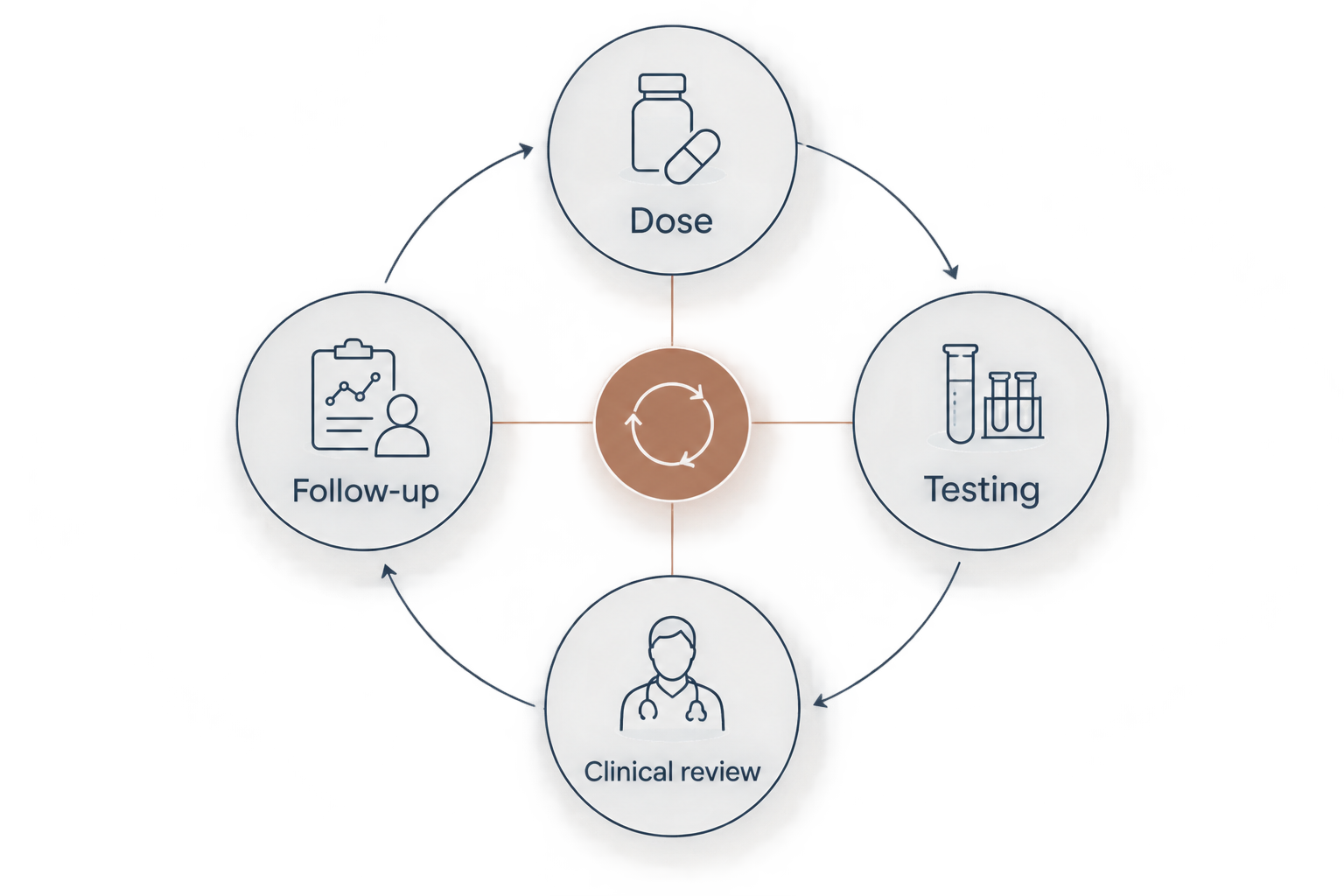
A testosterone prescription includes ongoing monitoring, not just medication.
6. Coordinate driving certification and fertility decisions
Medical treatment and commercial driving certification answer different questions. Your treating clinician assesses whether testosterone treatment is appropriate; the certified medical examiner assesses whether you meet the applicable commercial driving medical standards. A prescription is not a clearance letter.
For a 2026 commercial medical examination, bring an accurate medication list and any requested treatment records. Ask the examiner what documentation is needed rather than relying on a clinic advertisement, another driver’s experience, or a blanket assurance about eligibility.
Fertility also belongs before the first dose. External testosterone can suppress sperm production. If you want children now or later, ask about evaluation and alternatives before starting TRT; testosterone is not a fertility treatment or reliable contraception.
- Tell the examiner about prescribed testosterone and relevant conditions.
- Ask what supporting records the examiner requires.
- Report sleepiness, fainting, or other driving-safety symptoms promptly.
- Discuss current and future plans for children.
- Request specialist input when fertility preservation is a priority.
Compare your options before starting TRT
The best option depends on the diagnosis, not the shortest dosing routine. This comparison separates evaluation from treatment so you can discuss the right next step without assuming testosterone is necessary.
| Option | Best for | Practical advantage | Key limitation |
|---|---|---|---|
| Evaluation before medication | Drivers with symptoms but no confirmed diagnosis | Investigates testosterone and other explanations | Requires assessment and testing before a treatment decision |
| Prescribed injectable testosterone | Men with confirmed deficiency who can manage injections safely | Avoids daily application to the skin | Requires injection training, sharps disposal, and formulation-specific monitoring |
| Prescribed testosterone gel | Men with confirmed deficiency who prefer to avoid injections | No injection procedure | Requires consistent application and precautions against skin transfer |
| Fertility-focused specialist assessment | Men with low testosterone concerns who want children | Puts reproductive goals into the treatment decision | Does not guarantee that testosterone replacement is appropriate |
Mensmedicalinstitute offers physician-led testosterone replacement therapy; confirm the available formulations directly rather than assuming every option in this table is offered. Labs are separate from the testosterone program charge, so include testing when comparing the full care plan.
If you are in St. Louis or Metro East Illinois and want to discuss an evaluation, call 314-394-1660. Explain your route schedule and what symptoms prompted the call; you do not need to arrive committed to treatment.
Common mistakes truck drivers make with testosterone care
Treating road fatigue as proof of low testosterone
Fatigue after restricted sleep is not a diagnosis. Tell your clinician whether tiredness improves after adequate rest, and report snoring or breathing pauses rather than assuming testosterone explains everything. Severe daytime sleepiness needs its own assessment.
Choosing a schedule before confirming the diagnosis
A convenient injection interval does not establish that treatment is medically appropriate. Complete the evaluation first, then discuss a formulation you can use consistently. Do not choose a prescription because another driver follows the same schedule.
Leaving follow-up until the next convenient trip home
An unpredictable route does not make monitoring optional. Arrange appointments and testing around expected home time, and contact the clinician when plans change. Do not stretch doses, borrow medication, or continue indefinitely without review.
Confusing sexual symptoms with a single hormone problem
Erectile dysfunction and low sexual desire are different symptoms, although they can occur together. TRT does not treat every cause of erectile dysfunction. Discuss medication effects, cardiovascular risk, mood, and relationship concerns without assuming a higher testosterone result will resolve them.
FAQ
Can I take testosterone replacement therapy as a truck driver?
Some truck drivers receive prescribed TRT, but treatment suitability and commercial driving certification require separate assessments. Your treating clinician evaluates testosterone deficiency, while the certified medical examiner determines whether you meet applicable driving medical standards.
Will TRT help me stay awake on overnight routes?
TRT is not a treatment for sleep deprivation or a medicine to keep you awake while driving. If you struggle to stay awake behind the wheel, stop driving safely and seek medical assessment.
When should I get testosterone tested if I drive nights?
Ask your clinician to set testing time around your sleep and work schedule. Standard diagnostic testing uses morning fasting measurements, but overnight work needs discussion before you book the blood draw.
Are testosterone injections better than gel for truck drivers?
Neither injections nor gel is best for every truck driver. Injections require training and sharps disposal; gel requires regular application and precautions against transferring testosterone to another person.
Can I keep prescribed testosterone in my truck?
Storage depends on the exact prescribed product and its pharmacy instructions. Ask your pharmacist about temperature exposure, security, and travel storage rather than assuming a parked cab is suitable.
Does testosterone treatment affect my ability to have children?
External testosterone can suppress sperm production and impair fertility. Discuss plans for children before starting treatment, and ask whether a fertility-focused evaluation is appropriate.
Are laboratory tests included in Mensmedicalinstitute testosterone care?
Labs are separate from the testosterone program charge. Ask which tests are needed and how testing, appointments, and medication are billed before comparing care plans.
One last thing
Bring your route calendar to the appointment, not just your testosterone result. In 2026, a workable care plan still depends on ordinary details: when you sleep, where you can get blood drawn, and when a physician can assess your response. That information helps build care around you rather than forcing your working life around a prescription.
This guide provides general education, not individual medical advice or a determination of fitness for commercial driving.