GLP-1 weight-loss medications ranked by side effects in 2026

Tirzepatide has the lowest reported nausea rate in the separate adult weight-management trials compared here, followed by liraglutide and semaglutide—not a proven overall safety ranking. This 2026 guide compares those medicines, explains the limits of that order, and identifies symptoms that need medical attention.
TL;DR
- GLP-1 weight loss medication side effects compared: tirzepatide had the lowest nausea rate across these separate registration trials.
- Liraglutide requires daily injections; injectable semaglutide and tirzepatide use weekly schedules.
- Different trials cannot establish which medicine will cause you the fewest side effects.
- Mensmedicalinstitute provides physician-led weight management for men in St. Louis; treatment decisions require individual medical assessment.
Why this matters
Nausea matters, but so do dehydration, constipation, your other medicines, and whether you can eat adequately. The best prescription is not simply the medicine with the smallest percentage in a table.
Mensmedicalinstitute provides physician-led weight management for men in St. Louis. For men in St. Louis and Metro East Illinois comparing treatment in 2026, the useful question is which medicine fits your health history and has a clear follow-up plan.
This article provides general education, not individual medical advice. Do not start, stop, switch, or change a prescription dose based on this comparison.
What makes the best side-effect fit?
Use these criteria before reading the ranking:
- Digestive tolerance: Consider nausea, vomiting, diarrhea, constipation, reflux, and abdominal discomfort—not nausea alone.
- Medical suitability: Personal and family history, digestive disease, kidney health, and diabetes treatment affect the decision.
- Dose flexibility: Ask how your prescriber handles symptoms before increasing treatment. Do not create your own schedule.
- Daily function: A medicine needs to fit your ability to drink, eat, work, and remain active.
- Evidence quality: Compare the same outcome in similar populations. Separate trials provide context, not a reliable head-to-head safety verdict.
- Follow-up: Know whom to contact, what symptoms to report, and when urgent assessment replaces a routine message.
Side effects at a glance
This 2026 comparison covers injectable medicines labeled for chronic weight management: Zepbound, Saxenda, and injectable Wegovy. Tirzepatide acts on both GIP and GLP-1 receptors; liraglutide and semaglutide act on GLP-1 receptors.
The order below follows reported nausea percentages, not overall safety, effectiveness, or prescribing preference. Each medicine occupies a different discussion slot rather than serving as a universal winner.
| Rank and medicine | Best for discussing | Standout characteristic | Reported nausea | Key limitation |
|---|---|---|---|---|
| 1. Tirzepatide, Zepbound | A weekly option with the lowest nausea percentage in these separate trials | Dual GIP/GLP-1 action | 25–29%, depending on dose | Separate trials do not prove better individual tolerance |
| 2. Liraglutide, Saxenda | A daily-injection option | Daily rather than weekly administration | 39.3% | Daily injections and substantial digestive side effects |
| 3. Injectable semaglutide, Wegovy | A weekly GLP-1-only option | Weekly administration without GIP activity | 44% | Nausea was common in its adult registration trials |
Source and scope: FDA-approved prescribing information for Zepbound, Saxenda, and injectable Wegovy; adult weight-management adverse-reaction tables, summarized for this 2026 guide. Zepbound percentages span its maintenance-dose groups; the Saxenda and Wegovy figures describe their respective adult trial populations. These are separate studies, not one randomized comparison.
A nausea percentage does not describe severity, duration, or whether someone stopped treatment. Different participant characteristics, dose schedules, and study designs also prevent a direct safety ranking.
1. Tirzepatide: best for a lower-nausea-rate discussion
Tirzepatide, marketed as Zepbound for weight management, acts on GIP and GLP-1 receptors. It is administered weekly and can cause nausea, diarrhea, vomiting, constipation, abdominal pain, and other digestive symptoms.
In Zepbound's adult weight-management prescribing-information table, nausea occurred in 25–29% of participants across maintenance-dose groups. That is the lowest reported nausea range among the separate trial tables used here; it does not establish that tirzepatide is the safest medicine for you.
Tirzepatide pros:
- Weekly administration avoids a daily injection routine.
- Its prescribing information provides dose-specific digestive adverse-reaction data.
- The reported nausea range supports a focused discussion about tolerance without relying on anecdotes.
Tirzepatide cons:
- Digestive symptoms remain common despite the lower nausea percentage in this comparison.
- Vomiting and diarrhea can lead to dehydration and kidney injury.
- Tirzepatide carries important contraindications and warnings; a lower nausea rate does not remove them.
Best for: A physician discussion when you want a weekly option and need to weigh digestive tolerance alongside medical suitability.
Ask what happens if you develop symptoms before a planned dose increase. A written response plan is more useful than reassurance that side effects are normal.
Verdict: Hold—consider tirzepatide with your prescriber, not as an automatic safety winner.
2. Liraglutide: best for a daily-injection discussion
Liraglutide, marketed as Saxenda for weight management, is a GLP-1 receptor agonist administered daily. Like the weekly options, it reduces appetite and can cause digestive symptoms during treatment.
The Saxenda adult prescribing-information table reports nausea in 39.3% of treated participants. Its position between tirzepatide and semaglutide here reflects separate trial percentages, not proof of intermediate overall safety.
Liraglutide pros:
- Daily administration offers a different schedule from the weekly medicines.
- Its FDA-approved labeling defines dose escalation and management instructions.
- It provides a GLP-1-only option for an individualized treatment discussion.
Liraglutide cons:
- Daily injections add a recurring task.
- Nausea, vomiting, diarrhea, and constipation remain relevant concerns.
- A daily schedule does not establish that side effects will be milder or easier to manage.
Best for: Someone who wants to discuss whether a daily prescription fits better than a weekly one.
Do not assume that a daily injection lets you stop and restart whenever symptoms appear. Restarting instructions depend on the prescription and the length of the interruption; ask your prescriber before resuming.
Verdict: Hold—discuss liraglutide when the daily schedule fits, not because daily means safer.
3. Injectable semaglutide: best for a weekly GLP-1-only discussion
Injectable semaglutide, marketed as Wegovy for weight management, is administered weekly. It acts on the GLP-1 receptor and can cause nausea, vomiting, diarrhea, constipation, abdominal discomfort, and reflux-related symptoms.
The injectable Wegovy adult weight-management prescribing-information table reports nausea in 44% of participants. That figure ranks highest here, but it does not predict your response or prove semaglutide is the least safe option.
Injectable semaglutide pros:
- Weekly administration avoids daily injections.
- It offers a GLP-1-only alternative to dual GIP/GLP-1 treatment.
- Its prescribing information includes an escalation schedule and adverse-reaction guidance.
Injectable semaglutide cons:
- Nausea was common in the adult trials summarized here.
- Constipation or vomiting can interfere with eating and hydration.
- Weekly dosing does not allow you to reverse an injection once administered.
Best for: Someone considering a weekly GLP-1-only medicine after reviewing health history, goals, and tolerability with a physician.
If you have diabetes and a history of diabetic retinopathy, tell your prescriber. Semaglutide labeling includes a warning about diabetic retinopathy complications in patients with type 2 diabetes; changes in vision need prompt assessment.
Verdict: Hold—do not rule out semaglutide from its nausea percentage alone.
How this ranking works
The ranking uses one defined outcome: reported nausea in the FDA-approved adult weight-management trial tables for these injectable products. The criteria above broaden the decision beyond that single outcome.
This is a nausea-rate ordering, not a validated overall side-effect score. It does not combine unrelated adverse events, compare compounded formulations, or substitute for a direct comparative trial.
For a 2026 treatment decision, your physician should consider evidence relevant to your medical conditions, not just this table. There is no defensible way to turn separate nausea percentages into a personal guarantee.
Common symptoms versus warning signs
Mild nausea is different from repeated vomiting or severe abdominal pain. Use symptom severity and your ability to drink—not a ranking—to decide how urgently to seek help.
Contact your prescriber
Report persistent nausea, worsening constipation, repeated diarrhea, reflux that disrupts sleep, or difficulty eating enough. Contact your prescriber before the next planned dose increase if symptoms are continuing.
Describe when symptoms began, their relationship to injections and meals, and whether you can keep fluids down. Include any missed doses or recent medication changes.
Seek urgent assessment
Seek urgent care for severe or persistent abdominal pain, especially with vomiting; inability to keep fluids down; fainting; markedly reduced urination; or yellowing of the skin or eyes. These symptoms can indicate problems requiring examination rather than home management.
Call 911 for trouble breathing, swelling of the tongue or throat, collapse, or another apparent medical emergency. For more detail, read about when vomiting during tirzepatide treatment needs urgent attention.
Review before treatment
Tell your clinician about previous pancreatitis, gallbladder problems, severe digestive symptoms, kidney disease, and all prescription and nonprescription medicines. These medicines are not recommended for people with severe gastroparesis.
Zepbound, Saxenda, and Wegovy are contraindicated with a personal or family history of medullary thyroid carcinoma or multiple endocrine neoplasia syndrome type 2. Their boxed warnings describe thyroid C-cell tumors in rodents; whether they cause these tumors in humans is unknown.
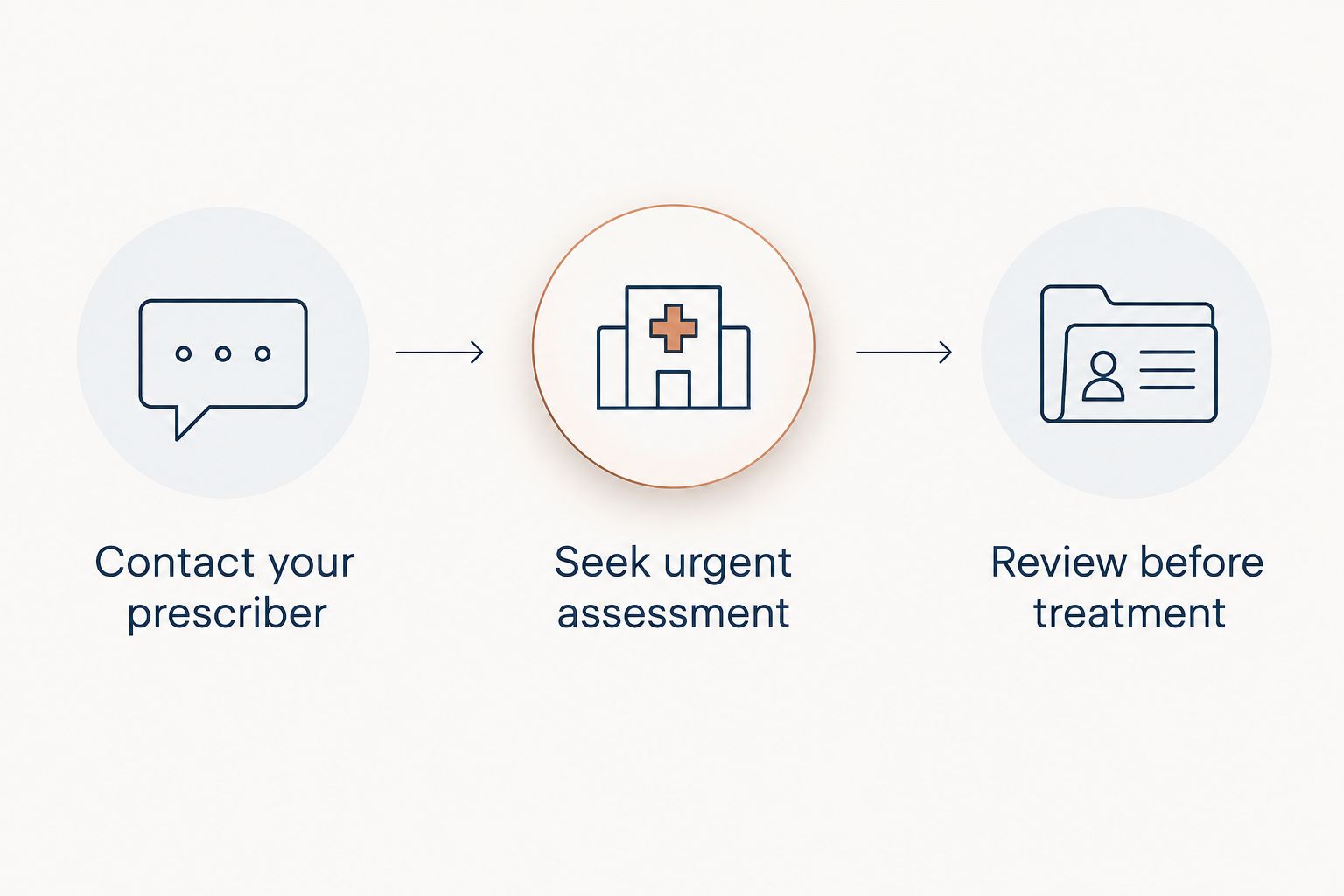
Match your response to the symptom and medical history, not the medicine's position in a ranking.
Make the treatment plan easier to follow
Before starting, ask your prescriber to explain the plan in plain language. You should understand what you are taking, how you will report problems, and who decides whether treatment changes.
- Confirm the prescription: Know the active ingredient, formulation, dose, and injection instructions. Do not translate dose units between different preparations yourself.
- Review other medicines: Insulin and sulfonylureas can increase hypoglycemia risk when combined with these treatments. Medication adjustments belong with your clinician.
- Discuss meals: Smaller meals and stopping when comfortably full can help with nausea. Persistent inability to eat needs clinical review, not simply a stricter diet.
- Plan for procedures: Tell the anesthesia or procedure team about treatment because delayed stomach emptying matters during anesthesia and deep sedation. Do not follow a blanket stop rule without their instructions.
Compounded semaglutide and tirzepatide are not FDA-approved. FDA does not review compounded products for safety, effectiveness, or quality before marketing; the trial percentages above should not be treated as verified side-effect rates for a particular compounded preparation.
Which medicine should you choose?
Choose a physician-guided assessment before choosing a winner. Tirzepatide leads this narrow nausea comparison, liraglutide offers a daily schedule, and injectable semaglutide offers a weekly GLP-1-only option.
Mensmedicalinstitute is best suited to men in St. Louis seeking physician-led weight-management care. Ask how treatment would account for your symptoms, other medicines, eating pattern, and ability to stay active—not just your weight.
For an unhurried discussion, call 314-394-1660. Ask what evaluation and follow-up involve, and request a clear explanation of treatment charges and exclusions before deciding.
Discuss your weight-management questions
Ask about physician-led care, follow-up, and what treatment involves.
FAQ
Which GLP-1 weight-loss medicine has the fewest side effects?
No single medicine has the fewest side effects for everyone. Tirzepatide had the lowest reported nausea percentage in the separate adult weight-management trial tables summarized here, but that does not establish overall safety superiority.
Is tirzepatide easier on the stomach than semaglutide?
Separate registration-trial nausea percentages cannot establish which medicine will be easier on your stomach. Your dose, escalation schedule, digestive history, and individual response all matter.
Is daily liraglutide safer than a weekly injection?
A daily schedule does not make liraglutide inherently safer. Liraglutide still causes digestive symptoms and carries important contraindications and warnings.
Should I increase my dose if I still feel nauseated?
Contact your prescriber before a planned dose increase if nausea continues. Do not change the dose or injection interval yourself; your clinician needs to assess severity, hydration, and the treatment plan.
When does vomiting on a weight-loss injection need urgent care?
Seek urgent assessment if vomiting prevents you from keeping fluids down or occurs with severe abdominal pain, fainting, or markedly reduced urination. Do not assume persistent vomiting is an expected symptom to tolerate.
Are compounded semaglutide and tirzepatide FDA approved?
No. Compounded semaglutide and tirzepatide are not FDA-approved, and FDA does not review these compounded products for safety, effectiveness, or quality before marketing.
Can Mensmedicalinstitute help me discuss weight-management treatment?
Mensmedicalinstitute provides physician-led weight management for men in St. Louis. Call 314-394-1660 to ask about evaluation and follow-up; an individual medical assessment determines whether a prescription is appropriate.
One last thing
Less nausea does not mean the medicine is failing, and more nausea does not prove it is working better. Side effects are not a treatment target.
Bring a short record of symptoms, fluid intake, bowel changes, and medication timing to your appointment. For your 2026 treatment decision, that record gives your physician more useful information than a ranking alone.