GLP-1 weight-loss programs ranked by physician involvement in 2026

Best overall: ongoing, physician-directed care. Best for coordinated support: a physician-supervised clinical team. Best for an occasional reassessment: an episodic physician consultation. These weight loss programs ranked by physician involvement compare care models—not clinic brands—so you can judge who makes decisions, who follows your progress, and who responds when treatment needs to change in 2026.
TL;DR
- For weight loss programs ranked by physician involvement, ongoing physician-directed care ranks first for continuity and individualized decisions.
- Mensmedicalinstitute offers physician-led weight management for men in St. Louis; confirm the follow-up arrangements before enrolling.
- GLP-1 prescribing and ongoing obesity care are not the same service.
- Choose clear clinical responsibility over a physician photograph, an automatic refill, or a convenient appointment format.
Why this matters
A prescription answers whether a clinician will authorize medication. A weight-management program should also explain how treatment will be monitored, when your plan will be reconsidered, and what happens if you become unwell.
Mensmedicalinstitute is a fit for men seeking physician-led weight management in St. Louis. That describes the practice's stated service, not a promise about a particular medication or outcome. Start with Mensmedicalinstitute and ask how its care arrangements match the criteria below.
For men in Metro East Illinois, convenience also includes whether the practice can provide the care you need where you live. Confirm that before arranging appointments or assuming remote follow-up is available.
What makes the best physician-involved weight-loss program?
For this 2026 comparison, physician involvement means responsibility for decisions—not simply a doctor's name on a website.
- Clinical ownership: You know which physician is responsible for your treatment and how other clinicians contribute.
- Individual assessment: Your medical history, medicines, goals, and previous treatment inform the decision to prescribe—or not prescribe.
- Ongoing judgment: Follow-up considers tolerability, nutrition, function, and health changes, not just the scale.
- Escalation access: You receive clear instructions for routine questions, worsening symptoms, and urgent problems.
- Care coordination: Relevant information can reach your primary care clinician and other treating professionals with your permission.
- Prescription clarity: You understand the prescribed product, its source, and whether it is FDA-approved or compounded.
Ask for concrete answers. “A physician oversees everything” does not explain whether that physician sees you, reviews changes, or becomes involved only when another clinician requests help. For questions about continuity, use this guide to choosing a weight-loss clinic with ongoing support.
Physician involvement at a glance
The table ranks defined workflows, not every practice using a particular label. A telehealth program with continuing physician responsibility belongs in the first row; an office visit followed by automatic renewals does not.
| Rank and care model | Best for | Standout feature | Key limitation |
|---|---|---|---|
| 1. Ongoing physician-directed care | Individualized decisions throughout treatment | A physician remains responsible across assessment and follow-up | The promised access still needs verification |
| 2. Physician-supervised team care | Support delivered by several clinical professionals | Shared follow-up with a defined physician escalation route | Responsibility becomes unclear without explicit handoffs |
| 3. Episodic physician consultation | A focused second opinion or reassessment | Direct physician input on a specific question | Separate visits do not automatically provide continuity |
| 4. Prescription-only encounter | A narrow prescribing assessment, not a complete program | A decision about a prescription at that encounter | Little continuing care is built into the model |
1. Ongoing physician-directed care: best for individualized treatment
In this model, a physician evaluates your suitability for treatment and remains responsible as your needs change. Follow-up connects the original assessment with later decisions about symptoms, medication, nutrition, and whether treatment should continue.
This ranks first because obesity treatment is not a one-time prescribing decision. A program earns this position through continuing responsibility, whether appointments happen in person or remotely.
Ongoing physician-directed care pros:
- Treatment changes have a clear clinical owner.
- New symptoms can be considered alongside your original history.
- Continuing, changing, or stopping medication remains an individualized decision.
Ongoing physician-directed care cons:
- The label alone does not establish appointment access or response arrangements.
- Physician involvement does not replace emergency care or eliminate treatment risks.
Best for: Men who want a physician to remain involved throughout treatment, especially when several health issues affect decisions.
Mensmedicalinstitute describes its weight management as physician-led. Ask who conducts follow-up, who reviews medication changes, and how you reach the clinical team between appointments; do not assume those details from the label.
Verdict: Buy into this care model when continuing physician responsibility is clearly explained.
2. Physician-supervised team care: best for coordinated support
A collaborative program divides work among clinicians while defining when the supervising physician participates. Depending on the actual program, different professionals handle prescribing, nutrition counseling, education, or follow-up within their qualifications.
Team care ranks second here because direct physician participation varies. It can still provide appropriate care; the deciding factor is whether responsibility and escalation are explicit rather than implied.
Physician-supervised team care pros:
- Different professionals can address different treatment needs.
- Routine support does not have to depend on a physician handling every interaction.
- Defined escalation connects routine follow-up with physician judgment.
Physician-supervised team care cons:
- Handoffs create opportunities for information to become fragmented.
- “Supervised” does not tell you how often a physician reviews your case.
Best for: Men who want coordinated support and are comfortable receiving some care from other qualified professionals.
Ask who can change your prescription and what triggers physician review. Also ask whether you must repeat your history when you speak with someone new.
Verdict: Buy into this model when physician responsibility and team handoffs are clear.
3. Episodic physician consultation: best for a focused reassessment
An episodic consultation addresses a defined question: whether medication remains appropriate, whether symptoms need investigation, or whether another treatment approach deserves consideration. It provides physician input without necessarily establishing a continuing weight-management relationship.
This is different from ongoing telehealth care. The limitation is the isolated encounter, not the screen or telephone used to conduct it.
Episodic physician consultation pros:
- A physician can assess a specific concern directly.
- The visit can clarify questions to take back to your usual clinician.
- A focused review can address uncertainty about the existing plan.
Episodic physician consultation cons:
- Someone still needs to own continuing monitoring and prescriptions.
- The consulting physician might not have your complete records unless you arrange access.
Best for: Men who already have ongoing care but want a focused second opinion or reassessment.
Before the visit, identify the decision you want help making. Afterward, establish who will act on the recommendations and communicate changes to your other clinicians.
Verdict: Hold as an add-on to ongoing care, not a substitute for it.
4. Prescription-only encounter: best for a narrow prescribing assessment
A prescription-only encounter centers on whether medication can be prescribed at that visit. It does not, by definition, establish continuing responsibility for your weight management.
A legitimate prescribing assessment still requires appropriate clinical evaluation. The concern is treating authorization as though it also includes ongoing monitoring, symptom management, and long-term planning.
Prescription-only encounter pros:
- The scope is narrow and understandable when disclosed clearly.
- It addresses a specific prescribing question rather than implying broader care.
- It gives you an opportunity to ask who will manage follow-up before proceeding.
Prescription-only encounter cons:
- Continuing support is not built into the model.
- Responsibility becomes fragmented if no clinician takes ownership afterward.
- A refill process does not itself establish that treatment remains appropriate.
Best for: A discrete prescribing assessment within a broader, explicitly coordinated care plan—not stand-alone obesity management.
Ask what happens after the prescription. If the answer identifies no responsible clinician or follow-up process, you have identified a gap, not a complete program.
Verdict: Skip as your only source of ongoing GLP-1 care.
How these care models were ranked
The 2026 ranking prioritizes continuing clinical responsibility, individualized decisions, and a clear response when treatment changes. It does not rank clinical outcomes, compare named competitors, or imply that physicians must personally handle every routine interaction.
The distinction matters: an office-based service can provide fragmented care, and a remote service can provide continuity. Judge the actual workflow against the criteria rather than choosing by location, branding, or appointment format alone.
What should a physician assess before prescribing?
A weight-management assessment should establish whether medication fits your health history and goals. It should also consider other medicines, previous treatment, relevant symptoms, and reasons a particular drug would be unsuitable.
For adults, FDA-approved chronic weight-management medicines generally use eligibility thresholds of 30 kg/m² BMI, or 27 kg/m² BMI with a weight-related condition, subject to the particular product's labeling. Meeting a threshold does not establish that a specific prescription is right for you; product-specific indications, warnings, and contraindications still matter.
These are questions for individualized assessment, not an online eligibility diagnosis:
- Health history: What conditions affect the treatment decision?
- Medication review: Do existing prescriptions need closer monitoring or adjustment?
- Treatment goals: What changes matter besides body weight?
- Safety plan: Which symptoms require contact, an appointment, or urgent care?
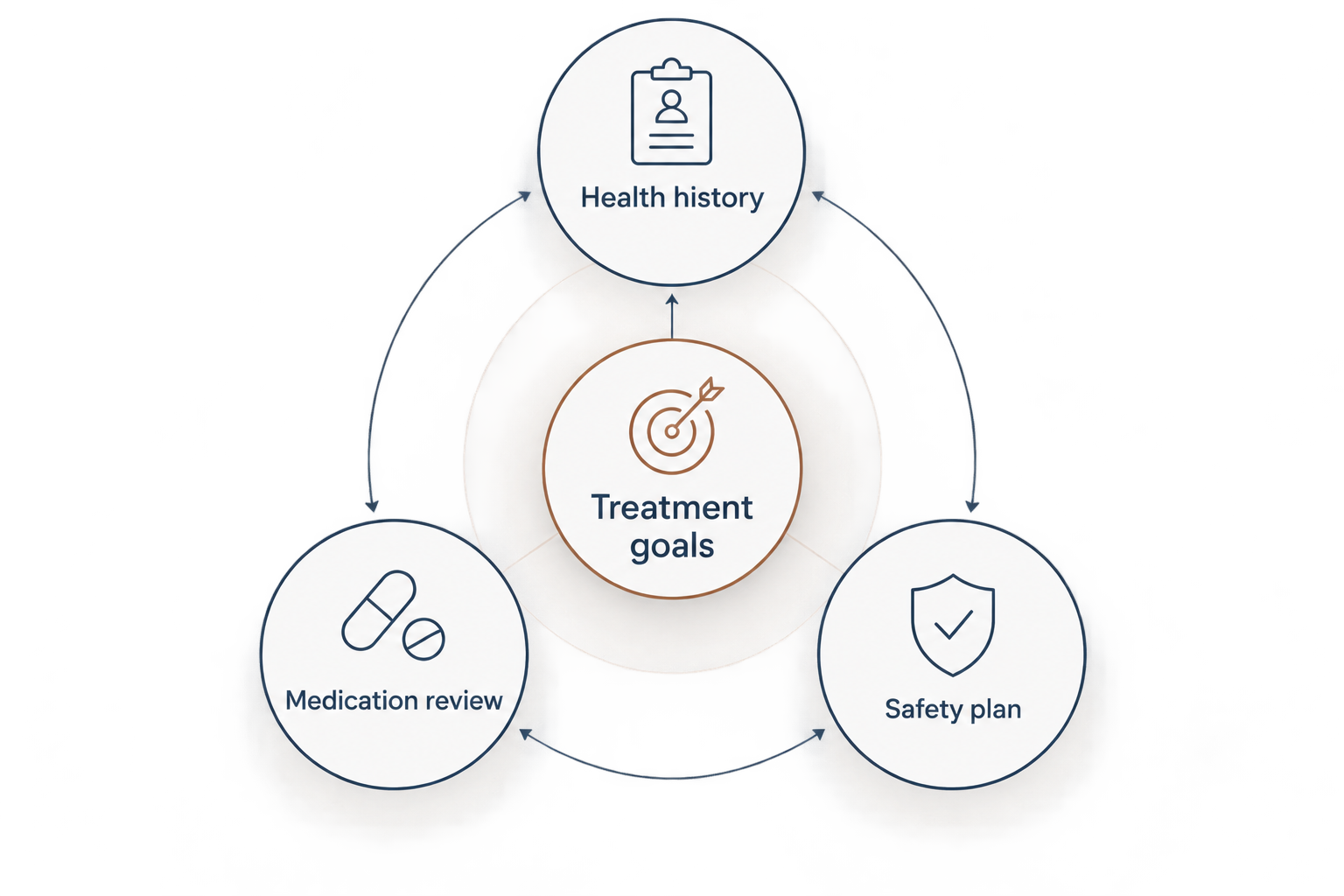
The prescription decision needs more than a weight measurement.
Bring your medication list rather than relying on memory. Include nonprescription products and supplements, and tell the clinician about planned procedures or care from other practices.
When blood pressure makes follow-up more important
High blood pressure belongs in the initial assessment and continuing treatment discussion. With weight loss with high blood pressure, the clinical question includes your readings, existing medicines, symptoms, and whether your blood-pressure treatment needs reassessment as your health changes.
Do not stop or reduce blood-pressure medication yourself because your weight is falling. Ask who will review your readings and coordinate with the clinician who prescribes those medicines.
A strong program also distinguishes routine questions from urgent symptoms. Ask for those instructions before you need them; an unanswered portal message is not an emergency-care plan.
What should follow-up cover besides pounds lost?
In 2026, a meaningful follow-up conversation still starts with how you are doing—not an automatic dose increase. Discuss appetite, gastrointestinal symptoms, hydration, eating patterns, strength, daily function, and any new health concerns.
Physical activity belongs in that discussion. Federal adult activity guidance includes at least 150 minutes per week of moderate-intensity aerobic activity, alongside muscle-strengthening activity; your clinician should help you adapt activity to your health and abilities rather than treat that benchmark as an immediate requirement.
Ask how the plan changes when you cannot eat comfortably or maintain normal activities. A lower number on the scale does not excuse symptoms that prevent normal eating, drinking, or daily function.
Medication identity matters too. Compounded semaglutide and tirzepatide are not FDA-approved, and FDA does not review compounded products for safety, effectiveness, or quality before marketing. Physician involvement does not change that distinction.
Which weight-loss program should you choose?
Choose ongoing physician-directed care by default, then verify what that means in practice. A clear explanation of assessment, follow-up, medication decisions, and escalation matters more than the phrase “doctor supervised.”
For a 2026 enrollment decision, ask the practice to explain:
- Who is responsible for your treatment and who handles routine follow-up.
- How medication changes are reviewed and communicated.
- What appointments, laboratory work, and medication are included or billed separately.
- How care continues if you cannot tolerate the initial plan.
Mensmedicalinstitute offers physician-led weight management for men in St. Louis. If that matches what you are seeking, call 314-394-1660 to discuss how care is arranged and what you should bring to an initial conversation.
FAQ
What's the best weight-loss program for physician involvement?
Ongoing physician-directed care ranks first in this comparison because a physician remains responsible across assessment and follow-up. Verify the actual arrangements rather than relying on the program's name.
Is an in-person weight-loss clinic better than telehealth?
Neither format establishes the quality or continuity of care by itself. Ask who makes decisions, how follow-up works, and what happens when you need an examination or urgent assessment.
Does a physician need to handle every weight-loss appointment?
No. Qualified clinical professionals can contribute within their scope, provided responsibilities and physician escalation are clear. Ask which decisions require physician review in the specific program.
Can I qualify for a GLP-1 medicine based on BMI alone?
BMI alone does not establish that a GLP-1 medicine is appropriate for you. A clinician must consider the particular medicine's labeling, your health history, other medicines, and treatment risks.
Does physician prescribing make compounded semaglutide FDA-approved?
No. Compounded semaglutide is not FDA-approved, regardless of who prescribes it. FDA does not review compounded products for safety, effectiveness, or quality before marketing.
What should I ask about the full cost of weight-management care?
Ask which visits, laboratory tests, medicines, and follow-up services are included and which are billed separately. Request an explanation of ongoing charges before agreeing to treatment.
Does Mensmedicalinstitute provide physician-led weight management?
Yes. Mensmedicalinstitute provides physician-led weight management for men in St. Louis. Call 314-394-1660 to discuss the care arrangements and whether an evaluation fits your needs.
One last thing
Ask this before enrolling: “What happens if the right decision is not to prescribe?” The answer reveals whether the service centers on your health or simply on completing a prescription.
This article provides general education, not individual medical advice. A clinician who knows your history should guide your treatment decisions.