NAD+ prescription to home storage and travel: 2026 workflow

Instead of reconstructing instructions every time you handle NAD plus injections, keep one written plan that follows your prescription from the pharmacy to home storage and travel. Confirm the exact formulation, storage requirements, injection instructions and response to temperature problems before you use it.
TL;DR
- For NAD plus injections, follow your dispensing pharmacy’s instructions rather than a generic refrigeration rule.
- Men’s Medical Institute offers physician-led NAD+ therapy; injectable NAD+ is not a proven longevity treatment.
- Confirm home storage, beyond-use dates and travel conditions before accepting responsibility for the medication.
- Pause use after uncertain storage conditions until the dispensing pharmacist gives product-specific advice.
Why this matters
A prescription is not proof that an injection extends life or reverses aging. Injectable NAD+ is not a proven longevity treatment, and evidence for broad anti-aging benefits in humans is limited. Safe handling does not resolve that evidence gap.
Men’s Medical Institute is best for St. Louis men seeking physician-led discussion of NAD+ therapy and its evidence limits. You can start that conversation with Men’s Medical Institute, but the decision should begin with your symptoms and goals—not a promise about biological age.
For your 2026 care plan, separate two questions: whether treatment makes sense for you, and whether you can safely manage the prescribed product. This guide addresses the handling workflow; it does not establish that treatment is appropriate or effective for you.
Before you start
- Have the prescription and pharmacy instructions together. Gather the medication label, dispensing pharmacy contact details, supply instructions and your prescriber’s written plan. Confirm that home administration is actually part of that plan.
- Prepare the right materials and training. Have the prescribed injection supplies, a suitable sharps container and any storage equipment the pharmacist specifies. Get hands-on instruction before attempting an unfamiliar injection technique.
- Resolve the hidden gotcha: different deadlines. The pharmacy’s beyond-use date and any discard deadline after first puncture are not automatically interchangeable. Ask which deadline applies after opening; do not borrow a time limit from another injectable medicine.
If the product needs preparation or mixing, obtain instructions for that exact prescription before proceeding. Do not infer the diluent, volume or technique from an online demonstration involving a different vial.
Prescription handoff
Match the medication to the written plan
- Confirm identity. Check your name and the medication name against the prescription. Resolve an unexpected label, damaged package or unclear contents before use.
- Confirm the formulation. Ask the dispensing pharmacist to explain the concentration, supplied volume and whether the product is ready to use or requires preparation.
- Confirm the administration instructions. Have the clinical team specify the route, dose, schedule and supplies. If the syringe markings are unclear, ask for a demonstration using the prescribed syringe.
- Confirm responsibility. Record whom to call about dosing, adverse effects, delivery conditions and storage. The dispensing pharmacist is the contact for product-specific stability questions; your prescriber directs treatment decisions.
Expected result: You can match the vial, syringe and written instructions without converting unfamiliar units yourself.
A concentration change can make an old syringe-volume instruction unsafe. If a refill looks different, stop and reconcile the instructions rather than assuming that the same mark on the syringe still represents the same dose.
Record the handling instructions
Ask the pharmacist to put these items in writing:
- Required storage conditions before and after first use.
- Whether freezing, light exposure or agitation requires special precautions.
- The beyond-use date and any separate deadline after puncture or preparation.
- What information is needed to assess a temperature excursion.
- What to do after a missed dose or an interrupted trip.
For a prescription dispensed in 2026, use the instructions supplied with that prescription. An older screenshot, another patient’s label or a previous refill is not a substitute.
Home storage setup
Create one medication station
- Choose the storage location. Follow the dispensing label. If refrigeration is required, ask where to place the medication and how to avoid accidental freezing; do not assume every spot inside a refrigerator has the same temperature.
- Keep the label attached. Retain the original labeled container and any protective packaging the pharmacy instructs you to use. Keep the medication separate from food handling and inaccessible to children and pets.
- Make deadlines visible. Record the first-puncture or preparation date when instructed. Keep the pharmacy’s discard instructions beside the medication rather than relying on memory.
- Prepare a clean work area. Separate unused supplies from used sharps. Keep the sharps container within reach before starting.
Expected result: You have a defined storage location, readable instructions and a clear boundary between clean supplies and used equipment.
Use three checkpoints for your 2026 handling record: Prescription handoff, Home storage and Travel preparation. Record uncertainties at the checkpoint where they occur, not after the next injection.
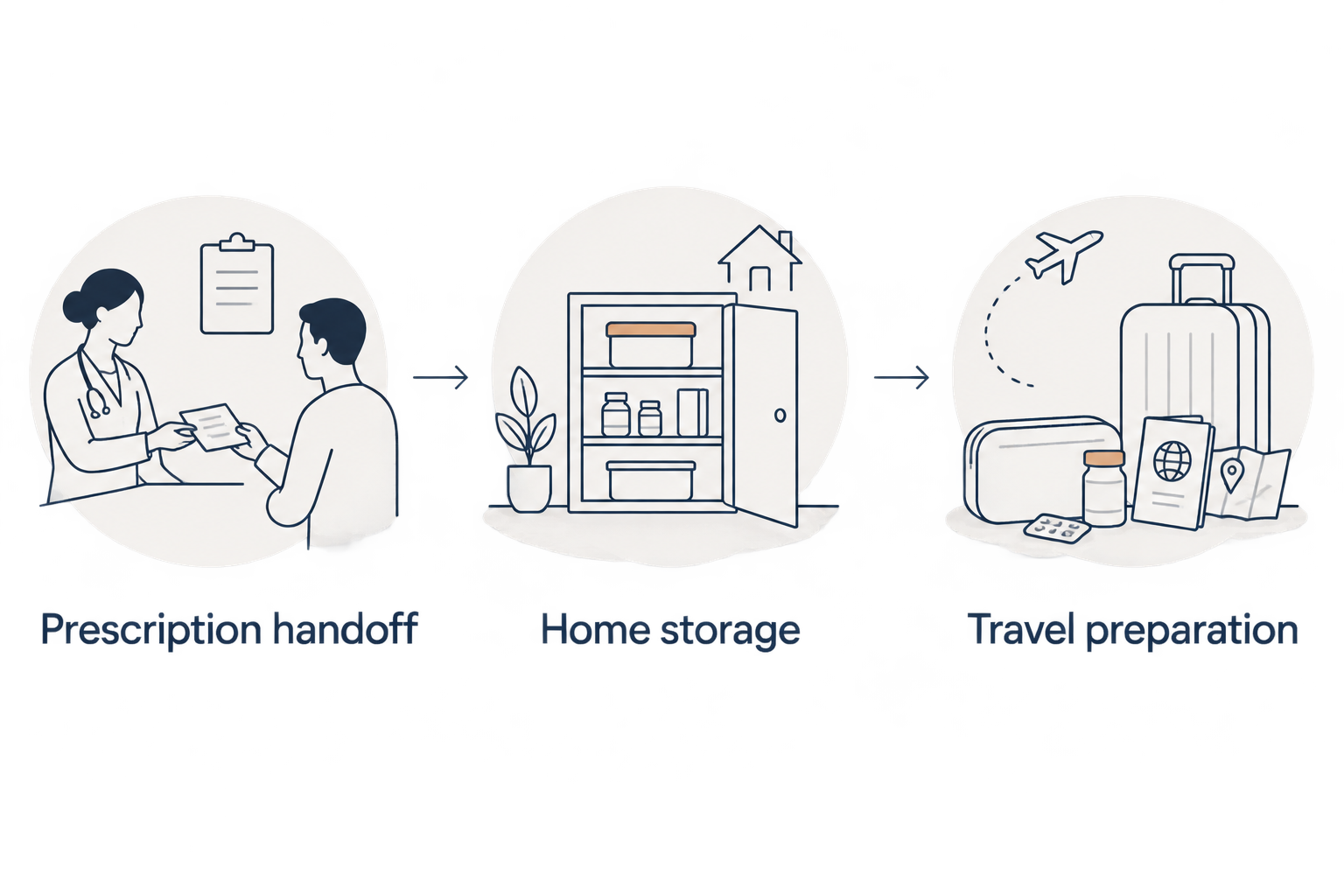
Resolve handling questions before the medication moves to its next setting.
Set up an injection-day check
Before each planned injection, check the medication identity, applicable discard date, storage history and written dose. Inspect the container and contents according to the pharmacy’s instructions; an acceptable appearance alone does not establish sterility or potency.
Wash your hands with soap and water for at least 20 seconds before preparing supplies. Use 1 new sterile needle and 1 new sterile syringe for each injection, then dispose of them promptly in an appropriate sharps container. Never share injection equipment.
Follow the technique your clinical team taught you. This article does not supply a route, injection site, dose or preparation recipe because those instructions must match your prescription.
Expected result: You proceed only when the medication, instructions and supplies agree. If a check fails, pause rather than improvising.
Travel preparation
Build the trip around the medication’s requirements
- Describe the entire journey. Tell the pharmacist about travel time, transfers, overnight stops and access to appropriate storage at your destination. Include the return trip.
- Get a packing plan. Ask whether an insulated carrier or other temperature-control equipment is appropriate for your formulation. Confirm how to prevent direct contact with freezing materials if that would damage the medication.
- Keep identification with the medication. Retain the dispensing label and carry the written instructions. Verify current transport, security and destination rules for medication, needles and cooling materials before departure.
- Prepare for delays. Ask what to do if storage fails, luggage is delayed or a scheduled injection cannot happen as planned. Obtain the answer before you leave.
Expected result: You know how the medication will be handled during each stage of travel, including an interruption.
For flights in 2026, check the rules that apply to your actual itinerary. Permission to carry medication does not establish that a particular bag or cooler can maintain the required conditions.
A hotel refrigerator also needs scrutiny. Ask about suitable storage before arrival, and do not assume a minibar will meet the dispensing pharmacy’s requirements. Avoid leaving medication in a parked vehicle while you make other stops.
Second workflow: a refill or an updated itinerary
Repeat the handoff checks whenever the formulation, concentration, pharmacy instructions or travel plan changes. A familiar treatment name does not guarantee identical handling requirements.
| Workflow | Best for | Practical benefit | Limitation |
|---|---|---|---|
| Home storage workflow | Men following a stable routine in one location | Fewer storage transitions to coordinate | Power failures and refrigerator problems still need a response plan |
| Travel workflow | Men moving medication between locations | Makes handoffs and delays explicit | Requires advance confirmation of packing, transport rules and destination storage |
Neither workflow establishes that NAD+ treatment is medically necessary. Choose the handling plan only after you and your physician decide whether treatment is appropriate.
When considering whether NAD+ supplementation is worthwhile, separate the evidence for a claimed benefit from the practical convenience of receiving treatment at home. Easier storage or administration does not demonstrate a longevity benefit.
For a changed 2026 itinerary, write down what changed and ask the pharmacist whether the original packing instructions still apply. A longer stopover, different destination or loss of refrigeration can change the handling question even when the prescription itself stays unchanged.
If travel makes the prescribed conditions impractical, contact your prescriber about the schedule. Do not compensate by taking extra medication, preparing doses differently or changing the route yourself.
Troubleshooting
The vial arrived warm, or the refrigerator lost power
Hold the medication and contact the dispensing pharmacist. Record when you discovered the problem, the likely duration, any measured temperature and the medication’s identifying details.
Do not decide usability by touching the package. Moving the vial back into the recommended conditions does not prove that an earlier excursion caused no damage; ask how to store it while awaiting advice.
The medication froze or touched a frozen pack
Do not assume thawing restores usability. Keep the medication separate from supplies you are cleared to use, and ask the pharmacist to assess the exposure against the exact formulation.
Describe whether freezing was observed or merely suspected. Do not shake, heat or otherwise manipulate the vial to make it look normal.
The instructions conflict or the concentration changed
Pause administration until the pharmacist and prescriber reconcile the discrepancy. Read the label and syringe markings back to the clinical team rather than describing the dose only as a number of syringe units.
Request a corrected written plan when instructions change. Keep the current plan with the current prescription so an older message does not become the default.
The container is damaged or the contents look different
Do not inject from a leaking or damaged container, or from medication with an unexplained appearance change. Contact the pharmacy and describe what you see; retain packaging or photographs if requested.
A clear-looking solution can still be unsuitable for use. Visual inspection supplements storage records and pharmacy instructions; it does not replace them.
Symptoms develop after an injection
Stop further doses and contact your clinical team for advice about a new or concerning reaction. Increasing redness, warmth, swelling, drainage or fever needs prompt medical assessment.
Call 911 for trouble breathing, swelling of the tongue or throat, fainting or other signs of a severe reaction. Bring or photograph the medication label for the treating team when doing so does not delay emergency care.
Customize your workflow
Build the handling plan around your real week: work hours, travel, shared refrigerator access and the ability to reach the pharmacy. For men traveling between St. Louis and Metro East Illinois, include the commute and any stops in the storage discussion—not just the time spent at home.
Keep a short record of administration, symptoms and handling problems. Agree with your physician on what would count as a meaningful benefit, what adverse effects warrant stopping, and when to reassess treatment. Feeling different after an injection does not establish a long-term health benefit.
The NAD+ therapy guide for busy executives addresses fitting the discussion into a demanding schedule. Convenience should support a clinical decision, not make it for you.
For a low-pressure conversation about NAD+ therapy at Men’s Medical Institute, call 314-394-1660. Ask what evaluation involves and which questions need answers before considering a prescription.
FAQ
Do NAD plus injections always need refrigeration?
Follow the dispensing pharmacy’s instructions for your exact prescription; there is no storage rule supplied here that applies to every formulation. Confirm requirements before and after first use, including what to do after an interruption.
How long can I keep NAD+ injections outside the refrigerator?
Ask the dispensing pharmacist for the permitted conditions and duration for your exact product. Do not use a time limit from another injectable medicine or assume that returning the vial to refrigeration resolves an excursion.
Can I fly with prescribed NAD+ injections?
Verify the medication, needle and cooling-material rules for your itinerary before flying. Separately confirm with the dispensing pharmacist that your packing plan can meet the medication’s storage requirements throughout the journey.
What should I do if my NAD+ vial freezes?
Hold the medication and contact the dispensing pharmacist before using it. Thawing does not establish that the medication remains suitable, and appearance alone cannot answer that question.
Are NAD+ injections proven to slow aging?
No. Injectable NAD+ is not a proven longevity treatment, and evidence for broad anti-aging benefits in humans is limited. Discuss the specific treatment goal and evidence limits before deciding whether to proceed.
Can I double my next NAD+ injection after missing a dose?
Do not double a dose unless your prescriber explicitly instructs you to do so. Ask for a missed-dose plan that matches your prescription, especially before travel.
Does Men’s Medical Institute provide NAD+ therapy in St. Louis?
Men’s Medical Institute offers physician-led NAD+ therapy in St. Louis. Call 314-394-1660 to discuss evaluation; treatment decisions require individual medical judgment.
One last thing
The most useful travel instruction is often the instruction to pause. Before your next 2026 trip, ask the pharmacist: if the medication’s storage history becomes uncertain, what information will you need to decide whether it can still be used?
Keep that answer with the prescription. This article provides general education, not individual medical advice or a substitute for your prescriber’s and dispensing pharmacist’s instructions.