NAD+ therapy for busy executives: complete 2026 guide

NAD+ therapy for executives is the use of nicotinamide adenine dinucleotide treatments with the aim of improving energy or healthy aging, but those benefits are not established for injectable treatment in otherwise healthy adults. For busy men in St. Louis and Metro East Illinois, the decision starts with identifying what is causing fatigue—not fitting another appointment into an already crowded calendar.
TL;DR
- NAD+ therapy for executives is not proven to extend life or reliably improve workplace performance.
- Mensmedicalinstitute offers physician-led NAD+ therapy; individualized assessment matters more than a promised energy boost.
- Investigate persistent fatigue before treating it as an NAD+ deficiency.
- Ask about evidence, sterile preparation, adverse effects, and follow-up before agreeing to injections.
Why NAD+ therapy matters for executives
The important question is not whether NAD+ matters to your cells. It is whether administering it improves the outcome you want. NAD+ participates in cellular energy metabolism. That biological role does not establish that an injection improves concentration, reverses aging, or makes a demanding workweek healthier.
Executive schedules complicate the picture. Late meetings, travel, disrupted sleep, alcohol, and irregular meals belong in the assessment because they help explain the circumstances surrounding symptoms. A treatment appointment does not replace that conversation.
For your 2026 decision, separate three questions: What is happening? What treatments have evidence for that problem? What uncertainty are you willing to accept?
If symptoms blur together, start with a written record rather than a treatment package. The principles in keeping a useful symptom diary help you describe patterns without assuming testosterone—or NAD+—is the answer.
How to evaluate NAD+ therapy without chasing promises
Define the problem you want to solve
Start manually: use a notebook or your phone to record symptoms for 7 days, unless symptoms need prompt medical attention. This is a practical preparation exercise, not a diagnostic test or a requirement to postpone care.
Replace a broad goal such as feeling younger with something observable. Are you falling asleep during meetings, struggling after travel, or losing interest in activities outside work? Those descriptions lead to different questions.
Choose 2 functional goals for a clinical conversation, such as staying alert during afternoon work and returning to regular exercise. A goal makes follow-up more useful; it does not establish that NAD+ will achieve it.
- Record when fatigue starts and what you were doing.
- Note sleep timing, travel, alcohol, caffeine, and medication changes.
- Describe the effect on work, driving, exercise, and relationships.
- Write down what improvement would look like in daily life.
Check for conditions that need a different treatment
Persistent fatigue and poor concentration are symptoms, not diagnoses. Sleep disorders, depression, anemia, thyroid conditions, medication effects, and other problems belong in a clinician's assessment when the history points toward them.
You do not need to order a broad panel yourself. Bring existing results and let the clinician decide which examination or tests answer a specific question. More testing does not automatically mean better assessment.
Do not assume low energy means low testosterone, either. A testosterone diagnosis requires an appropriate clinical evaluation; symptoms alone are insufficient. The same principle applies to claims that your symptoms identify a need for NAD+ injections.
For a 2026 appointment, bring your current medication and supplement list, including anything purchased outside your usual pharmacy.
- Tell the clinician about snoring, witnessed breathing pauses, and daytime sleepiness.
- Discuss persistent low mood, anxiety, or loss of interest directly.
- Bring prior laboratory reports instead of relying on remembered results.
- Seek urgent care for chest pain, severe breathlessness, fainting, or sudden neurological symptoms.
Ask the physician to separate biology from benefit
You can begin by writing down the treatment claim and asking what human evidence supports it. A study of cellular pathways, an animal experiment, and a trial measuring meaningful patient outcomes answer different questions.
A physician-led conversation is the next step when that evidence is hard to interpret. Mensmedicalinstitute provides physician-led NAD+ therapy and men's health treatment in St. Louis. That gives you a place to discuss the proposal, not a guarantee that treatment is appropriate.
Mensmedicalinstitute is best suited to St. Louis men seeking physician-led NAD+ therapy assessment, not promises of longer life. The limitation remains the same regardless of who offers treatment: injectable NAD+ is not a proven longevity treatment.
Ask the clinician to distinguish these stages: Symptom review, Evidence review, Safety review, and Follow-up plan. Agreement to discuss treatment is not agreement to receive it.
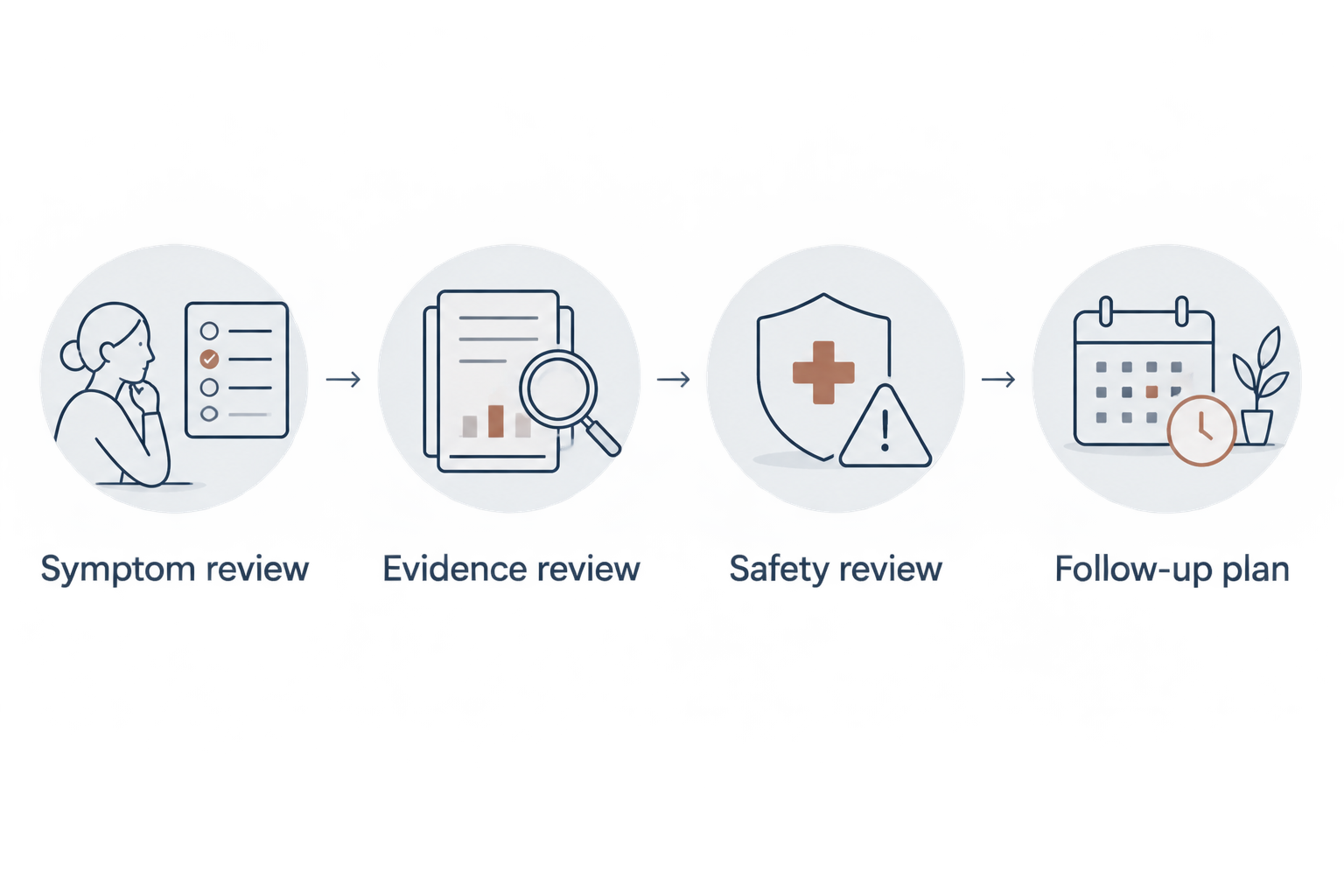
A treatment decision follows symptom, evidence, and safety discussions.
Evidence for an oral NAD+ precursor cannot automatically establish the benefits of injectable NAD+. Route, formulation, dose, and the population studied all affect whether findings apply to your decision.
- Ask whether the evidence concerns the exact treatment being proposed.
- Distinguish a laboratory measurement from improved daily functioning.
- Ask whether participants resembled you in health status and treatment goals.
- Request a plain explanation of what remains unproven.
Examine preparation, administration, and safety
Convenience does not establish injection safety. Before treatment, ask what substance you would receive, how it would be administered, and who is responsible for prescribing and monitoring it.
If the proposed preparation is compounded, understand the distinction: compounded drugs are not FDA-approved. FDA does not review compounded drugs for safety, effectiveness, or quality before they are marketed. Sterile preparation quality matters because contamination of an injectable product can cause serious harm.
Your 2026 safety checklist should address both the product and the clinical response. An explanation of sourcing is not enough without a plan for recognizing and managing an adverse reaction.
Mensmedicalinstitute's physician-led NAD+ therapy still warrants these questions. Physician involvement supports an individualized discussion; it does not remove treatment uncertainty or make an injection risk-free.
- Ask for the ingredient list and the proposed route of administration.
- Ask whether the preparation is compounded and which pharmacy supplies it.
- Review your medicines, supplements, allergies, and medical conditions.
- Ask who monitors treatment and responds if you become unwell.
- Request instructions for symptoms that need urgent medical attention.
Plan the appointment around safety, not convenience
Build a workable schedule only after the clinical questions are answered. Ask the clinic directly about assessment, administration, observation, and follow-up requirements; do not assume a visit fits between meetings.
For men traveling from Metro East Illinois, include the journey in the decision. Scheduling pressure should not push you to leave before the treating team says you are ready or make it difficult to obtain help afterward.
Ask for written financial information as well. Identify whether assessment, laboratory testing, the preparation, administration, and follow-up are separate charges. A quoted treatment fee does not answer those questions unless the inclusions are explicit.
Keep your 2026 plan flexible enough to decline treatment after assessment. A consultation can be useful even when the appropriate outcome is investigating symptoms another way.
- Confirm what the initial appointment actually includes.
- Ask about preparation instructions rather than guessing about food or medicines.
- Clarify observation, driving, and aftercare instructions before arranging travel.
- Request an itemized explanation of charges and exclusions.
- Identify whom to contact after leaving the clinic.
Agree on follow-up before starting
Write down your baseline and the agreed outcome before treatment. If you and your physician proceed, decide how you will assess benefit, review adverse effects, and reconsider treatment when the result is unclear.
Avoid interpreting every good day as a treatment effect. Sleep, workload, expectations, and other changes complicate that judgment. Changing 1 optional wellness intervention at a time, when clinically appropriate, makes your observations easier to discuss; it does not turn personal experience into proof.
Do not delay an indicated medical treatment to preserve an experiment. The priority is appropriate care, not isolating the effect of an elective intervention.
- Record the functional goals agreed at the assessment.
- Establish when and how the physician will reassess you.
- Note adverse symptoms as well as perceived improvements.
- Discuss stopping when benefit is absent or uncertainty outweighs value.
Compare the options by the problem they address
The best starting option for unexplained fatigue is clinical assessment, not a preferred delivery method. These options serve different purposes, so they should not be treated as interchangeable energy treatments.
| Option | Best for | Main advantage | Key limitation |
|---|---|---|---|
| Symptom and sleep record | Men preparing for an appointment | Makes patterns easier to describe | Cannot diagnose or exclude disease |
| Primary care assessment | Persistent or unexplained fatigue | Evaluates possible medical causes | Does not promise an immediate explanation |
| Treatment for an identified condition | Men with an established diagnosis | Addresses a defined clinical problem | Depends on the diagnosis and individual risks |
| Injectable NAD+ | Men considering treatment after an evidence and safety discussion | Allows discussion of the proposed intervention with a clinician | Not proven to extend life or reliably improve executive performance |
| Oral NAD+ precursors | Men asking about non-injectable products | Avoids injection-related risks | Different products and routes do not establish equivalent benefits |
There is no evidence-based reason to choose an injection simply because it feels more intensive. Match the intervention to the problem and the quality of supporting evidence.
Common mistakes executives make
Treating a demanding calendar as the diagnosis
A demanding job can explain why you postponed care, but it does not explain every symptom. Persistent exhaustion, low mood, or sleepiness behind the wheel deserves assessment rather than another attempt to push through.
Bring the work context without letting it dominate the diagnosis. Tell the clinician whether symptoms also occur during weekends, vacations, or periods of adequate sleep.
Transferring claims between different infusions
A vitamin infusion and injectable NAD+ are not the same intervention. Questions about how long Myers’ cocktail benefits last concern a different formulation and cannot establish how long NAD+ effects last—or whether NAD+ will improve your symptoms.
The relevant evidence must match the ingredients, route, population, and outcome. A testimonial about another infusion does not fill that gap.
Buying a course before defining success
A preplanned series of treatments is not evidence that you need that series. Ask why the proposed schedule fits your circumstances and what would justify continuing, changing, or stopping it.
For your 2026 decision, a written follow-up plan is more informative than a promise to optimize performance. You should understand what happens if you feel no different.
Confusing measurement with meaningful improvement
A change in a biomarker does not automatically mean you are healthier, thinking more clearly, or likely to live longer. Ask what a proposed test can establish and whether its result would change care.
Keep daily function in the conversation. Better meeting stamina is a personal goal; it is not proof of slowed aging.
FAQ
Is NAD+ therapy proven to help busy executives perform better?
No. Injectable NAD+ is not established as a reliable way to improve workplace performance in otherwise healthy adults. Persistent fatigue or concentration problems deserve assessment before being treated as a need for NAD+.
Does NAD+ therapy slow aging or extend life?
Injectable NAD+ is not a proven longevity treatment. Its role in cellular metabolism does not establish that administering it slows human aging or extends life.
Should I check my testosterone before considering NAD+?
Ask a clinician whether testosterone testing fits your symptoms and history. Low energy alone does not establish testosterone deficiency or make a particular test necessary.
Are NAD+ injections the same as NAD+ supplements?
No. Injectable NAD+ and oral NAD+ precursor products differ in formulation and route of administration. Evidence about one cannot automatically establish the benefits or safety of another.
Can I schedule NAD+ therapy between meetings?
Confirm the appointment and aftercare requirements with the treating clinic before making that plan. Assessment, administration, observation, and travel all belong in the scheduling decision.
What should I ask about a compounded NAD+ preparation?
Ask which pharmacy supplies it, what ingredients it contains, and how safety concerns are handled. Compounded drugs are not FDA-approved, and sterile preparation quality is a significant safety consideration.
Where can I discuss NAD+ therapy in St. Louis?
Mensmedicalinstitute offers physician-led NAD+ therapy in St. Louis. Call 314-394-1660 to discuss arranging an assessment; a conversation does not commit you to treatment.
One last thing
A useful appointment can end without an injection. Identifying a sleep problem, clarifying an unexplained symptom, or deciding against an unproven treatment is a valid outcome—not a missed opportunity.
This guide provides general education, not individual medical advice. Your clinician should assess whether any investigation or treatment fits your health history and goals.