Tirzepatide injection training to home dosing: 2026 workflow
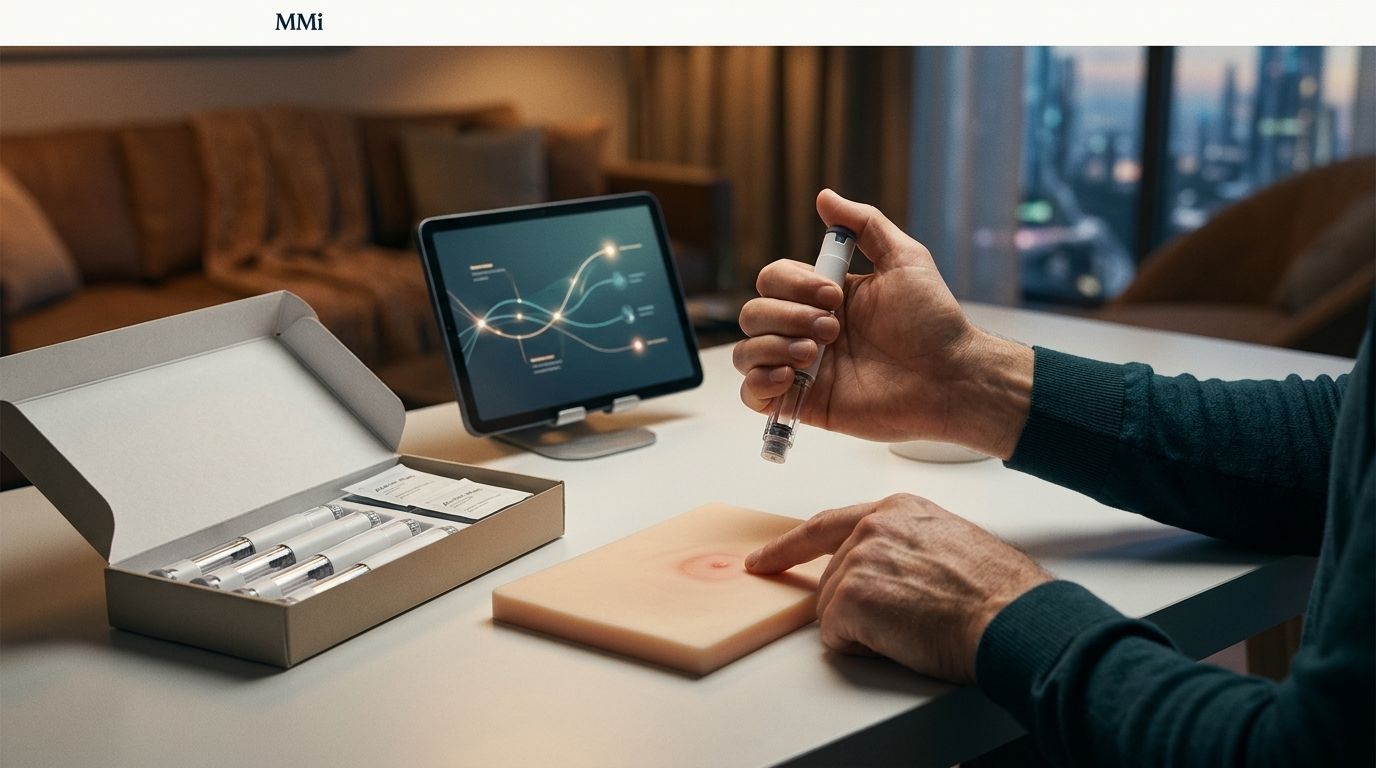
Instead of trying to remember injection instructions each week, use tirzepatide self injection training to build a repeatable routine: confirm your prescription, demonstrate the technique, and record each home dose. This 2026 guide explains the handoff from instruction to home dosing without substituting generic directions for your product’s instructions.
TL;DR
- Tirzepatide self injection training should match your exact prescription, device, and written home dosing plan.
- Mensmedicalinstitute offers physician-led weight management for men seeking individualized care in St. Louis.
- Never copy syringe units from another prescription or repeat an injection when delivery is uncertain.
- Home dosing requires a missed-dose plan, safe needle disposal, and clear instructions about when to call.
Why this matters
The difficult part of home injections is not always the needle. It is recognizing when a new strength, unfamiliar device, or unclear label makes last week’s instructions unsafe to reuse.
Mensmedicalinstitute is best suited to men seeking physician-led weight management in St. Louis. Individualized care means your prescriber decides whether tirzepatide fits your health history; training then addresses the prescription you actually receive.
If treatment has not been prescribed, start with the tirzepatide labs-to-first-prescription workflow. Learning injection technique does not establish that a medication is appropriate for you.
For this 2026 guide, the medication-safety reference is FDA-approved tirzepatide prescribing information and the applicable Instructions for Use. Your dispensed product determines the device-specific steps. This article is general education, not individual medical advice.
Before you start
- Bring the actual prescription and supplies. Have the labeled carton or container, written directions, applicable Instructions for Use, and any separately required needles or syringes. Arrange access to a pharmacist or prescribing clinician for questions.
- Prepare a home location. Use a clean, well-lit surface, handwashing access, alcohol swabs, and an appropriate sharps container. Check the product’s storage instructions before choosing where to keep it.
- Resolve the concentration gotcha first. Milligrams describe a drug dose; milliliters describe liquid volume. Syringe markings do not independently tell you how much tirzepatide you are receiving. Have the pharmacist reconcile any mismatch before injecting.
Bring your current medication list, including insulin, other diabetes medicines, supplements, and other weight-loss prescriptions. Tell the clinician about previous serious allergic reactions, severe stomach problems, pancreatitis, and a personal or family history of medullary thyroid carcinoma or MEN2. These affect the prescribing decision, not just injection technique.
Prescription and supply check
- Match the label to your written plan. Check your name, medication, prescribed dose, strength or concentration, route, and scheduled day. Do not calculate a replacement instruction from memory.
- Identify the presentation. Determine whether you received a pen or a vial requiring separate injection equipment. Confirm whether the container is single-dose or intended for multiple doses; never infer this from its appearance.
- Check storage and condition. Follow the exact temperature, light-protection, and discard instructions for your product. Do not use expired medication or medication with an unexplained change in appearance.
- Confirm other medicines. Ask specifically about insulin, sulfonylureas, other tirzepatide products, and GLP-1 medicines. Do not independently stop or combine treatments.
- Write down the contact plan. Record whom to contact for a dose question, a device problem, or symptoms after an injection. Keep that information with your dosing record.
Expected result: Your label, supplies, and written instructions agree. If they do not, pause before opening injection equipment.
Pen and vial training are different
Neither presentation eliminates the need for instruction. The practical advantage and limitation depend on how medication is measured and delivered.
| Presentation | Best for | Practical advantage | Limitation requiring training |
|---|---|---|---|
| Prescribed pen | Someone whose prescription uses that exact device | Device instructions define the delivery sequence | Controls and completion signals differ between devices |
| Prescribed vial and syringe | Someone prescribed a vial with matching supplies | The syringe allows the prescribed volume to be measured | Concentration and syringe markings must match the written instructions |
This table compares training needs, not treatment effectiveness. Do not change presentations simply because one seems easier, and do not assume a demonstration for one device covers another.
Technique demonstration and teach-back
- Read the applicable Instructions for Use together. Identify the preparation steps, injection controls, completion signals, and disposal directions for your device. A generic video is not a substitute for the matching instructions.
- Prepare the injection area. Wash your hands and set out the supplies on a clean surface. Inspect the medication as directed without touching sterile needle surfaces.
- Choose an approved injection site. FDA-approved tirzepatide instructions describe subcutaneous injection in the abdomen or thigh; another person can inject the back of the upper arm. Rotate sites and avoid damaged, bruised, tender, or scarred skin.
- Demonstrate your exact technique. For a pen, identify its controls and completion signal. For a vial, have the trainer verify the prescribed volume, correct syringe, drawing-up technique, and injection technique before you proceed.
- Repeat the process back. Explain what you will check, where you will inject, how you will recognize completion, and what you will discard. Ask the trainer to correct any uncertainty before home dosing.
Expected result: You can explain and demonstrate the sequence without guessing. A completed injection alone does not prove that you understand the next one.
Do not borrow a hold time, needle angle, priming instruction, or disposal method from a different device. Those details belong to the exact product instructions and the training you receive.
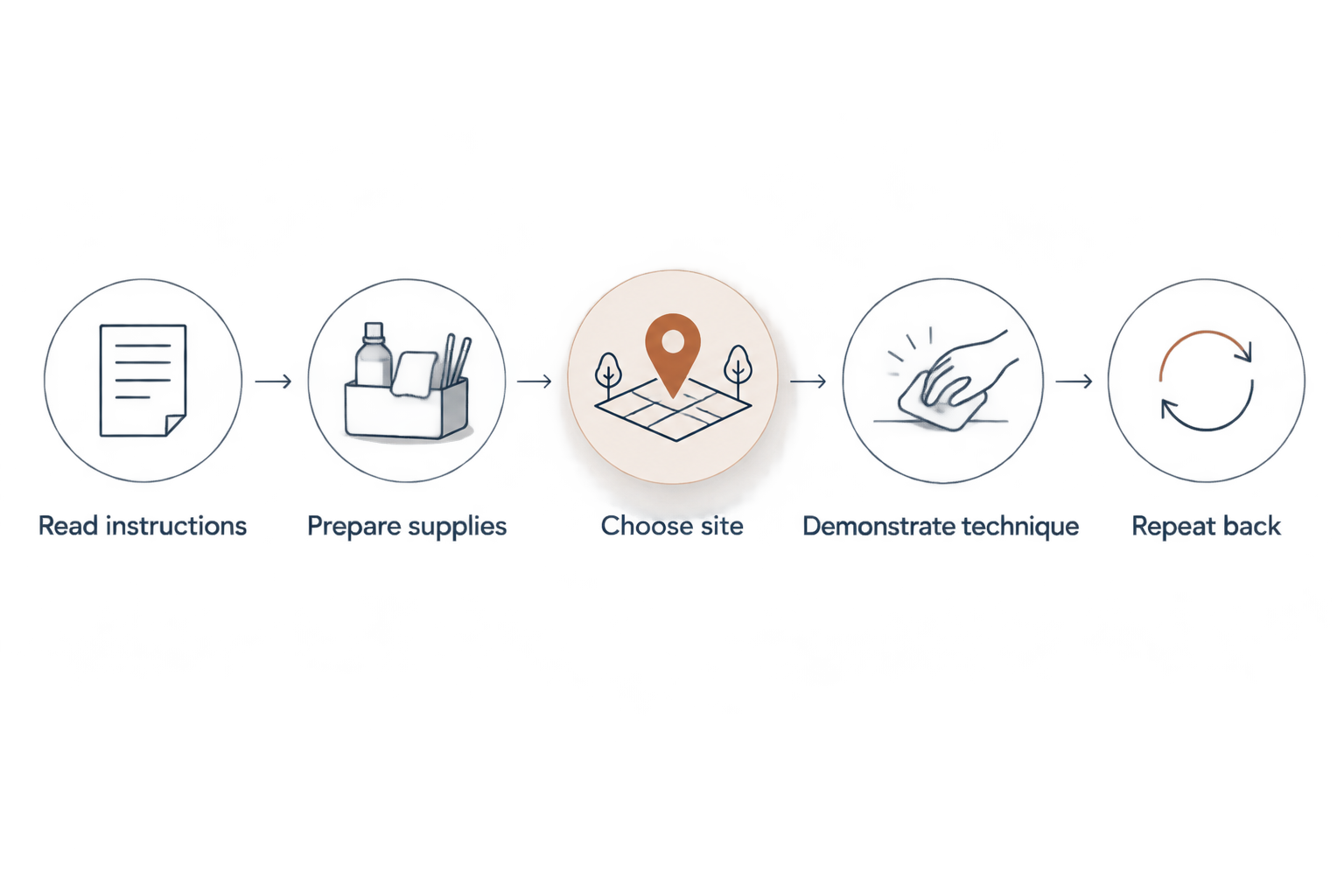
Teach-back checks your understanding before you manage injections at home.
Home dosing and documentation
- Choose a consistent weekly day. FDA-approved tirzepatide dosing is once weekly, generally every 7 days. Use the dose your prescriber ordered, not a dose suggested by someone else’s progress.
- Repeat the label check before every injection. Compare the medication, strength, prescribed dose, and device with your written plan. A familiar-looking carton does not replace this check.
- Follow the trained injection sequence. Use the exact product instructions, rotate the injection site, and follow the specified confirmation and disposal steps. Never share a pen, syringe, or needle.
- Record the dose immediately. Write the date, time, prescribed dose, injection site, and any delivery concern. Record symptoms separately so the clinician can distinguish a technique question from a treatment-tolerance problem.
- Follow the agreed follow-up plan. Report symptoms that interfere with eating, drinking, or daily function. Do not increase the dose because appetite suppression feels weaker or weight has stopped changing.
Expected result: Your 2026 home dosing record shows what you administered and when. You do not need to reconstruct the week from a reminder notification or an opened package.
A reminder tells you that a dose is scheduled; it does not prove that you took it. Mark the record after administration, not when the reminder appears.
Missed doses and schedule changes
FDA-approved tirzepatide prescribing information allows a missed dose within 96 hours, or 4 days, after the scheduled time. If more than 4 days have passed, skip the missed dose and resume the regular schedule. Do not double the dose.
When changing the weekly dosing day, keep at least 72 hours, or 3 days, between doses. These rules address timing, not whether restarting after a longer interruption requires a different plan.
Contact the prescriber after an extended gap or when you cannot establish the last injection time. Never use the missed-dose window to justify another injection after uncertain delivery.
Refill changes and retraining
A second workflow begins whenever a refill changes the strength, concentration, container, or device. In 2026, treat each unfamiliar refill as a new verification task rather than an automatic repeat of the previous prescription.
- Compare the new label with the previous plan. Identify every change before the next injection is due.
- Confirm the intended dose with the prescriber or pharmacist. Ask for updated written instructions whenever a change affects measurement or technique.
- Repeat device training when needed. Demonstrate the new steps or measurement rather than translating the old routine yourself.
- Replace the active instructions. Keep older directions separately so you cannot accidentally use them for the new prescription.
Expected result: You have one current instruction set that matches the medication in hand. Old syringe markings and old device habits are not part of the new plan unless explicitly confirmed.
Compounded tirzepatide is not FDA-approved. FDA does not review compounded products for safety, effectiveness, or quality before marketing. If a compounded product is prescribed, ask the prescriber and dispensing pharmacist to explain its clinical rationale, source, concentration, storage, and measurement instructions; never assume approval of a branded medicine extends to a compounded preparation.
Troubleshooting home injections
The label and syringe directions do not match
Do not inject until the pharmacist reconciles the instructions. Read back the concentration, prescribed dose, syringe type, and written volume. Do not convert another patient’s syringe units into your own dose.
The pen stopped or medication leaked
Do not automatically repeat the injection. Check the device-specific troubleshooting instructions and contact the pharmacist or prescriber when delivery remains uncertain; an extra injection can produce an unintended dose.
Storage conditions were uncertain
Set the medication aside and ask the pharmacist whether it remains usable. Provide the product name, presentation, approximate exposure, and duration. Putting medication back in the refrigerator does not reverse an unsuitable exposure.
Nausea or vomiting is disrupting fluids
Contact the treating clinician promptly if you cannot keep fluids down or are developing dehydration symptoms. Severe, persistent abdominal pain needs urgent assessment, especially with vomiting. Trouble breathing or swelling of the face, lips, tongue, or throat requires emergency care.
You cannot remember whether you injected
Check your dosing record before doing anything else. If uncertainty remains, contact the pharmacist or prescriber rather than taking an extra dose. Recording administration immediately is safer than relying on memory.
Customize your workflow
Build the routine around your actual week. If you travel between St. Louis and Metro East Illinois, plan storage, supplies, and disposal before leaving home. Do not assume a travel case maintains the temperature your medication requires.
For a 2026 follow-up, bring your injection record, medication list, and the questions that changed since training. Ask who handles technique questions, who authorizes dose changes, and what symptoms should prompt a same-day call. The workflow should make those responsibilities clear.
Men using insulin or a sulfonylurea need an individualized low-blood-sugar plan. Ask about glucose monitoring, symptoms, and treatment instructions before starting tirzepatide. Do not adjust diabetes medication independently.
Mensmedicalinstitute provides physician-led weight management; injection education should support that clinical relationship, not replace it. If you want to discuss care, call 314-394-1660 or use the contact page. Ask what instruction and follow-up your own treatment plan will include.
FAQ
Can I learn to inject tirzepatide myself at home?
You can administer prescribed tirzepatide at home after learning the technique for your exact product. Have a clinician or pharmacist verify your understanding, including dose checks, completion signals, storage, and disposal.
What should tirzepatide self injection training include?
Tirzepatide self injection training should cover the prescription, device, injection sites, technique, storage, disposal, and missed-dose plan. You should also demonstrate or explain the process back and know whom to contact when something does not match.
Where should I inject tirzepatide?
FDA-approved tirzepatide instructions describe injection under the skin of the abdomen or thigh, or the back of the upper arm when another person gives it. Rotate sites and follow the Instructions for Use for your exact product.
What if I miss my weekly tirzepatide injection?
FDA-approved prescribing information allows a missed dose within 96 hours, or 4 days, of the scheduled time. After that window, skip it and resume the regular schedule; do not double the dose. Ask your prescriber about longer interruptions.
Should I inject again if medication leaked onto my skin?
Do not automatically inject again after leakage or uncertain delivery. Follow your device’s troubleshooting instructions and contact the pharmacist or prescriber before taking any additional medication.
Does a new vial concentration change my syringe instructions?
A new concentration can change the volume needed to deliver the prescribed dose. Have the pharmacist confirm the new written directions and matching syringe before injecting; do not reuse old syringe-unit instructions without verification.
Can Mensmedicalinstitute help me discuss physician-led weight management?
Mensmedicalinstitute offers physician-led weight management for men in St. Louis. Call 314-394-1660 to discuss care and ask what instruction and follow-up would apply to your treatment plan.
One last thing
Read the label before relying on your memory. The most useful home-injection habit is a brief pause to confirm that the medicine, device, and written dose still match.
A refill can look familiar while containing a different strength or requiring different instructions. Keep the current directions where you prepare the injection, and stop whenever something does not agree. Asking for clarification is part of safe home treatment, not a failure to learn.