Tirzepatide labs to first prescription: 2026 workflow

Instead of chasing lab reports and wondering when treatment can begin, organize tirzepatide weight loss care around a physician visit, targeted testing, a prescription decision, and injection instructions. This 2026 workflow explains what to bring, what results mean, and what must be settled before your first dose.
TL;DR
- Tirzepatide weight loss requires a prescribing decision, not just normal lab results.
- Mensmedicalinstitute provides physician-led weight management for men in St. Louis.
- Bring medication lists and dated lab reports; your physician decides which tests need updating.
- Confirm the exact medicine, dose, injection technique, and follow-up plan before starting.
Why this matters
A lab panel does not establish whether tirzepatide is right for you. Your physician also needs your weight history, medical conditions, medication list, and treatment goals. Normal results are not automatic clearance, and an abnormal result does not explain itself.
Mensmedicalinstitute is best for men seeking physician-led weight management in St. Louis. For men traveling from Metro East Illinois, organizing records before the visit also helps prevent missing information from interrupting a treatment decision.
Start with reviewing your other medicines before tirzepatide. Insulin, medicines that increase insulin release, and other weight-management prescriptions deserve specific attention before treatment begins.
This is general education, not individual medical advice or a description of a guaranteed clinic protocol. Your prescribing physician determines which steps, tests, and follow-up arrangements apply to you.
Before you start
- Gather records: Bring dated lab reports with units and reference ranges, your weight history, diagnoses, allergies, and a complete medication and supplement list. Include medicines you use occasionally.
- Prepare access and questions: Know how to reach your primary-care clinician and obtain outside records. Ask the prescribing office what to send before the appointment and whether any ordered tests require fasting.
- Flag the easily missed issue: Tell the physician about previous weight-loss injections, the exact last dose, and any upcoming surgery or sedation. Do not assume a previous prescription makes restarting at the same dose appropriate.
You do not need to purchase a broad hormone or vitamin panel before asking about treatment. Let the physician identify the clinical question first; a test is useful when its result can change care.
Your clinical starting point
Build the history before the lab order
- Describe your goal. Explain what you want to improve: weight-related health, mobility, daily function, or another concern. Mention previous nutrition, activity, and medication approaches, including what made them difficult to continue.
- Document the starting measurements. Have your clinician confirm height, weight, blood pressure, and relevant weight-related conditions. Bring home measurements as supporting information rather than substituting them for an assessment.
- Disclose safety history. Report personal or family history of medullary thyroid carcinoma, multiple endocrine neoplasia syndrome type 2, serious allergic reactions to tirzepatide, pancreatitis, gallbladder disease, severe stomach-emptying problems, and kidney disease.
- Review every medicine. Include diabetes medicines, other GLP-1 medicines, other tirzepatide products, and oral medicines whose effect needs close monitoring. Do not stop prescribed treatment on your own.
For adult chronic weight management, FDA-approved Zepbound labeling includes a body mass index of 30 kg/m² or higher, or 27 kg/m² or higher with at least one weight-related condition. Meeting those thresholds starts the eligibility discussion; it does not replace a safety assessment.
Zepbound is contraindicated with a personal or family history of medullary thyroid carcinoma or multiple endocrine neoplasia syndrome type 2. A prior serious hypersensitivity reaction to tirzepatide or its ingredients is another contraindication. The FDA label also states that Zepbound is not recommended in patients with severe gastroparesis.
Expected result: Your physician has enough context to identify contraindications, medication conflicts, and the questions that testing needs to answer.
Your testing plan
Match each test to a decision
- Ask what each proposed test will change. Glucose testing can help clarify diabetes status; kidney function testing can inform assessment when kidney disease or dehydration is a concern. Other tests depend on your history and examination.
- Confirm preparation instructions. Ask whether fasting is necessary for the actual tests ordered. Do not fast simply because the appointment concerns weight loss.
- Submit complete reports. Send the collection date, results, units, and laboratory reference ranges. A screenshot showing only a flagged value leaves out context.
- Arrange interpretation. Find out how results will be discussed and who will tell you whether additional evaluation is needed. Receiving a report is not the same as receiving clearance to start.
There is no single universal pretreatment lab panel required by the FDA prescribing information for every adult starting Zepbound. A physician can still require testing based on your circumstances. Individualized testing is not the same as skipping a medical evaluation.
| Information or test | What it helps assess | Important limit |
|---|---|---|
| Hemoglobin A1c or glucose | Diabetes status and glucose management | Does not independently establish medication eligibility |
| Creatinine and estimated kidney filtration | Kidney function in the relevant clinical context | A baseline result does not prevent later dehydration |
| Lipids | Cardiovascular risk assessment | Does not determine the starting injection dose |
| Thyroid testing when indicated | A suspected thyroid disorder | Routine thyroid testing does not rule out the labeled thyroid tumor contraindications |
The FDA prescribing information states that routine calcitonin testing or thyroid ultrasound is of uncertain value for early detection of medullary thyroid carcinoma in patients taking Zepbound. Do not treat either as a universal clearance test.
Expected result: Each ordered test has a purpose, and you know who will interpret the results before the prescription decision.
Your prescription decision
Review the plan with the physician
- Connect results to your history. Ask which findings support treatment, which need attention first, and whether another approach fits your health better.
- Identify the exact medicine. Confirm the product name and whether the prescription is FDA-approved or compounded. Compounded tirzepatide is not FDA-approved; FDA does not review compounded products for safety, effectiveness, or quality before marketing.
- Review benefits and limitations. Tirzepatide can support weight reduction alongside nutrition and physical activity changes. It does not guarantee a particular result, and gastrointestinal side effects can interfere with eating, hydration, and continued treatment.
- Clarify care responsibilities. Establish who handles side effects, prescription questions, diabetes medication adjustments, and follow-up. Ask which services and tests are included in the proposed care arrangement and which are separate.
For this 2026 workflow, the dosing reference is the FDA-approved Zepbound prescribing information for adult weight management: the labeled starting dose is 2.5 mg once weekly for 4 weeks, followed by 5 mg once weekly. The starting dose is for treatment initiation, not maintenance. Further increases require prescriber direction and depend on response and tolerability.
Do not copy that schedule onto a different prescription or use it to calculate syringe markings. Milligrams describe the amount of medicine; milliliters describe liquid volume. Device instructions and concentrations matter.
Expected result: You have a clear treatment decision, the exact prescription, and a named contact for questions—not simply a message that your labs look fine.
Your first-dose preparation
Confirm instructions before injecting
- Check the dispensed prescription. Compare your name, medicine, strength, and directions with the written treatment plan. Ask the pharmacist or prescriber to resolve any mismatch before use.
- Learn the actual device. Follow the instructions supplied with the dispensed product. Request demonstration or clarification if you cannot explain how to prepare, administer, and dispose of the injection safely.
- Confirm handling. Read the product-specific storage and inspection instructions. Do not assume instructions from another injectable medicine apply.
- Set the follow-up plan. Know when to report symptoms, when reassessment is due, and who decides whether the dose changes. Keep the written instructions accessible.
Use this sequence for your 2026 appointment preparation: History, Testing, Decision, Instructions, Follow-up. It keeps lab collection from becoming the endpoint of care.
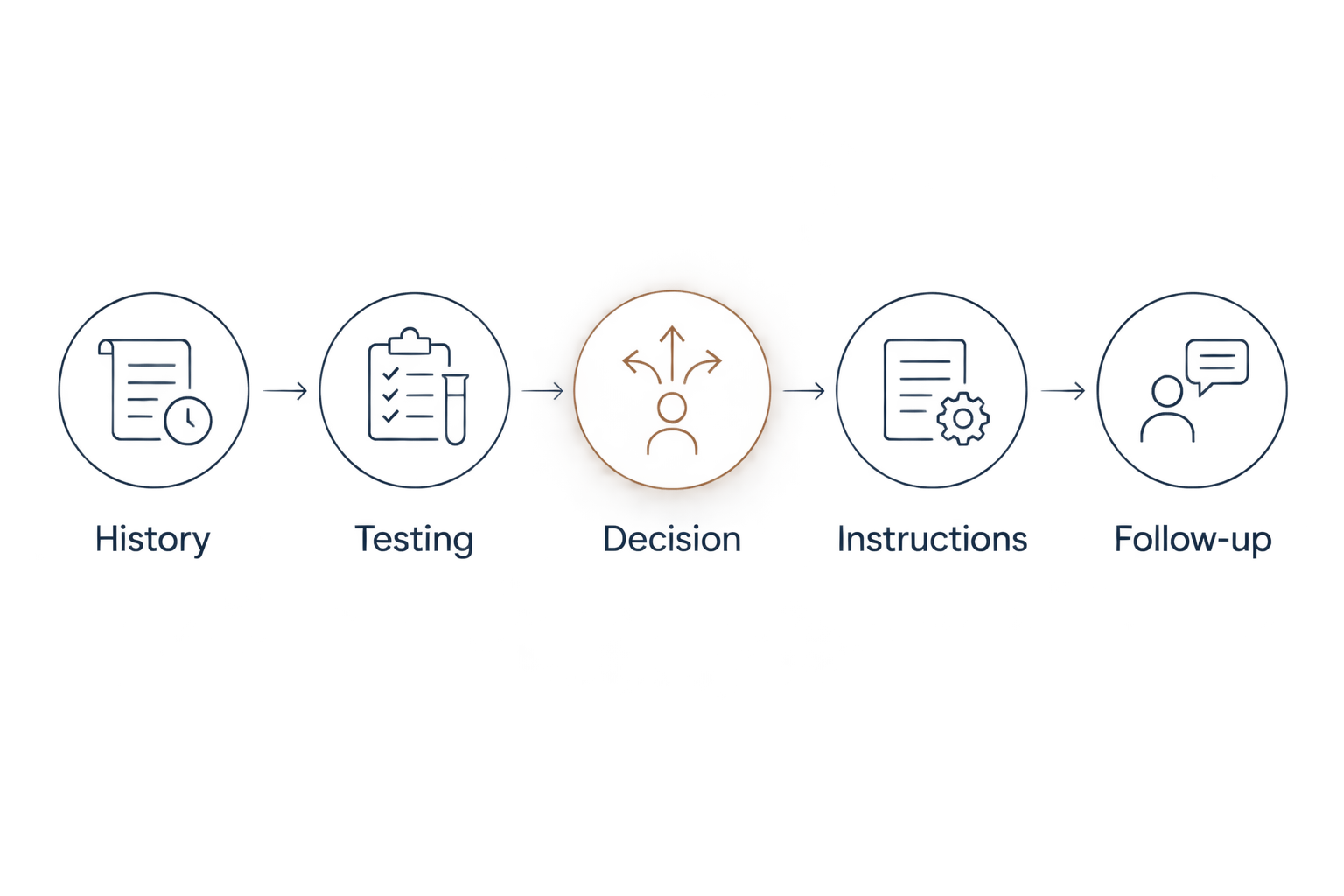
The first injection follows a prescribing decision and clear instructions, not just a completed lab panel.
Expected result: Before injecting, you can identify the medicine, explain the prescribed dose and device, and describe how to get help. If any part remains unclear, contact the prescriber or pharmacist before using it.
If you already have recent lab results
Existing results can support the assessment, but the prescribing physician decides whether they answer the current questions. There is no universal expiration date that makes every lab report acceptable or unusable.
| Testing pathway | Best for | Advantage | Limitation |
|---|---|---|---|
| Review existing results | Men with accessible, dated reports relevant to the assessment | Gives the physician prior results and trends | Missing tests or a changed health situation can require another draw |
| Obtain newly ordered tests | Men needing updated or additional clinical information | Answers the physician's current questions | Requires collection and interpretation before the related decision |
Send complete reports rather than ordering replacements yourself. Tell the physician about illness, medication changes, or substantial weight changes since collection. If a new result is abnormal, ask what it means and whether it changes the plan before assuming treatment must stop or proceed.
Troubleshooting before and after the first prescription
Your results arrived, but no prescription followed
Contact the prescribing office and ask whether the results have been reviewed and whether anything remains outstanding. A completed blood draw does not establish eligibility or mean a prescription has been issued.
Your directions use milligrams, but the syringe uses units
Do not convert the dose yourself. Ask the dispensing pharmacist and prescriber for matching instructions for the exact concentration and syringe. A unit marking alone does not identify how much tirzepatide it contains.
You use insulin or a sulfonylurea
Ask for a coordinated glucose-monitoring and medication plan before starting. Tirzepatide can increase hypoglycemia risk when combined with these medicines; the clinician managing diabetes should know about the new prescription.
Nausea becomes repeated vomiting or poor fluid intake
Contact the treating clinician promptly rather than waiting for a routine follow-up. Inability to keep fluids down, fainting, markedly reduced urination, or severe or persistent abdominal pain needs urgent medical assessment. Breathing difficulty or swelling of the face or throat requires emergency help.
You have surgery or sedation scheduled
Tell both the prescribing clinician and the procedural team that you take tirzepatide. Delayed stomach emptying matters for anesthesia planning. Do not follow a generic online medication-hold schedule instead of the team's individualized instructions.
Customize your workflow
Build follow-up around more than the scale. Track appetite, fluid intake, bowel symptoms, activity, and any difficulty eating enough to support daily function. Bring that record to reassessment; do not increase the dose because a particular week felt less effective.
For a 2026 care plan, ask three practical questions: Who reviews progress? Who handles side effects between appointments? What findings would change treatment? At Mensmedicalinstitute, physician-led weight management is the relevant starting point for that conversation—not a promise that every man needs the same prescription.
If you are considering care in St. Louis or traveling from Metro East Illinois, call 314-394-1660 or contact Mensmedicalinstitute. Ask what records to bring and how a physician evaluation is arranged.
FAQ
What labs do I need before starting tirzepatide for weight loss?
Your physician selects tests based on your medical history, medicines, and examination; there is no universal FDA-required pretreatment lab panel for every adult starting Zepbound. Glucose assessment and other targeted testing can help answer specific clinical questions.
Can I get a tirzepatide prescription if all my labs are normal?
Normal labs alone do not establish eligibility for tirzepatide. Your physician must also assess weight-related indications, contraindications, other medicines, and whether treatment fits your health needs.
Can I use lab results from my primary-care doctor?
Your prescribing physician can review outside lab reports and decide whether additional testing is needed. Send complete, dated reports and explain any health or medication changes since collection.
Do I have to fast before tirzepatide labs?
Fast only if the ordering clinician or laboratory instructs you to do so for the specific tests ordered. Different tests have different preparation requirements, so confirm before the blood draw.
What is the first tirzepatide dose for weight loss?
FDA-approved Zepbound labeling starts adults at 2.5 mg once weekly for 4 weeks, followed by 5 mg once weekly. Follow your own prescription and product instructions; do not use this general schedule to calculate syringe units.
How long does it take to go from labs to a prescription?
There is no fixed interval that applies to every patient. The prescribing decision depends on complete records, interpretation of any testing, and resolution of safety questions.
What should I ask before starting tirzepatide in 2026?
Ask which exact medicine is prescribed, why it fits your situation, how to use it, and who handles side effects. Also confirm the follow-up plan and which visits or tests are separate from the proposed treatment arrangement.
One last thing
The most useful first-dose check is whether you can explain the instructions back. Before leaving the visit or pharmacy conversation, describe your dose, your device, and what you would do if vomiting prevented you from drinking. If the explanation breaks down, pause and ask again.