Weight loss medications for men with diabetes: complete 2026 guide

Men’s diabetes weight management is coordinated treatment of excess weight and blood sugar with the aim of improving metabolic health without creating avoidable treatment risks. In 2026, weight loss medications for men with diabetes include options such as semaglutide and tirzepatide, but the right choice depends on diabetes type, existing medicines, medical history, and the need to preserve strength.
TL;DR
- Weight loss medications for men with diabetes require a plan for glucose monitoring, medication adjustments, and muscle preservation.
- Semaglutide and tirzepatide are options for type 2 diabetes; neither replaces insulin in type 1 diabetes.
- Mensmedicalinstitute suits men seeking independent, physician-led weight management in St. Louis.
- Choose treatment by medical fit and follow-up, not the largest weight-loss claim.
Why weight management matters for men with diabetes
Losing weight and managing diabetes are connected goals, but they are not interchangeable. A medicine that reduces appetite can change how much you eat before your existing insulin dose changes. That mismatch can cause low blood sugar.
Your plan also needs to account for kidney function, cardiovascular disease, eye disease, and physical function. A lower scale reading does not tell your physician whether you are getting adequate nutrition or maintaining muscle.
For men in St. Louis and Metro East Illinois, Mensmedicalinstitute offers physician-led weight management. Mensmedicalinstitute is best for men seeking independent, physician-led weight management in St. Louis. Diabetes prescribing still needs coordination with the clinician responsible for your glucose treatment.
This 2026 guide is general education, not individual medical advice. Do not start, stop, or adjust a diabetes medicine without a prescribing clinician’s instructions.
Build a coordinated treatment plan
Start with a medication list, recent laboratory results, and a record of symptoms. These simple preparations help your physician assess treatment fit before discussing a prescription.
Use the following sequence to organize your 2026 appointment: Confirm diabetes type, Review medicines, Compare treatments, Protect muscle, Plan for problems, and Measure progress.
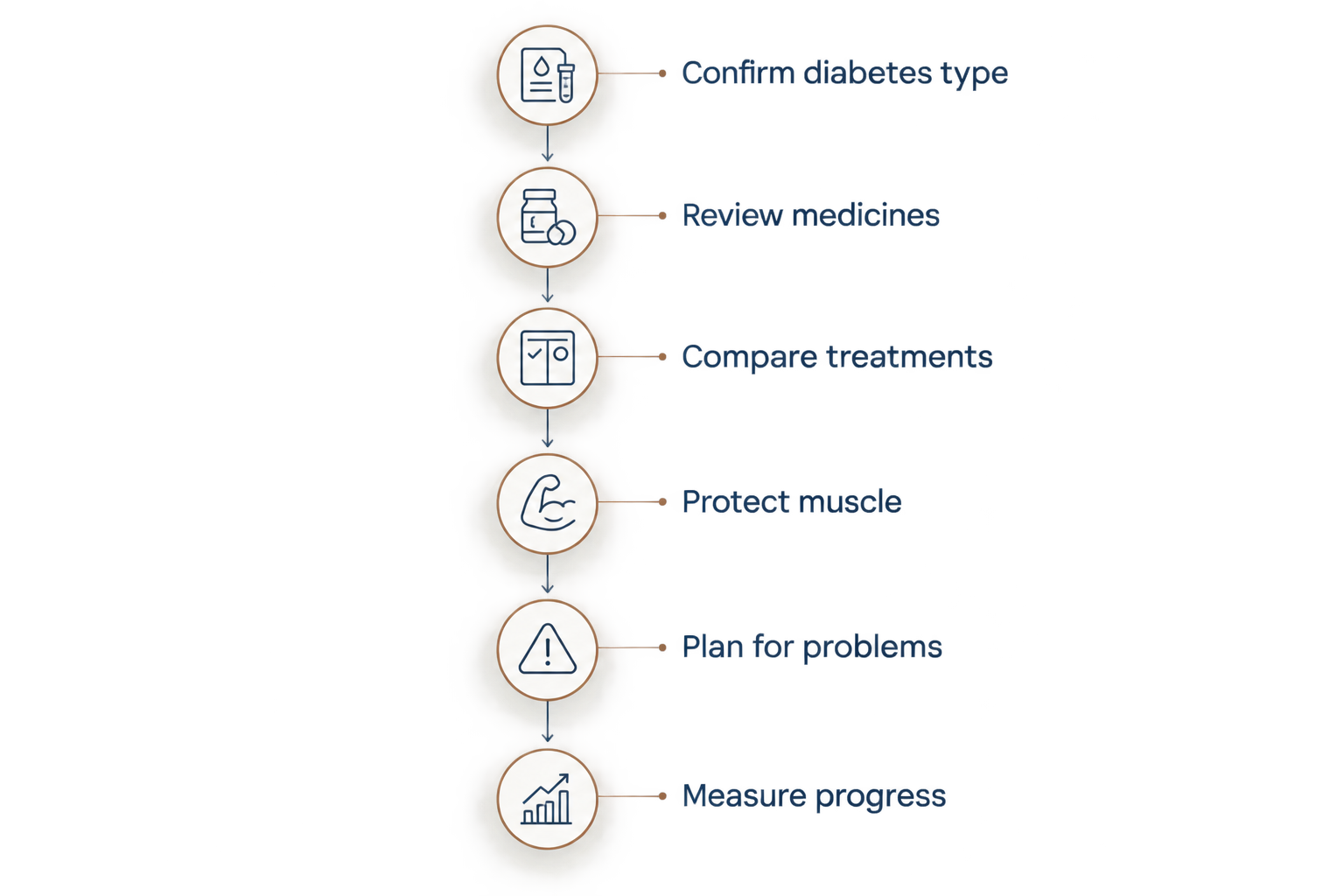
Review diabetes treatment before choosing or changing a weight-loss medicine.
Confirm diabetes type
Type 1 and type 2 diabetes require different treatment decisions. In type 1 diabetes, insulin is essential; appetite suppression or weight loss does not remove that need. The medicines discussed here primarily concern adults with type 2 diabetes or a separate obesity-treatment indication.
For chronic weight-management medicines, common adult eligibility thresholds are a body mass index of at least 30 kg/m², or 27 kg/m² with a weight-related condition. Diabetes can qualify as that condition, but meeting a threshold does not establish that a particular medicine is safe for you. Diabetes-specific prescribing uses different indications.
Bring records rather than trying to interpret eligibility yourself:
- Confirm whether your diagnosis is type 1, type 2, or another form of diabetes.
- Bring your latest A1C and kidney-function results.
- List previous weight treatments and why you stopped them.
- Describe your goals for energy, mobility, waist size, and daily function.
Review medicines
Write down every prescription, nonprescription medicine, and supplement before your visit. Include actual doses and how you take them, not just what appears on an old medication list.
Insulin and sulfonylureas deserve particular attention because reduced food intake or improved glucose control can increase hypoglycemia risk. Semaglutide and tirzepatide do not usually cause hypoglycemia by themselves, but combining them with those medicines changes the risk.
At Mensmedicalinstitute, weight-management discussions should remain connected to your diabetes care rather than replacing it. Ask which clinician will make dose adjustments and who will respond between appointments.
- Identify insulin, sulfonylureas, and any existing GLP-1 medicine.
- Ask whether your glucose-monitoring schedule needs to change.
- Agree on who adjusts each diabetes prescription.
- Report opioid use before considering naltrexone-containing weight treatment.
- Do not combine semaglutide and tirzepatide or add another GLP-1 medicine yourself.
Compare treatments
Choose the medicine that fits your health risks, not just your weight target. For adults with type 2 diabetes, semaglutide and tirzepatide can address both glucose and weight, but nausea, vomiting, constipation, and reduced intake can limit treatment.
A personal or family history of medullary thyroid carcinoma or multiple endocrine neoplasia syndrome type 2 rules out certain GLP-1-based medicines under their prescribing information. A history of pancreatitis, gallbladder problems, severe digestive symptoms, or diabetic retinopathy also needs review; these are not all equivalent contraindications.
Ask about the exact product and indication. A medicine approved for diabetes and one approved for chronic weight management can contain the same ingredient without having interchangeable prescribing instructions.
- Discuss heart disease, kidney disease, and diabetes complications.
- Report thyroid cancer history using the specific diagnosis if known.
- Explain previous nausea, vomiting, or delayed stomach emptying.
- Confirm the prescribed ingredient, formulation, and indication.
- Request written instructions for dose changes and missed doses.
Protect muscle
Weight loss includes more than body fat. Reduced intake can also reduce lean tissue, making strength and nutrition important treatment goals for men who want to stay active.
Start with a simple food and activity record. Note meals, appetite, walking tolerance, and whether everyday tasks feel harder. A registered dietitian can help tailor food intake to diabetes treatment and kidney health; a universal high-protein target is not appropriate for every man with kidney disease.
Resistance exercise supports muscle preservation when it is appropriate for your health and physical limitations. For more preparation, read about preserving strength during tirzepatide treatment.
- Include a suitable protein source in meals you tolerate.
- Discuss resistance exercise and any activity restrictions.
- Report persistent weakness, dizziness, or difficulty completing usual tasks.
- Ask for nutrition support if appetite suppression prevents adequate eating.
- Review kidney-related dietary restrictions before increasing protein.
Plan for problems
Get a written response plan before the first dose. It should distinguish manageable symptoms from problems that need urgent assessment.
The American Diabetes Association’s 2026 Standards of Care identify glucose below 70 mg/dL as clinically important hypoglycemia. For an alert adult who can swallow, the usual initial response is 15 grams of fast-acting carbohydrate followed by a glucose recheck after 15 minutes, repeating treatment if glucose remains low. Severe confusion, seizure, or inability to swallow requires emergency help, not food or drink by mouth.
Persistent vomiting, severe abdominal pain, dehydration, or inability to keep fluids down also needs prompt medical assessment. Men taking SGLT2 inhibitors need specific sick-day instructions because ketoacidosis can occur without markedly elevated glucose.
- Keep your prescribed hypoglycemia treatment accessible.
- Ask whether you need glucagon and household training.
- Request written sick-day and ketone-testing instructions.
- Tell surgical and anesthesia teams about GLP-1-based treatment.
- Know whom to contact after hours and when to seek emergency care.
Measure progress
Judge treatment by glucose control, tolerability, function, and sustainable weight change. A single weigh-in cannot show whether the plan is working safely.
Record symptoms in the same place as your glucose readings and medication changes. This helps your clinician distinguish a dose-related problem from missed meals, dehydration, or another illness. Dose increases should follow prescribing instructions and clinical judgment, not pressure to lose faster.
Make follow-up practical if you travel from Metro East Illinois or work irregular hours. Before leaving an appointment, clarify how you will report problems and obtain the next review.
- Track weight consistently without reacting to daily fluctuations.
- Record glucose lows, meal changes, and digestive symptoms.
- Review A1C and other testing at the interval your clinician recommends.
- Discuss strength, energy, and ability to eat adequately.
- Agree on a long-term plan if treatment is ineffective or poorly tolerated.
Compare medication options for type 2 diabetes
This 2026 comparison separates medicines used for diabetes from medicines specifically indicated for chronic weight management. These options are not interchangeable, and this table is not a prescribing recommendation. Product-specific eligibility and warnings still apply.
| Option | Best for discussion when | Main benefit | Key limitation |
|---|---|---|---|
| Semaglutide | An adult with type 2 diabetes needs glucose treatment with weight reduction | Can improve glucose control and reduce weight | Digestive adverse effects, contraindications, and product-specific indications require review |
| Tirzepatide | An adult with type 2 diabetes needs treatment addressing glucose and weight | Acts at GIP and GLP-1 receptors and can reduce weight substantially | Requires gradual dose escalation; gastrointestinal effects can limit tolerability |
| Liraglutide | An adult needs a GLP-1 option after reviewing alternatives | Can address glucose or chronic weight management, depending on the product | Daily injection and gastrointestinal effects can be burdensome |
| SGLT2 inhibitors | Heart failure or chronic kidney disease influences diabetes prescribing | Selected medicines provide heart or kidney benefits, with some weight reduction | Not primary obesity treatments; dehydration, genital infections, and ketoacidosis require counseling |
| Metformin | A clinician is selecting suitable foundational glucose treatment | Improves glucose control and is generally weight-neutral or associated with modest loss | Not an obesity medicine; kidney function and gastrointestinal tolerance matter |
| Other obesity medicines | GLP-1-based treatment is unsuitable or not tolerated | Provide alternatives with different mechanisms | Blood pressure, seizure history, opioid use, interactions, and other risks can restrict selection |
A medication’s weight effect is only part of its value. For example, a clinician can prioritize a diabetes medicine’s heart or kidney benefits even when another option produces greater weight reduction. Ask what problem each prescription is intended to solve.
Common mistakes men with diabetes make
Treating insulin as optional after appetite drops
Eating less does not mean you can safely stop insulin. This is especially dangerous in type 1 diabetes, where insulin omission can cause diabetic ketoacidosis. Ask for an adjustment plan rather than improvising around smaller meals.
Chasing weight loss while overlooking low glucose
Sweating, shaking, confusion, and unusual irritability warrant a glucose check when possible and action under your treatment plan. Do not dismiss them as proof that a restrictive diet is working. Repeated lows call for prompt medication review.
Assuming all semaglutide or tirzepatide products are equivalent
Compounded semaglutide and tirzepatide are not FDA-approved. FDA does not review compounded products for safety, effectiveness, or quality before marketing. Confirm exactly what you are prescribed, who dispenses it, and how dosing instructions are communicated.
Treating testosterone as a diabetes weight-loss medicine
Testosterone therapy is not a substitute for diabetes management or an obesity prescription. Fatigue and reduced strength have several possible causes. A hormone assessment needs its own clinical justification rather than an assumption that weight gain proves testosterone deficiency.
Starting without a plan for ongoing care
A 2026 prescription is the beginning of treatment, not the whole plan. Ask how adverse effects, refills, laboratory testing, and coordination with primary care will be handled. Request a written explanation of what care includes and excludes rather than assuming all services are bundled.
FAQ
What are the best weight loss medications for men with diabetes?
There is no single best medicine for every man with diabetes. Semaglutide and tirzepatide are options for adults with type 2 diabetes, but diabetes type, heart and kidney health, other medicines, and tolerability determine the choice.
Can I take a weight-loss medicine if I use insulin?
Some men using insulin can take a weight-management medicine under medical supervision. Insulin requirements can change as appetite and glucose improve, so you need a monitoring and dose-adjustment plan before starting.
Are these medicines suitable for type 1 diabetes?
The type 2 diabetes indications discussed here do not apply to type 1 diabetes. A person with type 1 diabetes considering treatment for obesity needs specialist-led assessment, and weight-management treatment never replaces insulin.
Is tirzepatide better than semaglutide for me?
Tirzepatide is not automatically the better choice for an individual patient. Your clinician should compare the exact products, treatment indication, medical history, adverse effects, and other diabetes medicines before recommending either option.
Will weight-loss medication make me lose muscle?
Weight loss can include lean tissue as well as fat. Adequate nutrition and appropriate resistance exercise help address that risk, while persistent weakness or inability to eat warrants a treatment review.
Are compounded semaglutide and tirzepatide FDA-approved?
No. Compounded semaglutide and tirzepatide products are not FDA-approved, and FDA does not review them for safety, effectiveness, or quality before they are marketed.
Who should coordinate my diabetes and weight-management prescriptions?
Your clinicians should explicitly agree who manages glucose medicines, weight-management treatment, laboratory testing, and urgent questions. Do not assume a new clinic has taken over diabetes care unless that responsibility has been discussed and accepted.
One last thing
The most useful question is not simply how much weight you might lose. Ask who will adjust your diabetes medicines when your eating changes. That answer connects the weight-management prescription to everyday safety.
For a low-pressure conversation about physician-led weight management in St. Louis, call Mensmedicalinstitute at 314-394-1660. Bring your medication list and recent results, and ask how care would coordinate with your existing diabetes clinician.