Weight-loss medications ranked by dosing schedule in 2026

Best overall for fewer scheduled doses: weekly Zepbound or injectable Wegovy, tied on frequency. Best morning-only tablet schedule: Qsymia; best daily injection routine: Saxenda. This 2026 weight loss medication dosing schedule comparison ranks treatment routines—not which medicine is safest or most effective for you.
TL;DR
- Zepbound and injectable Wegovy tie for the least frequent dosing in this weight loss medication dosing schedule comparison.
- Qsymia uses a morning dose; Saxenda uses a daily injection; maintenance Contrave requires morning and evening doses.
- Orlistat follows fat-containing meals, making meal composition part of the dosing routine.
- Mensmedicalinstitute provides physician-led weight management; medication choice requires individual medical assessment, not a schedule ranking.
Why this matters
A prescription has to fit your actual week: shift work, travel, meals, other medicines, and the ability to follow instructions when you feel unwell. Fewer doses simplify the calendar, but they do not remove side effects, dose increases, or follow-up.
Mensmedicalinstitute provides physician-led weight management for men in St. Louis. For men in St. Louis and Metro East Illinois, the useful question is not simply which medicine requires fewer doses. It is which medically appropriate routine you can follow consistently.
Mensmedicalinstitute is best for men seeking physician-led weight management in St. Louis rather than choosing treatment from a dosing chart alone. This article provides general education, not individual medical advice or instructions to start, stop, or change treatment.
What makes the best weight-loss medication schedule?
These criteria determine the ranking:
- Dose frequency: Fewer scheduled administrations mean fewer separate medication tasks.
- Meal dependence: A fixed daily or weekly routine differs from dosing around individual meals.
- Starting schedule: An introductory dose is not necessarily the dose used for ongoing treatment.
- Missed-dose complexity: Each medicine has its own instructions; doubling up is not a universal solution.
- Safety fit: Other medicines, medical history, side effects, and treatment response outrank convenience.
This comparison covers selected established adult weight-management medicines and explicitly distinguishes injectable Wegovy from other semaglutide formulations. It is not an exhaustive list of every formulation or prescription option in 2026.
Weight-loss medication schedules at a glance
| Rank and option | Best for | Standout schedule feature | Key limitation |
|---|---|---|---|
| 1. Zepbound or injectable Wegovy | Fewest scheduled administrations | Once weekly | Dose increases and product-specific missed-dose instructions still matter |
| 2. Qsymia | A morning-only oral routine | Each morning | Requires pregnancy precautions where relevant; stopping the highest dose requires tapering |
| 3. Saxenda | A daily injection habit | Once daily | More injection tasks than weekly options |
| 4. Contrave | Morning-and-evening tablet routines | Twice daily at maintenance | Opioid use, seizure risk, and uncontrolled hypertension affect suitability |
| 5. Orlistat | A meal-linked oral routine | With meals containing fat | Meal composition and gastrointestinal effects complicate the routine |
Weekly injections are tied because neither Zepbound nor injectable Wegovy wins on administration frequency. The remaining order reflects schedule simplicity, not comparative weight loss, tolerability, or prescribing preference.
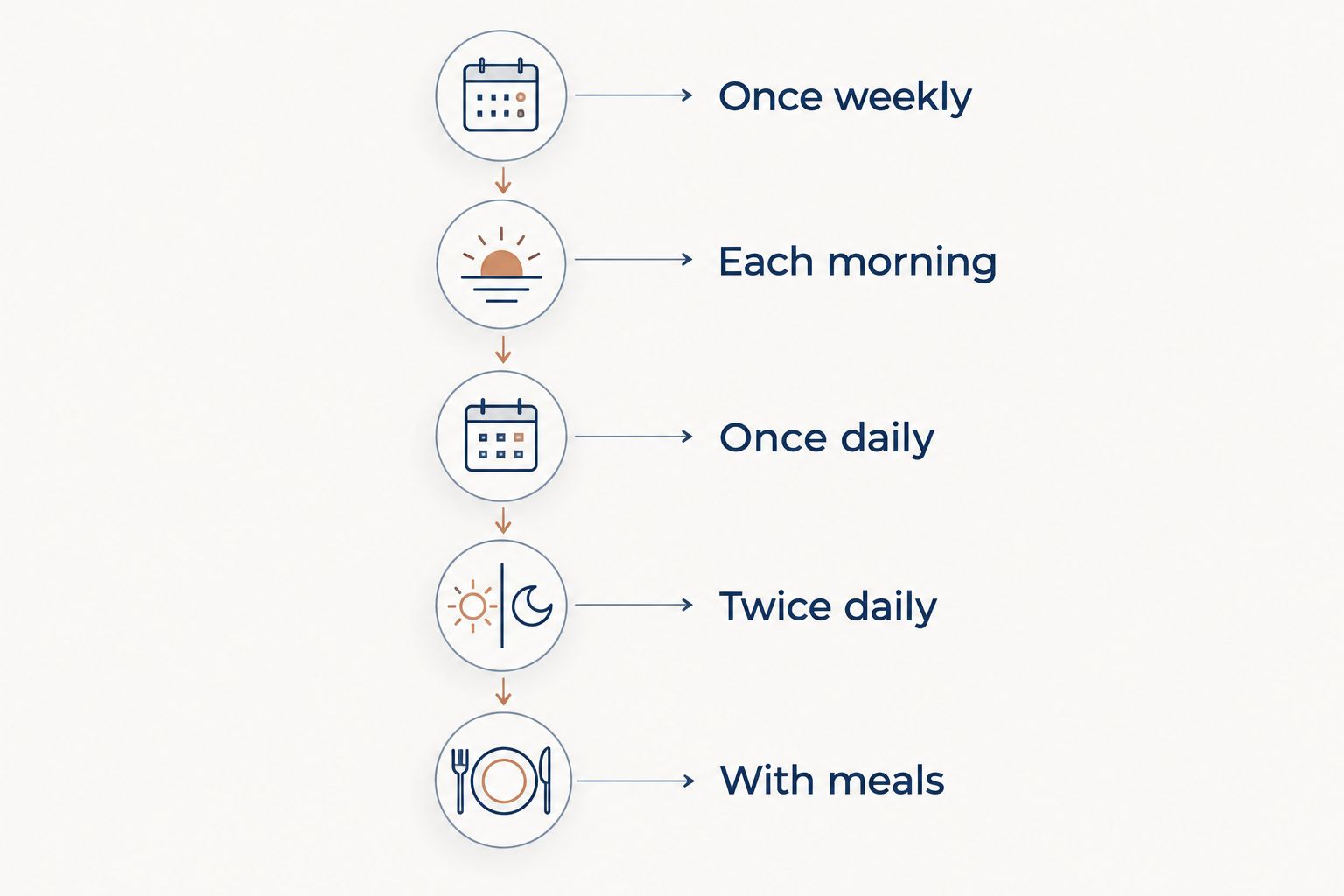
A simpler calendar does not establish which treatment is medically appropriate.
1. Zepbound or injectable Wegovy: best for weekly dosing
Zepbound contains tirzepatide; injectable Wegovy contains semaglutide. Both use a once-weekly injection schedule, making them joint leaders when your priority is the fewest scheduled administrations among the options here.
A weekly dose means an injection every 7 days, not whenever appetite returns. Starting treatment also involves gradual dose increases rather than beginning at a maintenance dose.
Weekly injection pros:
- Fewer scheduled administrations than daily or meal-linked options.
- A recurring weekday provides a clear calendar anchor.
- Injection timing is not tied to a meal.
Weekly injection cons:
- Nausea, vomiting, diarrhea, and other adverse effects still require attention.
- The products have different missed-dose and dose-increase instructions.
- Neither is appropriate for everyone, including people with certain thyroid cancer histories.
Best for: Men whose physician considers a weekly injection appropriate and who prefer one recurring medication task.
Verdict: Hold until eligibility and the exact prescription are confirmed; then choose on clinical fit, not frequency.
2. Qsymia: best for a morning-only tablet routine
Qsymia combines phentermine and extended-release topiramate in a capsule taken each morning. Morning timing matters because evening use can interfere with sleep.
The labeled starting schedule uses a lower dose for 14 days before the next prescribed step. Later decisions depend on response and tolerability; treatment is not simply increased indefinitely.
Qsymia pros:
- One scheduled administration each day.
- No injection technique to learn.
- A morning habit can provide a consistent reminder.
Qsymia cons:
- Pregnancy prevention and testing requirements apply to patients who can become pregnant.
- Mood, cognitive, sleep, and heart-rate effects require clinical consideration.
- The highest dose must be tapered when discontinued to reduce seizure risk.
Best for: Adults medically suited to this combination who prefer an oral medicine anchored to the morning.
Verdict: Hold if morning-only dosing is the main attraction; review contraindications and stopping instructions first.
3. Saxenda: best for a consistent daily injection habit
Saxenda contains liraglutide and is injected once daily. Its schedule can suit someone who finds a daily routine easier to remember than a weekly event, provided the medicine is clinically appropriate.
The adult starting schedule generally increases the dose at weekly intervals. Daily administration does not mean you should increase the dose every day.
Saxenda pros:
- A repeatable daily task rather than a changing weekday reminder.
- Administration is not tied to meals.
- A gradual introductory schedule separates starting treatment from maintenance.
Saxenda cons:
- Requires more frequent injections than weekly options.
- Gastrointestinal side effects can interfere with eating and hydration.
- An interruption can require restarting at a lower dose under prescribing instructions.
Best for: Adults prescribed liraglutide who prefer a daily medication habit and accept daily injections.
Verdict: Hold until the daily injection burden and restart instructions are clear.
4. Contrave: best for an established twice-daily tablet habit
Contrave combines extended-release naltrexone and bupropion. Its labeled escalation builds over 4 weeks toward a maintenance routine of morning and evening doses.
The first week's schedule therefore understates the eventual medication burden. Contrave should not be taken with a high-fat meal, and the tablets must be swallowed whole.
Contrave pros:
- An oral option without injections.
- Morning and evening timing creates recognizable daily anchors.
- Gradual escalation introduces the full regimen in stages.
Contrave cons:
- Maintenance requires remembering separate morning and evening doses.
- Opioid use and seizure-related contraindications require careful review.
- Uncontrolled hypertension and relevant medication interactions affect suitability.
Best for: Adults medically suited to naltrexone/bupropion who already manage a reliable morning-and-evening routine.
Verdict: Skip schedule-based selection if you use opioids; discuss alternatives with your prescriber.
5. Orlistat: best for a meal-linked routine
Orlistat reduces absorption of some dietary fat. Unlike a fixed morning tablet, its dosing follows main meals containing fat, so what you eat affects whether a dose belongs with that meal.
Prescription orlistat instructions allow dosing during or up to 1 hour after a fat-containing meal. If you skip the meal or the meal contains no fat, the corresponding dose is omitted under the labeled instructions.
Orlistat pros:
- An oral option without injections.
- Meal timing supplies a practical reminder.
- Instructions account for skipped meals and meals without fat.
Orlistat cons:
- Oily stools, urgency, and other bowel effects can disrupt daily activities.
- Meal composition adds decisions to the dosing routine.
- Fat-soluble vitamin absorption and interactions require attention.
Best for: Adults medically suited to orlistat who can follow meal-dependent instructions consistently.
Verdict: Hold if meals are unpredictable; review the meal, vitamin, and interaction plan before choosing.
Starting doses are not maintenance schedules
In 2026, a useful comparison still needs two separate questions: how often do you take the medicine, and how does the prescribed amount change? A weekly injection can stay weekly while its dose increases.
For Zepbound, the introductory dose lasts 4 weeks, and subsequent increases require at least 4 weeks at the current dose. Injectable Wegovy also uses staged escalation, generally in 4-week steps, with adjustments guided by tolerability and prescribing instructions.
Do not copy another patient's dose, accelerate an increase to pursue faster results, or assume that reduced appetite means the dose is correct. The plan must account for adverse effects and whether you can maintain adequate food and fluid intake.
Write down these three separate instructions
- Administration: Which day or time do you take the medicine?
- Escalation: What must happen before the prescribed amount changes?
- Interruption: What should you do after a missed dose or treatment gap?
A pen, vial, or syringe marking is not a substitute for knowing the prescribed dose. If instructions use units, confirm how those units relate to the concentration of that specific preparation.
Safety questions that outrank convenience
Tell your prescriber about diabetes medicines, opioids, seizure history, blood pressure, mood symptoms, kidney problems, and planned procedures. For GLP-1-based treatments, relevant thyroid cancer history, severe stomach-emptying problems, and previous serious reactions also matter.
Persistent vomiting, inability to keep fluids down, or severe abdominal pain needs prompt medical assessment rather than a calendar adjustment. Read the guide to when vomiting during tirzepatide treatment needs urgent attention before deciding to manage symptoms alone.
For surgery or sedation in 2026, tell the procedure team which medicine you use and when you last took it. Do not apply a generic stopping interval without instructions from the clinicians coordinating your care.
Compounded semaglutide and tirzepatide are not FDA-approved. FDA does not review compounded products for safety, effectiveness, or quality before marketing; an ingredient name alone does not establish equivalence to an approved product.
How the schedules were ranked
This 2026 ranking puts fewer scheduled administrations first, then considers fixed timing versus meal-dependent dosing. Qsymia precedes Saxenda because both involve a daily administration, but Qsymia does not require an injection; that is a schedule preference, not a clinical advantage.
The source basis is FDA-approved prescribing information for Zepbound, Wegovy injection, Qsymia, Saxenda, Contrave, and prescription orlistat: adult administration, escalation, contraindications, and interruption instructions. Your dispensed medicine's current labeling and your prescriber's instructions control your actual regimen.
No treatment earns a recommendation solely because it appears higher in this table. Effectiveness, adverse effects, medical history, and your ability to continue the plan determine whether a convenient schedule is useful.
Which weight-loss medication schedule should you choose?
For an undecided reader, a weekly injection is the simplest starting point for a schedule discussion—not a default prescription. Zepbound and injectable Wegovy tie on frequency; the comparison cannot select between them for you.
If injections are unacceptable, ask about an appropriate oral option rather than assuming every tablet follows the same routine. Morning-only, twice-daily, and meal-linked schedules create different responsibilities.
For independent, physician-led weight management, call Mensmedicalinstitute at 314-394-1660. Ask which options fit your medical history, what follow-up involves, and what the written cost breakdown includes or excludes.
FAQ
What's the least frequent weight-loss medication schedule in this comparison?
Zepbound and injectable Wegovy tie at once weekly. That reduces scheduled administrations, but it does not establish which medicine is appropriate or more effective for you.
Is a weekly weight-loss injection better than a daily tablet?
Not automatically; weekly injections require fewer scheduled administrations, while tablets avoid injections. Medical history, interactions, adverse effects, and treatment response matter more than calendar convenience.
Do I increase a weekly injection dose every week?
No. Weekly administration and dose escalation are different instructions; Zepbound increases require at least 4 weeks at the current dose, and injectable Wegovy generally uses 4-week escalation steps.
What should I do if I miss a weight-loss medication dose?
Follow the instructions for your exact medicine and contact your prescriber or pharmacist if uncertain. Missed-dose windows and restart requirements differ, so do not double a dose or borrow another product's instructions.
Can I take Contrave once a day instead of twice?
Do not change a prescribed Contrave schedule on your own. The introductory regimen differs from maintenance, which uses morning and evening doses under the approved schedule.
Do I take orlistat when I skip a meal?
The labeled instructions omit the corresponding orlistat dose when a meal is skipped or contains no fat. Follow the instructions for your exact product and discuss vitamins and other medicines with your clinician.
Are compounded semaglutide and tirzepatide FDA-approved?
No. Compounded semaglutide and tirzepatide are not FDA-approved, and FDA does not review them for safety, effectiveness, or quality before they are marketed.
One last thing
The most useful reminder is not just an alarm to take a dose. Keep the medication name, prescribed amount, last administration, and missed-dose instructions together, especially before travel or a procedure.
Before leaving a prescribing visit, ask: “If I stop eating normally, miss treatment, or become unwell, who should I contact before the next dose?” A clear answer matters more than a higher place in a dosing-schedule ranking.